
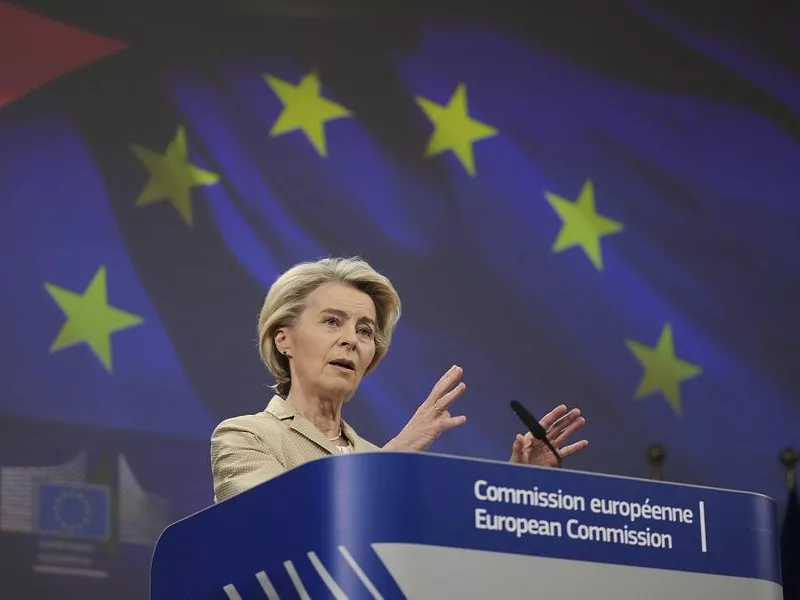
The European Commission says that around $8.7 billion of U.S. agricultural exports will receive “better market access” to Europe through allocation of tariff-rate quotas under a new trade pact.
President Donald Trump and European Commission President Ursula von der Leyen in Scotland on Sunday outlined contours of an agreement to soften the tariff blow Aug. 1. Under the deal, U.S. tariffs on most EU exports will be capped at 15% -- lower than the 30% Trump threatened – and the sides committed to reducing agricultural trade frictions, although details were sparse.
Von der Leyen initially told reporters on Sunday that certain agricultural products would be covered by a “zero-for-zero” tariff arrangement but added that negotiations remained ongoing. A European Commission explainer on the deal published Tuesday said that around $8.7 billion of “non-sensitive” U.S. ag exports will receive tariff-rate quotas. The explainer made no mention of the “zero-for-zero” arrangement.
The explainer did not say whether the ag products – which it says will include soybean oil, planting seeds, grains or nuts, processed foods, ketchup, cocoa and biscuits – would get duty-free access under the quotas or merely a lower tariff rate. The document only asserted that U.S. ag exporters would see “better market access.”
Alaska pollock, Pacific salmon, and shrimp will also receive new tariff-rate quotas, it says.
A European Commission official in Washington told Agri-Pulse Tuesday morning that the explainer had the most up-to-date information on the negotiations but declined further questions.
A commission spokesperson in Brussels responded to a list of questions on the latest ag provisions by directing Agri-Pulse to recent public comments but said that joint statement text is currently “being stabilised, therefore we are restricted in how much detail we can provide.”
A White House fact sheet Monday said the EU had agreed to eliminate tariffs in some areas and “provide meaningful quotas” for certain products but offered no further details on what industries or products would see tariffs scrapped and made no mention of equivalent U.S. tariff reductions.
Both the White House and European Commission fact sheets include a commitment to continue bilateral cooperation on sanitary and phytosanitary (SPS) measures. The U.S. side said that the two economies would work to streamline requirements for dairy and pork sanitary certificates.
Further, a White House official stressed to Agri-Pulse on Tuesday that the U.S. and EU will “continue to talk about agricultural products and their barriers.”
But European Commission trade spokesperson, Olof Gill, told reporters on Tuesday that cooperation on SPS does not mean the EU will change its standards.
Streamlining certification, he said, “essentially means changing the types of forms you use. So, we’re not moving on our regulations. We’re not moving on our rules.”
Although the EU documentation makes no mention of the “zero-for-zero” arrangement, it does suggest that the U.S. has, in fact, made some tariff reduction commitments, including on natural resources.
It’s easy to be “in the know” about what’s happening in Washington, D.C. Sign up for a FREE month of Agri-Pulse news! Simply click here
“As of 1 August 2025, US tariffs on EU aircraft and aircraft parts, certain chemicals, certain drug generics or natural resources will go back to pre-January levels,” the explainer reads. “This will provide immediate tariff relief for key EU industries, while the EU and US agreed to keep working to add more products to this list.”
However, the White House official said the U.S. had “made no firm commitments on any additional tariff reductions on our end.”
Other parts of the deal also remain equally as murky, as officials on either side of the Atlantic push diverging interpretations of what was agreed to in Scotland.
Trump told reporters on Sunday that the EU would buy “hundreds of billions” of dollars of U.S. weaponry. But arms purchases are not part of the European Commission’s mandate.
Von der Leyen’s public comments and the European Commission’s explainer have both also touted reduced U.S. steel and aluminum tariffs and the creation of tariff-rate quotas for EU exports at historic levels.
The White House specifically noted in its fact sheet, however, that the U.S. steel and aluminum tariffs “will remain unchanged,” adding that “the EU will continue to pay 50% and the parties will discuss securing supply chains for these products.”
“This new tariff regime will generate tens of billions of dollars in revenue annually and help to close the longstanding trade imbalance between the United States and Europe,” the fact sheet reads.
Gill told reporters Tuesday that the discussions on steel and aluminum are still ongoing.
For more news, go to Agri-Pulse.com.

