
The White House has unveiled its new tariff plan, setting rates for countries that had not secured specific deals. But some governments also will be waking up with some relief because the new duties won’t go into effect today as expected, but in seven days time.
Only Canada will see its new tariff rate of 35% go into effect today. As with the previous 25% rate, the new tariffs will only apply to products not covered by the U.S.-Mexico-Canada free trade agreement.
Mexico also has a longer runway, after President Donald Trump and Mexico’s Claudia Sheinbaum agreed to a 90-day extension of the current rate to keep working toward a solution.
Here’s where many of the largest economies stand under the new proposals:
The dealmakers: For countries that struck deals, the new rates reflect those previously announced. Japan, the European Union and South Korea secured 15% tariffs in exchange for investment promises, purchase commitments and other concessions. A slew of other countries also got 15% rates, despite facing higher duties under the April 2 plan.
A second group of smaller economies, made up of Indonesia, the Philippines and Vietnam, have secured rates of 19% or 20%. Cambodia, Thailand and Pakistan, which officials said had secured deals in recent days, were also hit with a 19% rate, but so was Malaysia, which received no such announcement.
The no-dealers: Multiple countries, like Canada, were in negotiations with the administration but did not reach a deal with the U.S. before the deadline. Accordingly, India faces a 25% rate, along with an unspecified future “penalty.”
The other deadlines: Mexico joins a select group of countries that have received separate deadlines. A pause on higher tariffs on China is set to expire on Aug. 12. Brazil’s tariff is set rise to 50% on Aug. 6, per an executive order published Wednesday.
Senate action set on Lindberg
The Senate has confirmed Tyler Clarkson as general counsel at USDA. Clarkson is the third of Trump’s USDA nominees to get Senate approval, joining Ag Secretary Brooke Rollins and Deputy Secretary Stephen Vaden.
Next up: Luke Lindberg, Trump’s nominee for undersecretary for trade and foreign agricultural affairs, and son-in-law of Senate Majority Leader John Thune, R-S.D.
Thune on Thursday night filed cloture on Lindberg’s nomination, teeing up a vote.
Senate Dems lead Brazil tariff challenge
Senate Minority Leader Chuck Schumer, D-N.Y., and three Democratic colleagues — Tim Kaine or Virginia, Ron Wyden of Oregon and Jeanne Shaheen of New Hampshire — are mounting an effort to force a vote on the administration’s new Brazil tariffs.
Agri-Pulse reported on Wednesday that Democrats would challenge a new emergency declaration from the president to bump the baseline tariff rate on Brazilian exports to 50%. The four senators said they would lead the effort in a joint statement Thursday.
Previous tariff votes have peeled off several Republican backers.
It’s easy to be “in the know” about what’s happening in Washington, D.C. Sign up for a FREE month of Agri-Pulse news! Simply click here
Take note: A new emergency declaration also means an opportunity for fresh legal scrutiny. The administration says the duties are justified because Brazil’s prosecution of its former president is politically motivated, undermining the rule of law and posing a threat to U.S. interests in the country.
Greta Peisch, a former top lawyer for the U.S. trade representative, told Agri-Pulse she would expect the order to attract legal challenges.
Ex-USDA’ers discuss reorganization on Newsmakers
Former USDA officials offer different perspectives on the proposed reorganization of the department on this week’s episode of Agri-Pulse Newsmakers.
Bruce Knight, who was undersecretary for marketing and regulatory programs during the George W. Bush administration, said the plan needs to be given a chance to work. But he also said he hopes the proposal sparks a conversation about the services USDA should be providing, and how best to provide them.
Former Undersecretary for Farm Production and Conservation Robert Bonnie, who served during the Biden administration, agreed to an extent. “Bruce is right that [we need] to think about how we make sure government serves farmers, ranchers, all the constituents better. It's just not clear to me that this plan has anything to do with that.”
The plan contemplates moving staff from the national capital region to five hubs around the country. Knight said the department needs to “look at the work and the function that needs to be done, as opposed to just where folks are located. … The sooner we get to that conversation, using this process in the next 30 days … that’s the opportunity that I see for good government at USDA.”
Watch Newsmakers today on Agri-Pulse.com.
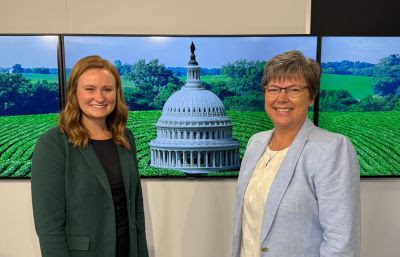 A longtime crop insurance agent in Iowa and member of both the Iowa and American Soybean Association board of directors, Pat Swanson may be new to USDA but not to the many crop insurance programs farmers depend on. On this week’s episode of Agri-Pulse Newsmakers, Lydia Johnson speaks with Risk Management Agency Administrator Pat Swanson about how she plans to lead the agency and how her background serving on the Federal Crop Insurance Corporation has prepared her for the role.
Bill would simplify labeling to reduce food waste
Food waste reduction advocates are backing a new bill that would require labels stating clearly whether foods are safe to eat.
The bill was introduced in the House by Reps. Chellie Pingree, D-Maine, and Dan Newhouse, R-Wash. The Senate’s bill comes from Sens. Richard Blumenthal, D-Conn. and Rick Scott, R-Fla.
The Food Date Labeling Act would mandate the following language, according to a news release from the lawmakers: “BEST If Used By” means “the quality of the food product may begin to deteriorate after the date. ‘USE By’ communicates the end of the estimated period of shelf life, after which the product should not be consumed.”
Among the groups backing the bill: The Consumer Brands Association, ReFED and the Zero Food Waste Coalition.
Union Pacific-Norfolk Southern merger process kicks off
Union Pacific and Norfolk Southern have formally kicked off their attempt to merge, filing a notice of intent with the Surface Transportation Board to begin the complex regulatory process.
Both companies announced their plans to merge last week. If approved by the board, Norfolk Southern would become a direct, wholly owned subsidiary of Union Pacific, according to an STB press release.
The two companies must submit a merger application to the board in three to six months. They have said they intend to file that by Jan. 29 of next year, the press release said.
USDA could do more to tout Dairy Margin Coverage Program, GAO audit says
A new Government Accountability Office report says dairy producers could benefit from more information and resources about USDA’s Dairy Margin Coverage (DMC) Program.
The report says federal officials have not “assessed the effectiveness of the USDA’s communication methods in facilitating dairy farmer awareness of and participation in the program,” which compensates producers if national prices for milk and feed fall below certain levels.
"By assessing how effectively it is communicating with farmers about the DMC program, USDA could better ensure it is helping farmers make informed decisions about participation in the program, potentially helping them stay in business,” the report says.
Final word
"I've never had a farmer complain to me that there are too many people in those field offices, that there are too many opportunities to interact." — Robert Bonnie, former USDA undersecretary for farm production and conservation, commenting on staff reductions at USDA.
Oliver Ward and Noah Wicks contributed to today’s Daybreak.


