

New tariffs on Brazil kick in today, but despite an intense lobbying campaign and a shoutout from Commerce Secretary Howard Lutnick, there has been no exemption granted for coffee.
The White House has exempted hundreds of items from the new 40% tariffs, including many agricultural products that the U.S. does not produce in significant volumes and without alternative sources. But coffee wasn’t among the exclusions.
Joana Colussi, an agricultural economist at the University of Illinois, told Agri-Pulse coffee’s omission is a “big” surprise.
Lutnick even seemed to suggest it could get an exemption in an interview on CNBC last week. He cited coffee as the type of product that the administration is looking at exempting from new duties because of the small domestic industry.
But, but, but: Industry groups in Brazil and the U.S. have been lobbying administration officials, as have companies like Starbucks, according to Valor, a Brazilian media outlet. Fernando Maximiliano, a coffee market analyst at StoneX, said the administration could still add items to the exemptions list.
“Maybe we could see changes,” Maximiliano said.
Read more about the impact of the new tariffs on Brazil and the lobbying effort to secure exemptions in Agri-Pulse’s newsletter this week.
Industry optimistic MAHA movement has room for sugar
Courtney Gaine, president and CEO of the Sugar Association, remains optimistic that the Make America Healthy Again (MAHA) movement is compatible with the sugar industry’s aims.
The first MAHA report published earlier this year took aim at sugar and its role in ultraprocessed foods. The movement’s leader, Health and Human Services Secretary Robert F. Kennedy Jr., has called sugar “poison.”
But Gaine argued to attendees at the International Sweetener Symposium in Traverse City, Michigan, on Tuesday that MAHA’s devotees are not necessarily in lockstep with Kennedy.
She cited polling showing that more than 90% of MAHA followers agreed that sugar can be part of a balanced diet, while more than 80% prefer sugar to artificial sweeteners.
“I still maintain the MAHA movement is one that will treat us well,” Gaine said.
It’s easy to be “in the know” about what’s happening in Washington, D.C. Sign up for a FREE month of Agri-Pulse news! Simply click here
Take note: When Coca-Cola announced last month that it would launch a product sweetened with cane sugar instead of high-fructose corn syrup, both President Donald Trump and Kennedy touted the move as a MAHA win.
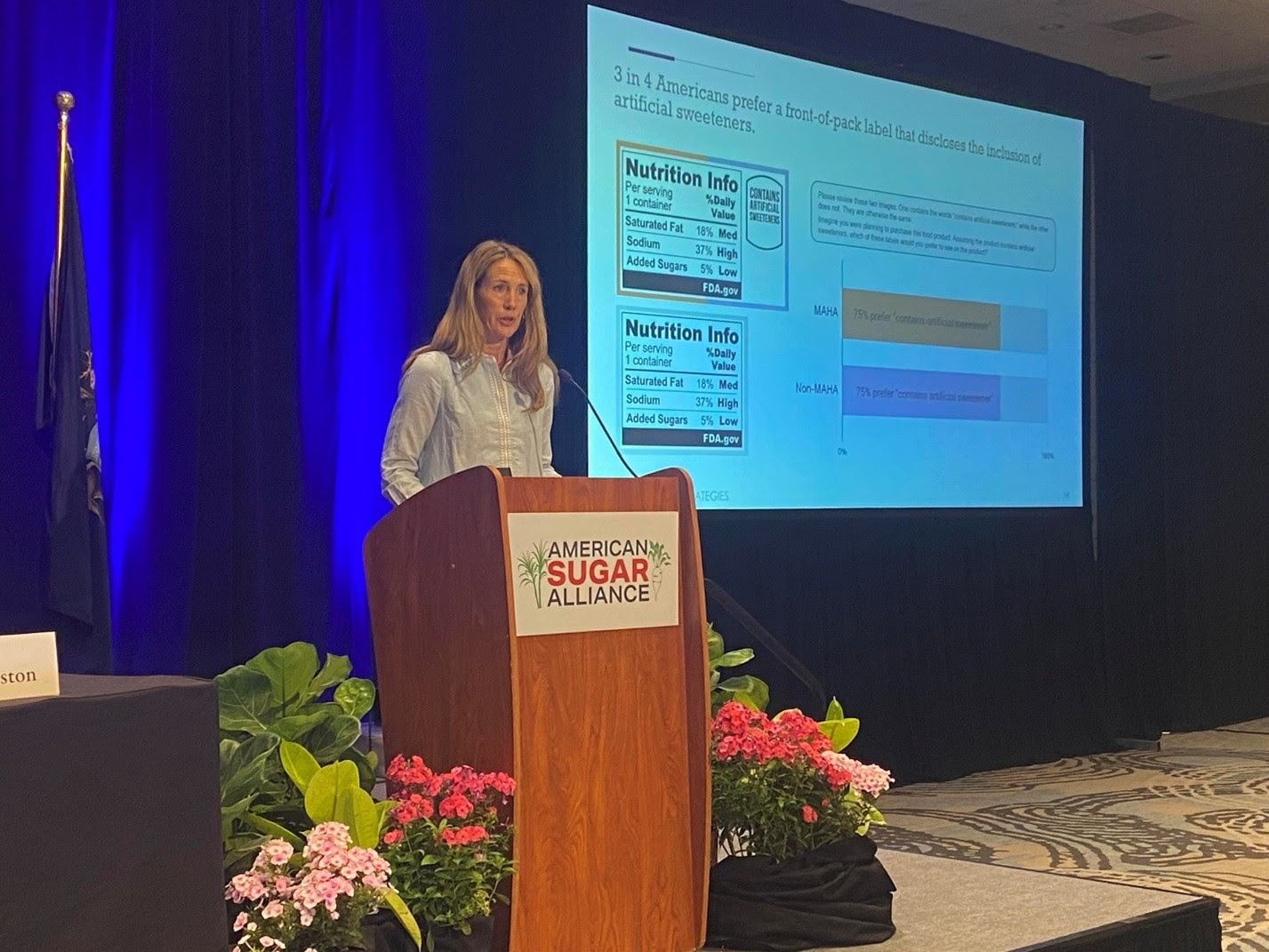 Courtney Gaine speaking at the International Sweetener Symposium in Traverse City, Michigan, on Tuesday (Agri-Pulse photo).
Grassley wants to know more about reorganization
Sen. Chuck Grassley wants to know why Des Moines did not qualify as a regional hub in USDA’s reorganization plan released July 24.
On a call with reporters Tuesday, the Iowa Republican said his initial reaction to the plan “was not based on policy,” but on the fact that the plan wasn’t shared with senators well ahead of time.
“It would have been better if they'd come to us and said, you know, we're thinking about doing this,” he said. That way, he added, he would have been able to voice his support for Des Moines over Kansas City, Missouri.
Senate Ag Committee ranking member Amy Klobuchar, D-Minn., also said she was “very concerned” about the lack of a hub in the upper Midwest. At Minnesota Farmfest Tuesday, Klobuchar noted that South Dakota, North Dakota, Iowa, Minnesota and Wisconsin were left off the list of hubs, while Utah, which is 37th in agricultural production, made it.
The department is currently taking comments on the proposed reorganization.
Vaden touts cost of living in new hub regions, says agency will still have representation in DC
Deputy Agriculture Secretary Stephen Vaden on Tuesday said every USDA mission area will continue to have representation in Washington as its reorganization plan goes into effect. He also touted the agency’s decision to relocate much of its D.C.-based workforce as a way of easing their living costs.
Vaden, speaking at Farmfest in Minnesota, said employees will have an easier time covering living expenses with their federal salaries in the proposed hubs of Raleigh, North Carolina; Indianapolis; Fort Collins, Colorado; Salt Lake City; and Kansas City, Missouri. He said the median price of a home in Washington is $800,000 but added that they can sell for $1 million or more in neighborhoods close to the USDA’s headquarters.
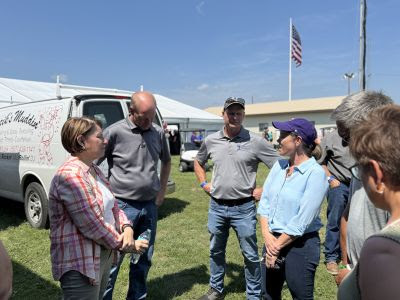 Sen. Amy Klobuchar, D-Minn. (left) at Minnesota Farmfest (Agri-Pulse photo)
Take note: On the USDA’s Emergency Commodity Assistance Program, Vaden said he “has personal skin in the game.” He mentioned that his brother was able to receive assistance three days after applying by visiting the county FSA office and filling out a one-page form.
“That’s what we’re aimed at doing at USDA, because we know you cannot wait on the monies due to you until the next calendar year,” Vaden said.
According to USDA ethics forms, Vaden owns land in Obion County, Tennessee, and Fulton County, Kentucky, but leases these out to a tenant for farming.
Ernst, Klobuchar introduce bill to expand E15 access
The Ethanol for America Act introduced today by Sens. Amy Klobuchar, D-Minn., and Joni Ernst, R-Iowa, urges  AFBF President Zippy Duvall, Rep. Angie Craig, D-Minn., and Minnesota Farm Bureau President Dan Glessing (Agri-Pulse photo)the EPA to implement a rule first approved in 2021 to update E15 fuel labeling and approve existing fuel infrastructure for E15 compatibility.
The senators sent a corresponding letter to EPA Administrator Lee Zeldin.
EPA has already approved E15 for all light-duty vehicles model year 2001 and newer, which includes over 96% of the vehicles currently on the road. The senators argue that current E15 labeling discourages consumers from choosing the cleaner-burning, more affordable fuel at the pump.
Final Word
“We are going to continue to say that glyphosate is safe, right, because [the Environmental Protection Agency] has done robust scientific reviews, and we have found that glyphosate is safe. And we will say that until the weight of the scientific evidence shifts, and we can no longer say that glyphosate is safe.” — Nancy Beck, deputy assistant administrator in the EPA’s Office of Chemical Safety and Pollution Prevention, speaking at the International Sweetener Symposium. She also said the agency’s goal is to have dicamba labels “agreed upon and stamped” for some uses by this fall.
Lydia Johnson, Oliver Ward and Noah Wicks contributed to today’s Daybreak.


