

|
This is the first in a three-part series examining Brazil's growing agricultural competitiveness and its potential for additional expansion, "Brazil's Ag Powerhouse: Any Limits?"
U.S.-Brazilian competition in agricultural export markets has been growing with expanding productive land in Brazil and output growing at a rapid clip. Industry analysts and representatives in both countries tell Agri-Pulse that competition will intensify as new fronts open and Brazil continues to boost export potential in major commodities.
Last year likely will have been another milestone for Brazilian agriculture. Preliminary data suggests that the country surpassed the U.S. to become the world’s largest beef producer, according to a USDA report published in December.
Mounting U.S. trade tension with China also likely paved the way for record soybean exports. Early estimates suggest Brazil shipped almost 109 million tons globally, with around 85 million going to China.
Fierce competition in international markets is set to continue; Brazil’s beef, soybean and corn acres all are projected to grow amid efforts to trim its production costs – which are already below the United States' – even further.
In addition to more intense competition on raw commodities like soybeans and beef, the country is investing in processing facilities to claim a more prominent role as an exporter of corn and soybean derivatives.
The new fronts
Several recent policy developments provide clues on where competition is headed. In late 2024 and early 2025, following the election of U.S. President Donald Trump, Brazilian President Luiz Inácio Lula da Silva and China’s President Xi Jinping agreed protocols for Brazilian distillers’ dried grains (DDG) and sorghum exports to China.
The deals came at an opportune time. DDGs are a byproduct of corn ethanol production, and the Brazilian industry is in the midst of raising production to meet a new 30% blending requirement in gasoline that took effect last August.

A worker at Inpasa's corn ethanol plant in Sinop, Brazil, the world's largest corn ethanol plant. (Agri-Pulse photo)
Citi Investment Bank estimates that demand for corn ethanol production in Brazil will almost double by 2032 to 16 billion liters. In 2025, the industry had 22 working corn ethanol plants, with another 21 under construction or awaiting approval, Citi noted.
As the country has boosted its corn ethanol production, it has also grown its output of DDG and dried distillers’ grains with solubles (DDGS) – a byproduct that is used in animal feed.
Since the 2019/20 growing season, DDG and DDGS production in Brazil has grown by more than 250%, according to USDA data. It now exports around 20% of its product to some 21 countries.
Brazil sent its first shipment of DDGS to China last week – in what its industry hope will be a lucrative new market. Bruno Maier, corporate sustainability and advocacy manager at Inpasa, an ethanol producer with multiple plants in Brazil, also told reporters that Inpasa is eying increased DDG export opportunities across Asia.
DDG exports represent an important revenue stream for U.S. ethanol producers, accounting for around $3.2 billion in 2024 revenue, according to the Renewable Fuels Association. With around 40% of DDGs exported, any change in global supply could have significant price and revenue implications.
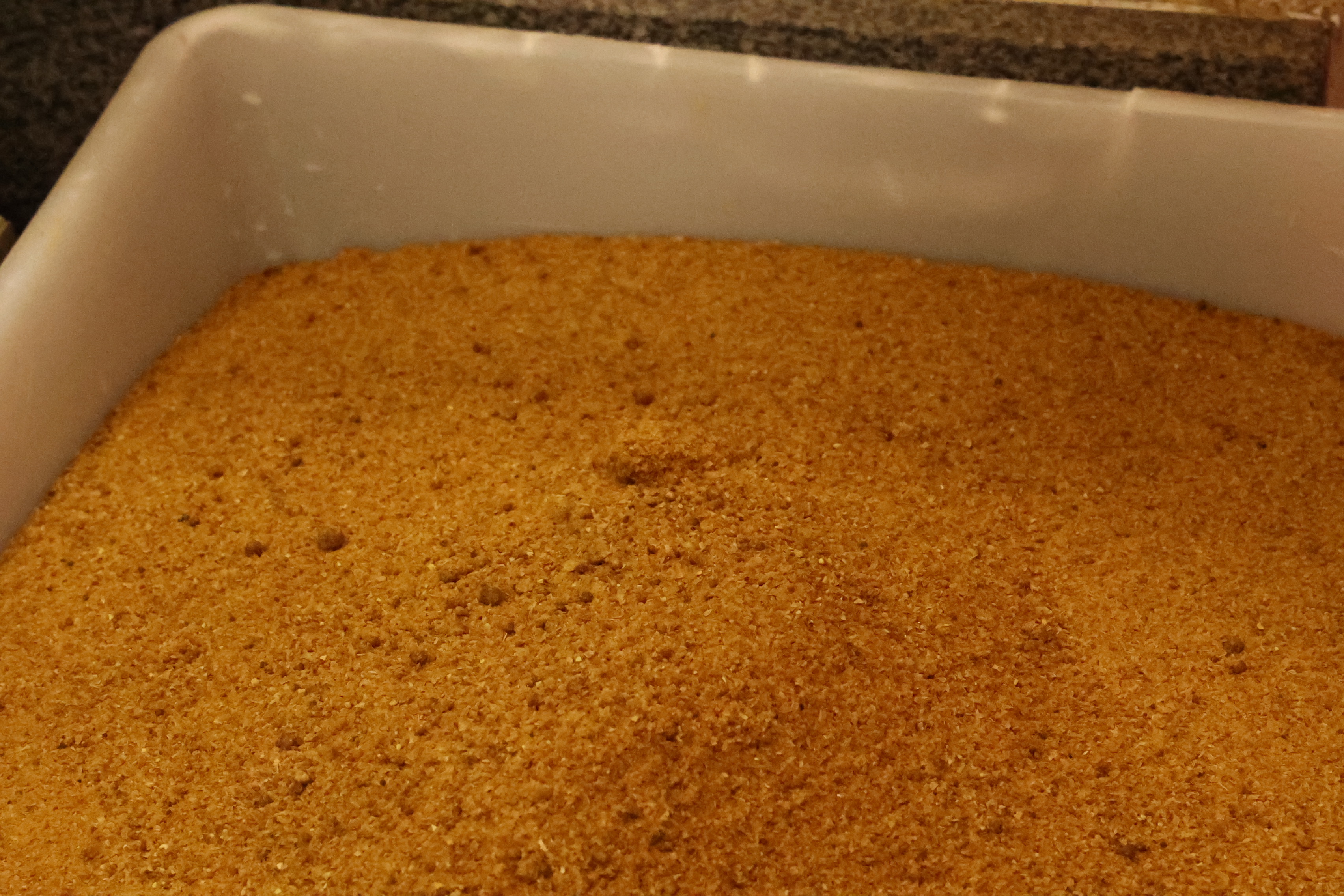 Dried distillers' grains with solubles at a lab in Inpasa's Sinop plant (Agri-Pulse photo)
Brazil has also increased its mandatory biodiesel blend to 15% and is supposed to increase it to 16% this year. As with DDG and DDGS in corn ethanol production, crushing soybeans for biodiesel generates soybean meal as a byproduct used in animal feed.
“We don’t have demand in the United States to soak up all that meal, as Brazil does not either,” said Stephen Nicholson, a strategist for grains and oilseeds at Rabobank. “We're going to be competing on the meal side.”
However, Nicholson and other analysts noted that Brazil’s biofuel policies have not been entirely consistent. The government, for example, ended up delaying its bump from 14% to 15% by several months, and could do again this year.
Raphael Bulascoschi, a market intelligence analyst at StoneX Brazil, pointed out that Brazil has a general election approaching in October, injecting uncertainty into the long-term biofuel, and therefore soybean meal, outlook.
“This could also shift the biofuel policy,” he said.
On the sorghum front, Brazil has not begun exporting to China, but a Brazil-based analyst said Chinese investors have expressed interest in sorghum production projects near ports in the far south and north of the country.
China has historically been the largest importer of U.S. sorghum, accounting for more than 85% of exports.
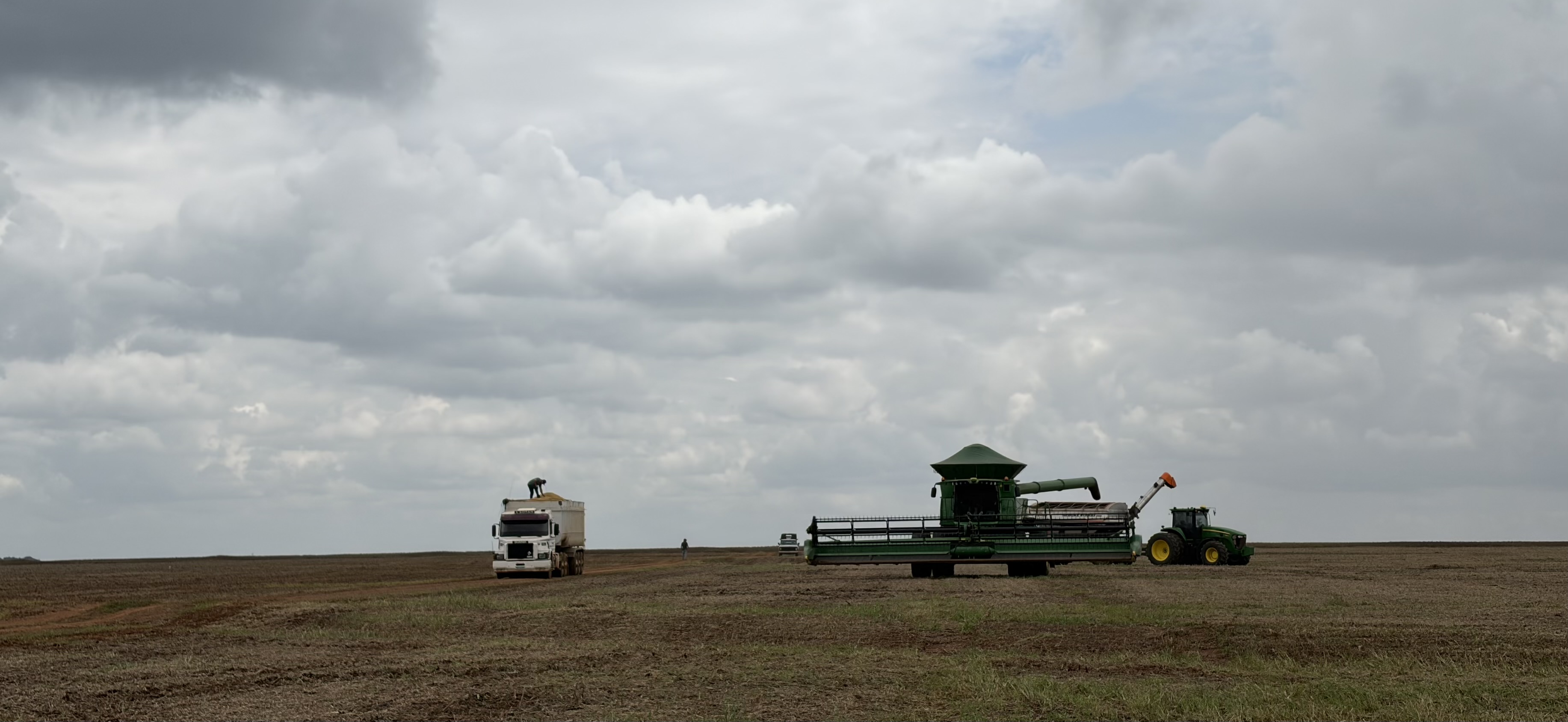 A soybean and corn farm in Nova Mutum, Mato Grosso, during harvest in early February, 2026 (Agri-Pulse photo)
Fiercer competition on existing fronts
Brazil’s soybean acreage has been growing rapidly, increasing from 84 million acres in the 2016-17 crop season to a forecast 121 million acres this crop year, according to the country’s National Supply Company (Conab).
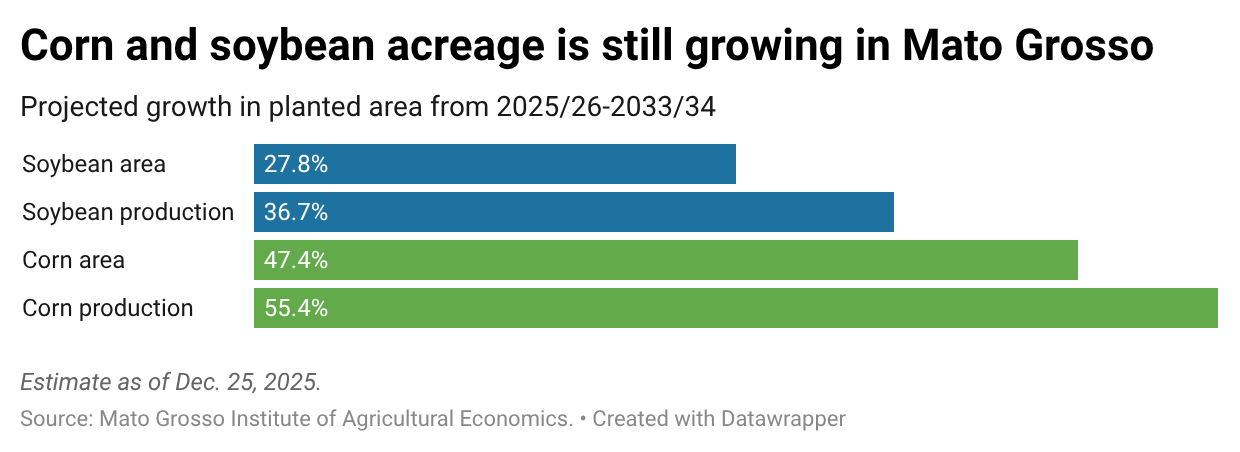
The state of Mato Grosso, which accounts for around 30% of the country’s total output, is anticipating even more growth in its soybean acreage as livestock moves to feedlots and degraded pasture is converted to soybeans.
The Mato Grosso Institute of Agricultural Economics (IMEA) estimates that soybean planting area in the state will increase by almost 30% by 2033/34. Overall production is set to grow even faster, from more than 47 million tons today to 64.5 million – an increase of almost 37%.
Internal demand for soybeans is also likely to rise, particularly as livestock production continues to grow. But Cleiton Gauer, IMEA’s superintendent, said he projects soybean production to grow faster than domestic demand, providing additional product for export and sending more Brazilian beans onto international markets.
 U.S. soybean exports have been on a downward trajectory since the 2020/21 crop season. Early USDA estimates see 2025 exports, decimated by China’s pivot from U.S. agriculture sources, could be as much as 13% lower than the previous year.
Lucas Beber, president of Aprosoja-MT, a trade group representing soybean and corn growers in Mato Grosso, argues that U.S. producers will struggle to recoup these lost exports in the face of rising Brazilian production.
Americans “understand that Brazil has tapped into markets that now are very hard for the USA,” Beber told Agri-Pulse through an interpreter, adding that he no longer sees the U.S. as a direct competitor “even though it is the second-largest producer.”
Bulascoschi also noted that a weaker currency will also work in Brazil’s favor in international soybean markets.
“It's natural for Brazil to gain more market share worldwide,” Bulascoschi said.
Beber says that the Brazilian soybean industry, much like the U.S. industry, is already aggressively pursuing new markets, particularly in Asian and Arab countries.
Corn faces the most export headwinds
Planting and production estimates for Brazilian corn are set to grow as more producers plant it as a second or even third crop. And productivity could improve substantially, but soaring internal demand from the growing corn ethanol industry is set to constrain export growth in the near term, analysts said.
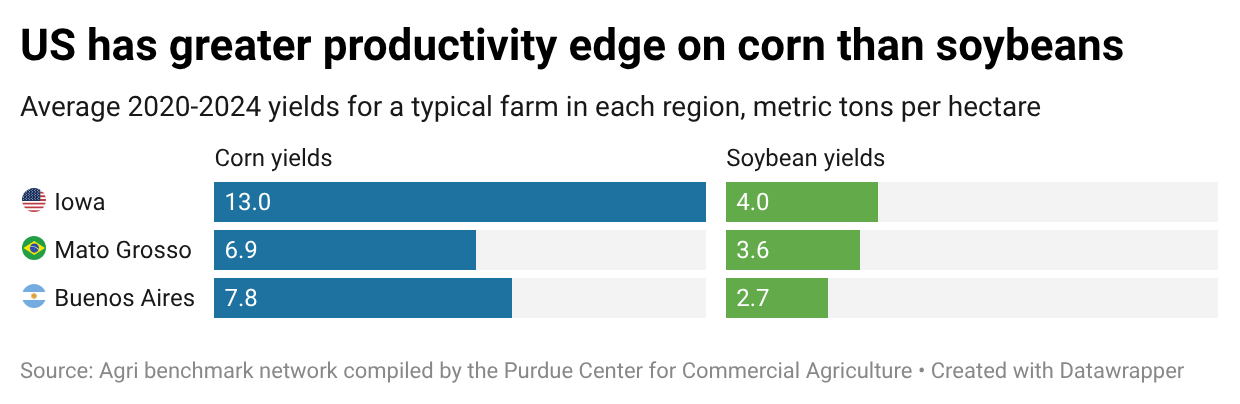
Brazilian corn yields still significantly lag the U.S.’, in part, because farmers prioritize higher value soybeans. But Beber notes that the gap is closing, and predicts that Brazilian corn will one day have comparable yields to the U.S.
Aprosoja-MT is among the organizations working to improve producer yields through two specialized research facilities dedicated to improving soybean and corn cultivation for specific soil types.
“We are going to be as efficient as the U.S. farmer,” he said through an interpreter. “We just need time.”
But Nicholson said that while soybeans remain the top choice for Brazilian planters, there is likely to be some productivity gap with U.S. producers.
“I don't want to discount that they would not ever reach U.S. yield,” he said. But added that “if it's your second crop, you want a good crop, but you may not want to spend the maximum amount of inputs to get that big crop.”
Whether Brazil lives up to its full export potential for both corn and soybeans will depend on several factors, including whether it can upgrade its infrastructure to keep pace with growing production and how it adapts to policies designed to curb deforestation.
Agri-Pulse will examine these factors shaping the future of the relationship in coming weeks. But even with the unknowns, underlying economics point to even fiercer competition in global markets between the global agricultural titans.
Daniel Veloso helped with translation.
Some of the reporting for this story was completed during a nine-day reporting trip to Brazil’s state of Mato Grosso. Seven of those days were undertaken at the invitation of Aprosoja-MT, a trade group representing soybean and corn producers in the region, with the group funding flights, accommodation, transportation and food for a group of reporters during the visit.
Logo produced with Google.ai.

