
Welcome back to Daybreak after our August break. The Make America Healthy Again recommendations were originally due out last week but their release has been delayed amid some continued concerns about how they will address food and agriculture.
The president and CEO of the National Council of Farmer Cooperatives, Duane Simpson, notes that there is a long road ahead for the recommendations, whatever they are.
“The final end game of this … does have to be that the proposed policies that come out of this have to go to the appropriate agencies, into Congress, and when they get there, they're going to be subject to public comment,” Simpson says on this week’s Agri-Pulse Open Mic.
Meanwhile: Some environmental groups are lashing out at the Trump administration over a New York Times report that a draft of the MAHA recommendations stops short of proposing restrictions on pesticides and ultraprocessed foods.
The draft instead calls for research on issues such as electromagnetic radiation and children’s oral health and recommends action on such matters as breastfeeding, infertility and the dangers of vaping, according to the Times.
Kari Hamerschlag, deputy director of the Food and Agriculture Program at Friends of the Earth, called the draft recommendations “a gift to the agrochemical industry and a slap in the face to the health of the American people and the MAHA voters that helped elect him. Instead of protecting families from toxic pesticides, it proposes speeding up approvals and launching PR campaigns to convince the public that chemicals are safe because the EPA has “robust review processes.”
Lori Ann Burd, environmental health director at the Center for Biological Diversity, says this: “Big Ag’s success in steamrolling the commission’s attempt to act on pesticides is a gut punch to everyone who genuinely believed we could finally make progress on protecting children’s health from these poisons.”
Keep in mind: Farm groups were upset at the references to pesticides in the initial report released in May, and there remains some concern within the industry that the recommendations could indirectly affect agriculture through the concept of limiting “cumulative exposure” to substances such as air emissions, microplastics, pesticides and other environmental factors. But it’s still unclear what exactly will be in the report.
Don’t miss a beat! It’s easy to sign up for a FREE month of Agri-Pulse news! For the latest on what’s happening in Washington, D.C. and around the country in agriculture, just click here.
RFK Jr: No, I’m not running for president
Health and Human Services Secretary Robert F. Kennedy, Jr. is denouncing rumors that he’s running for president in 2028, attributing them to opponents of his MAHA agenda.
“The swamp is in full panic mode. DC lobby shops are laboring fiercely to drive a wedge between President Trump and me, hoping to thwart our team from dismantling the status quo and advancing ’ Make America Healthy Again agenda. They’re pushing the flat-out lie that I’m running for president in 2028,” he says in an X post.
He goes on, “We’ll keep moving forward, we’ll keep delivering wins, and no smear campaign will stop us.”
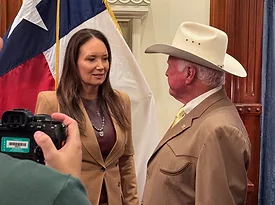 Ag Secretary Brooke Rollins and Texas Ag Commissioner Sid Miller confer after she announced significant new funding for the battle against New World screwworm Friday in Austin. Read our coverage at Agri-Pulse.com. (Agri-Pulse photo)
Trump takes small step back from ‘secondary’ tariffs on Russian oil
President Donald Trump isn’t ruling out further tariff increases against countries buying Russian oil. But he said after Friday’s meeting with President Vladimir Putin that they won’t be imminent.
The president has already slapped 25% duties on India for its continued purchases of Russian oil. China remains the largest buyer of Russian oil. But in comments to reporters en route to Alaska to meet with Putin, Trump was coy about the possibility of further tariffs on Beijing over its Russia ties.
“If I have to do it, I'll do it. Maybe I won't have to do it,” he said. He argued that should he go through with it, the tariffs would be “very devastating” for the Chinese economy.
Why it matters: Fertilizer industry analysts are watching for signs of next steps in the U.S.-Russia relationship and Trump’s use of “secondary tariffs.” Russia is a prominent exporter of potash and urea.
If Trump continues down the path of using tariffs to foster peace, it could prompt Russian retaliation, Matt Simpson, CEO of Brazil Potash, a potash mining company, told Agri-Pulse.
“If Putin decided to wake up and cut off fertilizer supply,” Simpson said, “It would be catastrophic.”
USTR announces updated FY2026 sugar quotas
The Office of the U.S. Trade Representative has published its fiscal 2026 sugar tariff-rate quotas, reflecting recent changes that will see fewer imports of reduced-tariff specialty sugar imports, including organic sugar.
The FY26 raw cane sugar allocations are the same as in the previous year, with the U.S. administering the minimum required volume under World Trade Organization rules. However, language in the One Big Beautiful Bill Act signed into law last month directs the administration to reallocate quotas from countries projected to fall short of their quotas “as soon as practicable.”
The refined sugar TRQs have been reduced to 22,000 metric tons. Last year, an additional 210,000 tons was added for specialty sugars, which USDA has scrapped this year. Around half of that quota was filled by Brazil.
Bumper apple crop projected
A new forecast puts the 2025-2026 apple crop at 11.7 billion pounds, a 1.3% increase from last year and 3.6% above the five-year production average.
Washington is set to remain the top producing state with a forecasted crop of more than 180 million bushels, according to a report released by the U.S. Apple Association on Friday. New York is set to produce 30.5 million bushels, while Michigan, Pennsylvania, Virginia and Oregon all follow.
State AGs support ranchers’ challenge to 'Product of USA' labeling
Eleven state attorneys general want the 8th U.S. Circuit Court of Appeals to declare beef with “Product of USA” labels from animals raised outside of the U.S. as “misbranded” under South Dakota law.
Attorneys General from South Dakota, Nebraska, Idaho, North Dakota, Colorado, New Mexico, Texas, Montana, Kansas, Oklahoma and Wyoming filed an amicus brief in a case against the nation’s four largest meatpackers.
In it, they argued that the Federal Meat Inspection Act does not preempt states from deeming cattle born, raised or slaughtered outside of the U.S. carrying ‘Product of USA’ labels as misbranded under their own laws.
The case was originally filed by two South Dakota ranchers who claim JBS Foods, Tyson Foods, Cargill and National Beef violated state statutes in their use of “Product of USA” labels.
Final word
“The issue we're talking about today involves every square inch of the state of Texas, but also you'll find out that it involves every square inch of the United States of America.” – Texas Gov. Greg Abbott, speaking at an Austin event with Agriculture Secretary Brooke Rollins, where she announced significant new spending in the fight against New World screwworm, a flesh-eating cattle pest.
Oliver Ward and Noah Wicks contributed to this report.


