
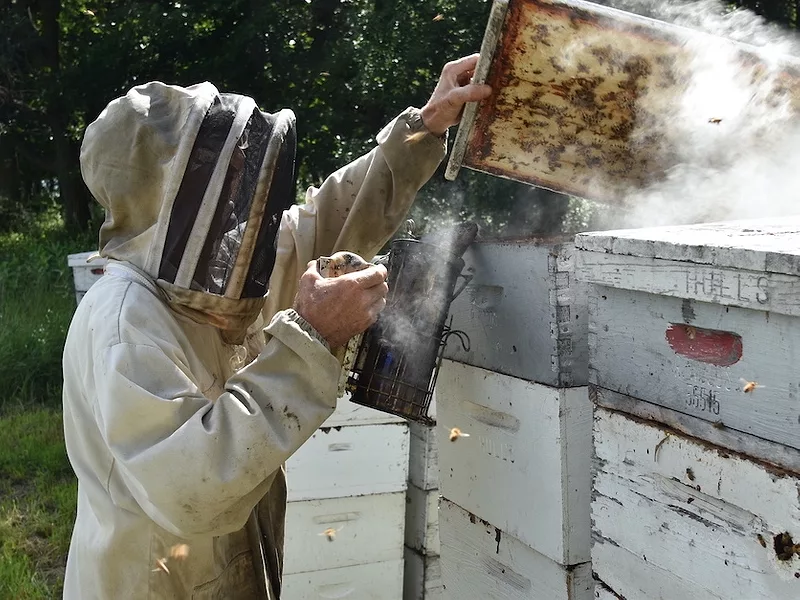
Wes Hull knows losing bees is part of the honey business. But every year, he's seeing more and more die.
In the early 1990s, the Minnesota beekeeper says he and his brother, Jeff, only expected to lose up to 15% of their bees in a given year. That death rate has since climbed to nearly 60% amid mounting pressures from mites, viruses, bears and pesticides. All the while, their colonies' honey output has fallen.
“We can’t keep anything alive,” Jeff Hull said. “That’s been a change that Wes and I have seen in our lifetime.”
The two brothers aren’t alone. More than 840 beekeepers across the U.S. reported losing an estimated 1.6 million colonies between June 2024 and March 2025, according to a survey by Project Apis m., a bee research group. Respondents saw a mean loss rate of 55.3%.
“We’re having a bad year in a bad period for beekeeping,” said David Tarpy, an extension apiculturist at North Carolina State University.
Commercial beekeepers, or those with more than 500 colonies, lost an average of 62% of their colonies during the survey period, while “sideliners” with between 50 and 500 colonies lost an average of 54%. Hobbyists with up to 49 colonies lost an average of 51%.
“Beekeepers have expected 15% losses as a normal part of doing business for decades, but that number has been creeping up,” said Matthew Mulica, a senior project director with the Keystone Policy Center, which oversees the Honey Bee Health Coalition. He noted that losses near 60% have become “the new normal.”
Beekeepers stand to lose an estimated $600 million from lowered honey production, less pollination income and colony replacement costs due to the 2024-2025 losses, the survey found.
A second survey conducted by the Apiary Inspectors of America, Auburn University and Oregon State University found 55.6% of managed honeybee colonies were lost between April 2024 and April 2025, an increase of 14.2 percentage points from the running 14-year average.
Using this survey’s loss rates and USDA data, University of Illinois economist Brittney Goodrich calculated replacement costs for impacted colonies at around $208 million, though that does not include lost revenues from almond pollination and honey production, or additional costs incurred in producers’ attempts to keep their bees alive.
“These are really big numbers for our beekeeping industry in general,” she said, adding that some operations have sustained higher-than-normal losses over multiple years. The Apiary Inspectors of America survey estimated U.S. colony losses above 40% nearly every year since 2018 with the only exception being 2022, when they were 39%.
“What I really worry about as an economist is the overall effect on the beekeeping operations,” she said. “They just keep getting hit year after year after year. Eventually, that’s going to take a toll.”
Threats abound for U.S. honeybees
Pinpointing the exact causes of colony declines is challenging, since bees face a number of threats and circumstances behind each loss event differ. Even experienced honey producers struggle to identify the exact causes of their die-offs.
"You talk to any beekeeper and they’ve had many years of unexpected loss that they really don’t understand,” Wes Hull, the Minnesota beekeeper, said. “We know the threats: viruses, loss of habitat, poor nutrition, pesticides. But we can’t sit back and say, ‘it was A, B or C.’ It’s probably everything.”
Scientists at the Agriculture Department’s Bee Research Lab who have been studying recent years’ losses believe a significant portion could be driven by viral infections caused by varroa mites, a pest that it appears is becoming increasingly resistant to longstanding treatments.
Cut through the clutter! We deliver the news you need to stay informed about farm, food and rural issues. Sign up for a FREE month of Agri-Pulse here.
In a recent study, the USDA researchers found “unusually high levels" of deformed wing virus and acute bee paralysis virus in samples they took from impacted colonies. All of the varroa mites they collected tested positive for genes linked to resistance to amitraz, a common miticide used in beekeeping. The researchers acknowledged that other stressors, like pesticides, may also contribute to the losses.
 Scott McArt (Cornell University photo)
“There are lots of problems,” said Cornell University assistant professor of pollinator health Scott McArt, noting that on top of the varroa mites and viruses, honeybee populations can be threatened by pesticide exposure, declines in forage availability, changing weather patterns and certain management practices.
Loss rates vary by operation, but some producers have seen theirs rise above 60%. Bee veterinarian Terry Ryan Kane told Agri-Pulse she knows of one Detroit-based operation that has lost 90% of its bees. McArt said one New York beekeeper with “several thousand” colonies lost every single one last year.
“I saw more and more beekeepers this last year go out of business just from frustration,” said Trevor Tauzer, vice president of business strategy at California-based Tauzer Apiaries. "It’s not fun to work all day long and then owe things back, still be in the red and the bees still die."
Beekeepers split up their surviving colonies when rebuilding, which offers them more flexibility in the recovery process than producers of other types of livestock, said Tarpy, the North Carolina State University apiculturalist. But it can take several months to a year to fully revive lost colonies, and subsequent loss events can set back these efforts, he added.
Josette Lewis, the Almond Board of California’s chief scientific officer, said recent losses have California almond growers concerned that impacted honeybee operations may not be fully recovered in time for next year’s pollination. Almonds are 100% reliant on honeybees, since California’s native bees are generally not active from mid-February through mid-March, when pollination takes place.
While Lewis has heard anecdotally of almond growers struggling to secure optimal hive numbers during this year’s pollination, recent USDA estimates of a 3-billion-pound crop suggest there were no major yield decreases caused by a lack of pollinator availability.
Still, “it could very well have an impact next year,” she cautioned.
Future of bee lab unclear as USDA looks to reorganize
It’s unclear yet how current efforts to research bee losses will be affected by USDA leaders’ plans to close the Beltsville Agricultural Research Center, which hosts the agency’s main bee research laboratory. Beekeepers from around the country often send dead bees to the lab for analysis, and many of these are housed in cold storage onsite, said Mulica with the Keystone Policy Center.
 Matthew Mulica (Keystone Policy Center photo)“The Beltsville lab held a lot of bee researchers and the future remains uncertain on where that research is going to go, where it’s going to be housed and to what extent it’s going to have funding,” Mulica said.
BARC’s closure was announced as part of a reorganization plan released by Agriculture Secretary Brooke Rollins last month that would relocate staff currently based in and around Washington, D.C., to “hubs” in North Carolina, Missouri, Indiana, Colorado and Utah. In a memorandum, she wrote that BARC “will be vacated over multiple years to avoid disruption of critical USDA research activities.”
"President Trump was elected to make real change in Washington, and we are doing just that by moving our key services outside the beltway and into great American cities across the country,” Rollins said in a press release at the time of the announcement.
Zac Lamas, who worked at the bee lab before becoming a visiting researcher at the University of Maryland, said Beltsville scientists are still waiting for specifics from the agency on how and when the reorganization will occur. However, he warned that any attempts to separate Beltsville’s scientists could reduce the lab’s research output.
“Once we break up those working groups and fraction those working groups, our output additively isn’t the same. It’s much lower,” Lamas said during a webinar hosted by the Pennsylvania-based Chester County Beekeepers Association.
Lamas said the Beltsville location is ideal for bee research. Agricultural pressures in the region are minimal and few beekeepers operate nearby, which limits exposure of the lab’s bees to pathogens and pesticides. There’s a long research season from February through November, and the remaining cold months allow scientists to evaluate winter stress in hives.
“We really are in this Goldilocks zone,” he said.
Increasing bee deaths a challenge for Minnesota operation
The Hulls are the third generation in a line of beekeepers that stretches back to the 1890s, when their grandfather developed a fascination with the hives that pollinated the apple trees on his family’s farm in Pennsylvania. He moved the operation to North Dakota’s Red River Valley — an area abundant with sweet clover — in the mid-1920s only to once again relocate to Central Minnesota when the Great Depression struck.
In recent summers, the Hull brothers have kept around 3,000 hives in Minnesota, about 600 less than they did 15 years ago. Another 450 are held in Louisiana, where the two beekeepers raise queens and split hives.
 Wes Hull (Noah Wicks photo) The Hulls also transport bees to and from California each year to pollinate almond producers’ orchards. In recent years, they’ve noticed fewer bees surviving the trip.
“You know this warehouse? ... Half will be dead hives,” Wes said as he stood in a large building near Battle Creek, Minnesota, and gestured to where he and Jeff unload their bee boxes in the spring. “Semi-loads of hives coming back from California with no bees on them.”
Mite infestations have become a problem for the two beekeepers, who spend time “playing mad scientist” in their kitchen as they work to develop their own treatments after struggling to find effective and affordable options on the market. Additionally, they’ve noticed farmers in the area increasingly using neonicotinoids, which they fear may be impacting their colonies as well.
The Hulls are now slowly selling off their hives as they make plans to shut down their business in a few years. Rising loss rates have helped to solidify their decision to begin closing up shop.
“I see some writing on the wall that I’m not real comfortable with, and with the struggles that we’ve been through just trying to keep our operation going — we just feel like we maybe need to get out while it’s good,” Wes said.
Click here to see photos taken during Agri-Pulse's visit to Wes and Jeff Hull's honey operation in Minnesota.
For more news, go to agri-pulse.com.

