
The Agriculture Department is lowering its forecast for farm earnings in 2025 as declines in the crop sector more than offset soaring incomes for cattle producers.
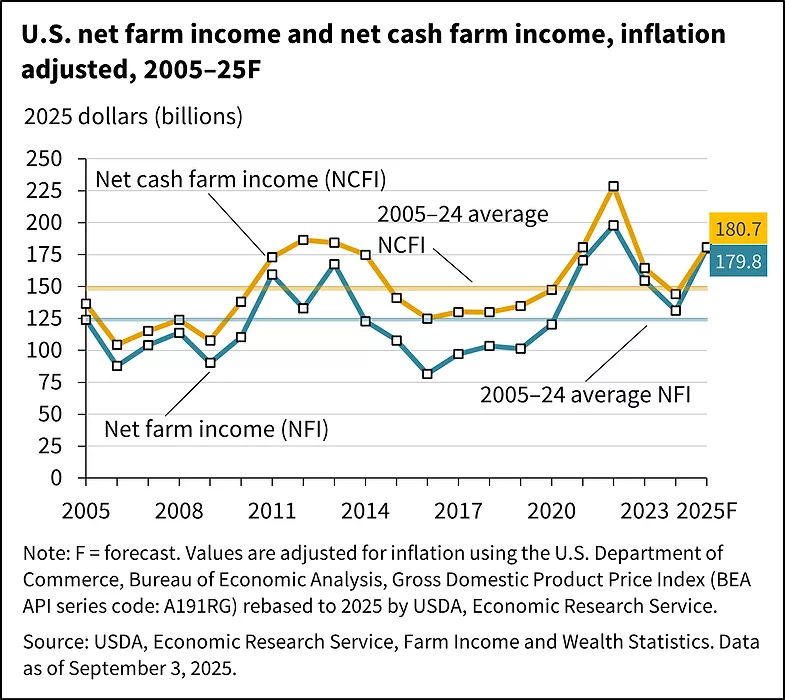
Net cash farm income, a measure of producers' cash flow, is forecast at $180.7 billion for 2025, an increase of $36.5 billion, or 25.3%, over last year when adjusted for inflation, according to the forecast issued by the Economic Research Service on Wednesday. In February, USDA had forecast net cash farm income for 2025 at $193.7 billion.
Net farm income, a broader measure of profits, is forecast at $179.8 billion for 2025, an increase of $48.8 billion, or 37.2%, over 2024 when adjusted for inflation. February's forecast was for net farm income of $180.1 billion.
Even with the lower numbers, both the estimates for net farm income and net cash income this year are above the 20-year average, largely due to an influx of government payments to row crop producers.
Net cash farm income is based on cash receipts from farming, plus government payments and other farm-related income, minus cash expenses. Net farm income also factors in depreciation and changes in inventory values.
USDA estimates that direct government payments to producers will hit $40.5 billion this year, a $30.4 billion increase from last year, and the largest amount since the pandemic year of 2020. The total for this year includes an influx of government aid approved by Congress last December. Congress is considering providing another tranche of emergency assistance before the end of the year to compensate producers for the impact of President Donald Trump’s trade policy.
Supplemental and ad hoc disaster assistance payments are expected to total $34.2 billion this year.
But even without the government payments, farm earnings are still expected to increase in 2025 by more than $19 billion to $130 billion, according to ERS economist Carrie Litkowski.
Don’t miss a beat! It’s easy to sign up for a FREE month of Agri-Pulse news! For the latest on what’s happening in Washington, D.C. and around the country in agriculture, just click here.
The forecast doesn't include changes to commodity programs made by the One Big Beautiful Bill enacted in July, said Litkowski. "They would affect payments more starting in 2026," she said on a webinar.
Farm cash receipts are forecast to increase this year by 4.7%, not adjusted for inflation, but that number masks the stark difference in conditions of the crop and livestock sectors.
Total cash receipts for crops are expected to fall by 2.5%, not adjusted for inflation, while receipts form livestock products rise by 11.2%.
Corn receipts are projected to drop 3.7%, not adjusted for inflation, while soybean receipts are estimated to drop 7.1% and wheat receipts are projected to fall 9.8%.
The updated income forecast incorporates data from the World Agricultural Supply and Demand Estimates report issued in August. USDA projected farmers would produce a record 16.7 billion bushels of corn this fall and sharply lowered its forecast for the average corn price, which if realized could trigger significantly higher commodity program payments.
By contrast, cash receipts from cattle and calves are forecast to increase by 15.7%, while sales in the hog sector are estimated to increase by 9.5%.
Average net cash income is expected to drop 14.8% for corn farms, 13.8% for soybean growers and 2.1% for wheat operations. Specialty crop growers are expected to see a drop of just 1%.

Cattle operations are expected to see average net cash income increase by 66.6%, while poultry operations see 26.7% more.
Farm sector production expenses are estimated to be $467.4 billion this year, about the same as last year when adjusted for inflation. Labor costs are expected to be 4.2% higher, while spending on feed, pesticides and fuel are expected to be lower.
Farm debt and equity are both expected to grow. Farm sector equity is expected to increase 2.1% in 2025 to $3.8 billion, while farm debt is expected to rise 2.4% to $600 billion.
The farm debt-to-asset and debt-to-equity ratios are expected to remain relatively stable but still above their 2015-2024 average.
The median income for farm households is expected to increase 3.7% when adjusted for inflation.
Commercial farms are expected to have median farm incomes of $182,012 in 2025, a 1.2% increase from 2024. Those farms are expected to have median off-farm income of $66.253 this year.
For more news, go to Agri-Pulse.com.

