
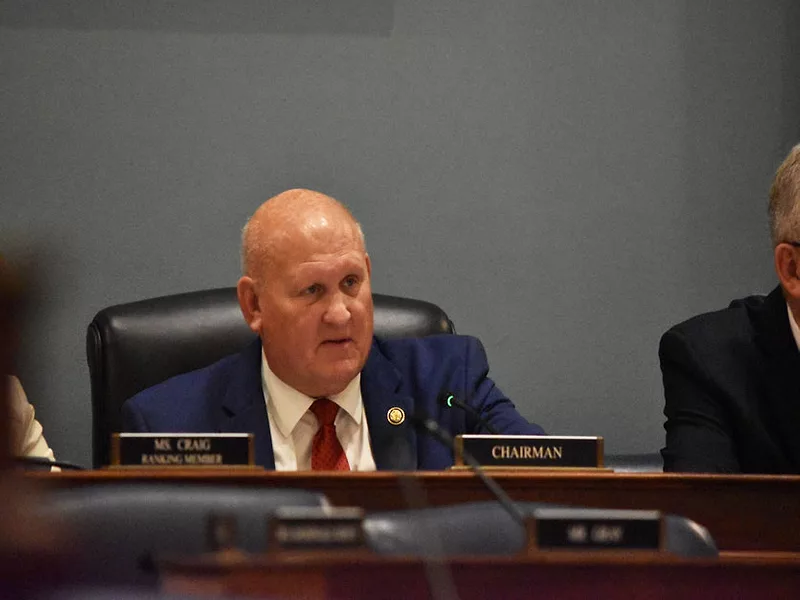
House Agriculture Committee Chair Glenn “GT” Thompson is expressing confidence in President Donald Trump’s trade policy. But Thompson, R-Pa., says on this week’s Agri-Pulse Newsmakers that the size of an emergency farm assistance package will depend in part on whether Trump can nail down some new trade deals.
He says that the aid package should be seen as a “reward for the patience of our farmers” as Trump uses tariffs to negotiate agreements with U.S. trading partners.
“I think our farmers in the end are going to be big winners when it comes to the President Trump-led trade [policy],” Thompson says.
Thompson says it’s still to be determined how large the aid package will be. “There are a lot of variables that are out there,” he says.
Watch Newsmakers today at Agri-Pulse.com.
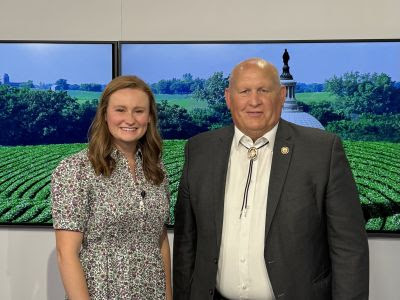 Agri-Pulse Newsmakers host Lydia Johnson and House AG Committee Chair Glenn "GT" Thompson (Agri-Pulse photo)
Labor Department confirms it will take a look at H-2A methodology
The Labor Department plans to publish a proposal in February changing the way it calculates the adverse effect wage rate used in the H-2A program.
The department had signaled during recent litigation over the H-2A program that it wants to examine the methodology used to set the AEWR. The tentative date for the proposal is included in the department’s semiannual regulatory agenda released by federal agencies Thursday.
Over at USDA: The Agriculture Department lists many of the target dates for its long-term actions as “to be determined.” That includes a final rule with guidelines on using crops as
low-carbon biofuel feedstocks and a labeling proposal for meats made with animal cell culture technology.
USDA’s Food and Nutrition Service, however, says it plans a proposed rule in August 2026 to amend the definition of "eligible foods" in the Supplemental Nutrition Assistance Program.
Kennedy, senators trade barbs at Finance Committee hearing
Health and Human Services Secretary Robert F. Kennedy Jr. and senators from both parties clashed over vaccines at a Senate Finance Committee hearing that came just days after Kennedy fired the head of the Centers for Disease Control and Prevention.
It wasn’t your normal Capitol Hill hearing.
Democrats were unsparing in their criticisms of Kennedy, accusing him of misleading them with promises about continued vaccine access at his confirmation hearing and not knowing how his own agency works.
Kennedy accused Sen. Tina Smith, D-Minn., of “making stuff up” and said Sen. Ben Ray Luján, D-N.M., was “talking gibberish.”
GOP also concerned: Not all the criticism came from the Democratic side. Sen. Bill Cassidy, R-La., said the Food and Drug Administration’s recent move to restrict the availability of COVID vaccines to the elderly and people with preexisting conditions amounts to “denying people vaccines.”
Don’t miss a beat! It’s easy to sign up for a FREE month of Agri-Pulse news! For the latest on what’s happening in Washington, D.C. and around the country in agriculture, just click here.
“You’re wrong,” Kennedy told him, insisting that vaccines would still be available.
Sen. John Barrasso, R-Wyo., said he had been hearing concerns from his medical colleagues in Wyoming about Americans being put at risk.
On food and ag: The Make America Healthy Again initiative received some attention, with Kennedy defending the recent MAHA Commission strategy to attack chronic disease and mentioning work the administration has been doing to limit food dyes.
He also assured Sen. Chuck Grassley, R-Iowa, who said some farmers had expressed concerns to him about MAHA’s goals, that he was working closely with Ag Secretary Brooke Rollins.
“We've met with over 140 farm interests over the past three months to incorporate them, to make sure that the MAHA agenda is consistent with their agenda,” he said.
Pennsylvania, GT clash over SNAP
Pennsylvania Human Services Secretary Val Arkoosh is defending her agency’s operation of the Supplemental Nutrition Assistance Program amid scrutiny from House Ag Committee Chair Thompson.
In a letter to Pennsylvania Governor Josh Shapiro last week, Thompson said the state’s error rate puts it “in the top third of worst performing states.” He also took issue with Pennsylvania’s SNAP administrative costs of around $214 million annually, which he said are the third-highest in the country.
He added that because of these administrative costs, “you have been outspoken in blaming insufficient federal funding as an attempt to obfuscate a clear lack of program integrity in Pennsylvania's SNAP program.”
In a letter to Thompson on Thursday, Arkoosh said Pennsylvania’s SNAP error rate of 10.76% is below the national average of 10.93%. She added that some of the errors included in the error calculation may not necessarily have led to incorrect payments and said the state is also using technology and manual checks to find and correct such errors.
"My team and I stand ready to work with you to protect Pennsylvanians’ access to this critical program — and we look forward to hearing from you on ways you can actually help us reduce our error rate,” Arkoosh wrote.
Take note: In her response to Thompson, Arkoosh noted USDA’s Food and Nutrition Service has stopped holding monthly calls with Pennsylvania’s Department of Human Services and has not responded to many of the state agency’s requests.
Final word
“We're consulting every stakeholder in the farm community in everything that we do." — Robert F. Kennedy Jr., speaking about his Make America Healthy Again agenda to Sen. Chuck Grassley, R-Iowa, at a Senate Finance Committee hearing on Thursday.
Philip Brasher and Noah Wicks contributed to today’s Daybreak.


