
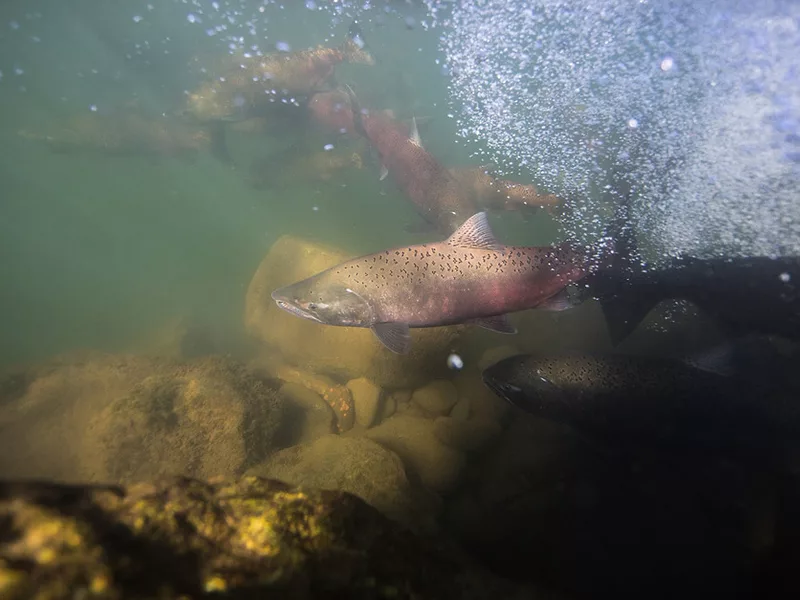
The California Legislature has approved a contentious measure to permanently enshrine drought rules for the Scott and Shasta rivers into law. Tribes say it would ensure protections for endangered salmon as the years-long rulemaking process continues to play out. Yet farmers and ranchers fear it is locking in broad curtailments with no end in sight and upending a more collaborative approach that seeks to balance the needs of the local agricultural economy.
Assemblymember Chris Rogers, D-Santa Rosa, lauded the state’s removal of four dams in the region to improve water quality, reduce fish diseases and create new spawning habitat.
“But despite this exciting new chapter, the river still remains in peril,” he told senators. “The two tributary streams that currently produce most of the Klamath’s wild Chinook — the Shasta — and wild coho — the Scott — are under constant strain from increased water diversions.”
The Karuk and Yurok tribes blamed low flows in 2022, at the height of the last drought, for fish kills and charged that four years of emergency rulemaking to preserve instream flows are not a reliable way to guarantee protections.
 Asm. Chris Rogers (Rogers office photo)
Farm groups agree, arguing that extending the same emergency rules has limited their due process rights, and they recognize that permanent flow requirements are unavoidable at this point in the regulatory process. Yet they worry Assembly Bill 263 would disrupt the complex and delicate balancing act the State Water Resources Control Board has been navigating with the competing interests.
The ‘hammer approach’ to policymaking
“The impact of this regulation carries consequences,” said Brandon Fawaz, a hay farmer and officer in the Siskiyou County Farm Bureau, during a committee hearing. “The ending of family farms and breaking working landscapes will be the legacy of emergency curtailments.”
Fawaz warned lawmakers during a committee hearing that AB 263 “would entirely wipe out these due process protections and could easily be expanded to include any watershed in the state.” He explained that farming families “live in financial fear, farmers lose hope, the next generation abandons the desire to return to the farm, and historic ranches are broken into ranchettes and marijuana grows.” He described how those pressures are weighing on agricultural communities, with the suicide rate of farmers now exceeding that of combat veterans.
Cut through the clutter! We deliver the news you need to stay informed about farm, food and rural issues. Sign up for a FREE month of Agri-Pulse here.
Fawaz noted that the legislation has pitted neighboring lawmakers against each other and charged that Rogers’ wealthy constituents are driving a policy that diminishes a socially disadvantaged and poverty-stricken community. The Klamath region falls within the district of Asm. Heather Hadwick, R-Alturas, who staunchly opposed AB 263.
“This bill disregards the meaningful proactive efforts undertaken by farmers, ranchers and water users in my district who have worked in good faith to conserve water and protect the local environment,” said Hadwick, during floor debate. “These stakeholders have invested significantly in sustainable practices, participating in voluntary water-sharing agreements, improved irrigation projects and contributing to habitat restoration.”
She blasted Rogers for writing a bill “about my district without my knowledge or our input” and without conversations with stakeholders, ignoring their concerns.
“This is why rural people — farmers, people in the north state — get pissed off,” added Assembly Minority Leader James Gallagher.
Supporters’ case
Rogers downplayed the criticism, arguing the proponents “are just asking to not undo the progress that’s been made over the last few years.”
The environmental group California Coastkeeper Alliance, a cosponsor on the bill, argued a permanent standard is warranted because flows in the two rivers “consistently dip below levels deemed to be the minimum necessary for fish survival, even in average water years, due to excessive diversions and groundwater pumping,” creating a risk of extinction.
Several Democratic lawmakers recognized that the Legislature is not the appropriate venue for deciding on such complex and impactful policies but still hewed to the party line and voted in favor of AB 263. Asm. Steve Bennett, D-Ventura, believed lawmakers must step in to ensure protections while the negotiations continue, because powerful agricultural interests would otherwise subvert the process.
“If we don't, those forces have been successful over and over again at overdrafting, overpumping, overusing water in California,” said Bennett.

