
|
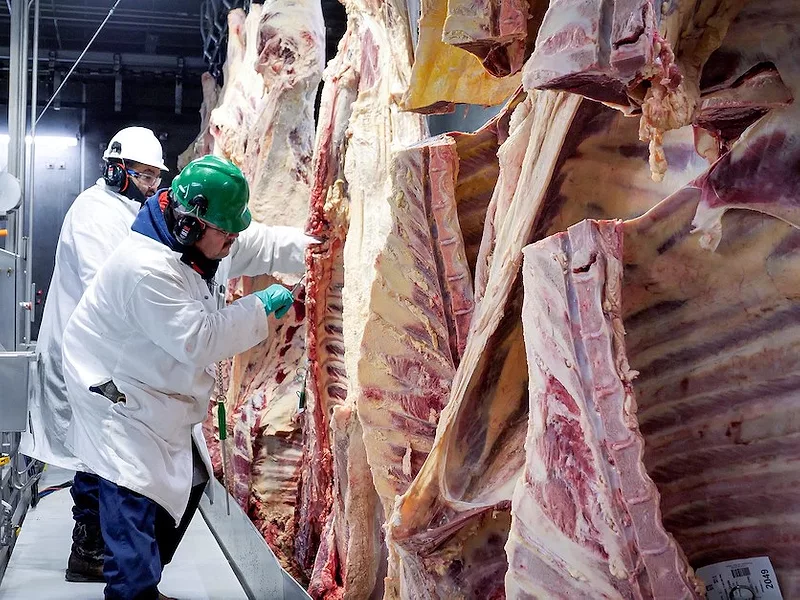
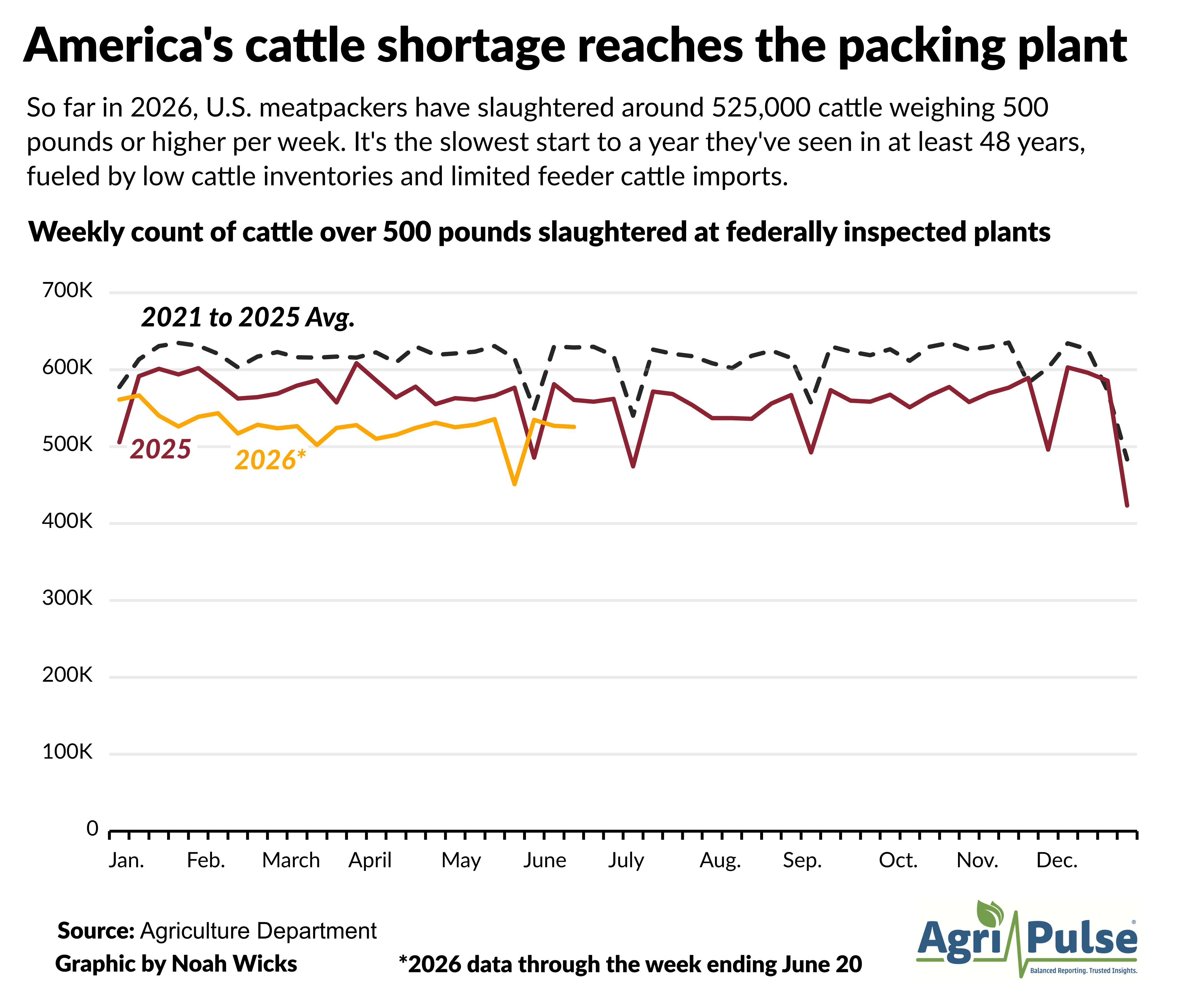
A shrunken U.S. beef herd has forced meat processors into a bidding war for a dwindling supply of animals, making it harder for them to turn a profit. Some, including Tyson and JBS, have shuttered plants under the strain.
Meat processors are competing for a shrinking supply of beef carcasses while also grappling with rising costs of labor, a confluence of factors that has resulted in some major plants shutting their doors. However, a slate of new market entrants is set to bring several new plants online in coming years, injecting new capacity into an already crowded sector. Rich Nelson, chief strategist at agricultural commodity research and brokerage firm Allendale, told Agri-Pulse he expects to see at least one or two more major plants close amid an overabundance of shackle space.
“The packing industry is in a very tough bind,” Nelson said. “We don’t have clear signs of expansion starting and even if we did, that’s a year and a half before those numbers hit. So this is a slow-moving trainwreck — I don’t see an easy way out of it.”
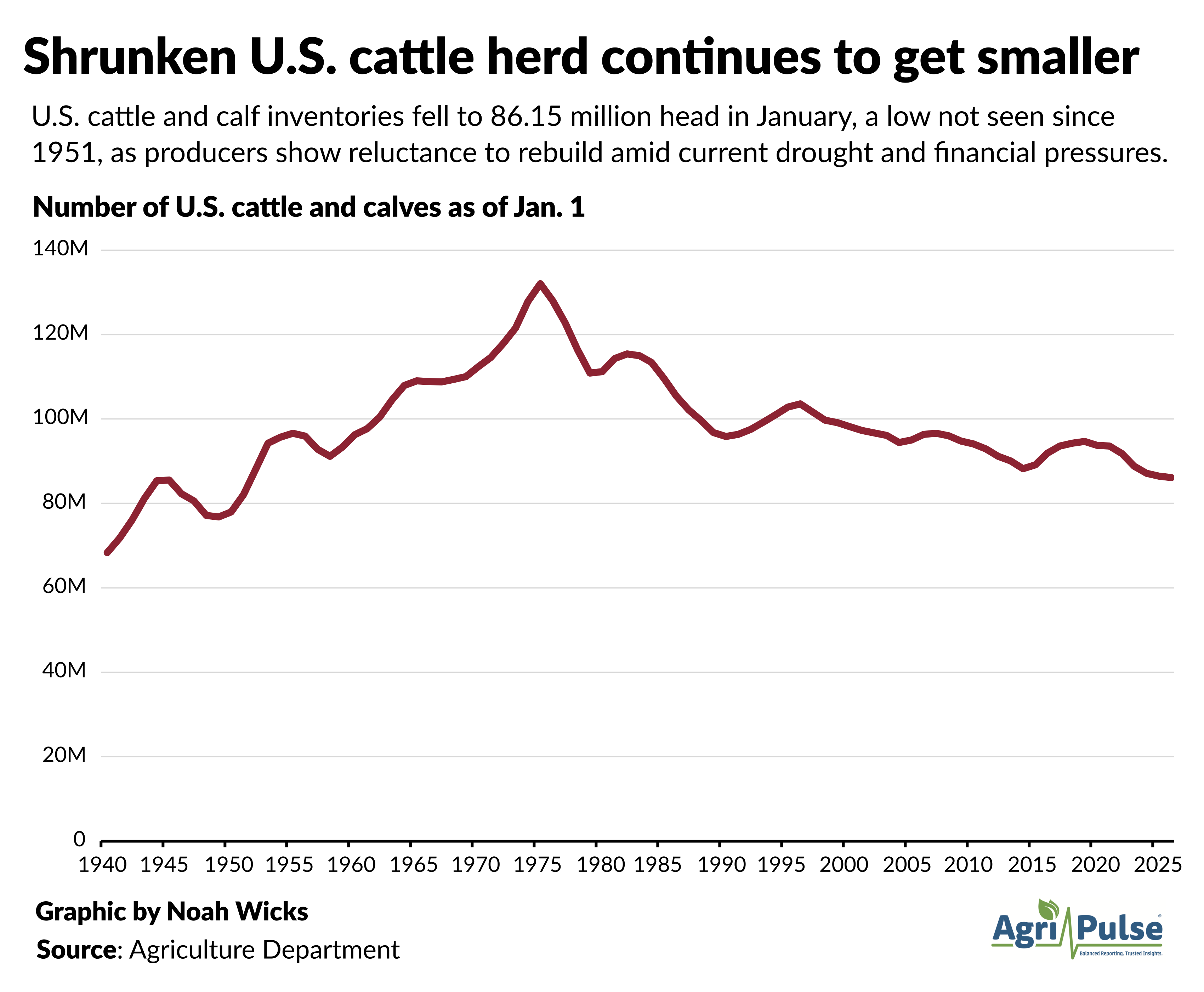
U.S. producers saw cattle and calf inventories of only 86.15 million head in January, a low not seen since 1951, according to USDA’s most recent survey. Beef prices have climbed to record highs as the shrinking herd meets strong consumer demand.
Nelson said when there is overcapacity in the beef industry, packers “bid up artificially high for cash cattle, regardless of what the beef price is."
Kansas State University Economist Glynn Tonsor told Agri-Pulse the beef industry has long struggled with overcapacity, or as he puts it, “too many hooks relative to cattle.” New plants that have come online in recent years, some with federal and state support, “actually make this national issue worse, because we’ve added hooks at a time when we’ve already had too many hooks,” he said.
Tonsor doesn’t expect the sector’s overcapacity challenge to go away. U.S. cattle are becoming larger over time, which means the national herd probably won’t need as many animals in future cycles, he noted.
“It has a clear implication,” Tonsor said of the trend. “We don’t need as many hooks."
The most recent edition of the Sterling Beef Profit Tracker estimates packer margins at a negative $314.48 per head for the week ending June 27. The tracker, published by Sterling Marketing Inc., projects annual packer margins at negative $220 per head.
If processors lose $314.48 for every animal they slaughter, the loss rate would pencil out to $314,480 for plants that kill 1,000 head. Darin Parker, the president of Parker-Migliorini International, a global food distribution and supply chain company, noted that while beef prices have increased amid falling cattle inventories, they have not risen enough to recoup packers' profits.
“I mean, it’s not sustainable, right?” he said of the losses. “These guys are losing a fortune every single day.”
Justin Tupper, the president of the U.S. Cattlemen’s Association, said in the current environment, “you get the big four packers finally having to compete for some of these animals, and that puts pressure on those smaller regional plants, because they have to pay more to get the product they need to sell.”
“It’s a good thing that we have prices where they are, it’s good for our producers,” Tupper said. “But it also presents different challenges for our friends in the packing industry.”
Nelson said larger packers that process a mix of animal types are likely to fare better in the current market than smaller facilities, since they can rely on other species like chicken to help turn a profit.
“These smaller companies with one plant or two plants who only do beef — they are in a serious bind,” Nelson said.
The Agriculture Department last week announced the Strengthening Processing for U.S. Ranchers (SPUR) program, a $500 million program to pay small and mid-sized processors for higher costs they face acquiring cattle due to the supply shortage.
David Anderson, an extension economist and professor at Texas A&M, said that smaller plants tend to see higher costs than larger ones. He noted that the top four beef processors handle about 85% of fed cattle slaughter, or steers and heifers going through a feedlot.
He also noted that increased interest from cattle producers in local and direct-to-consumer marketing following the COVID-19 pandemic has led to a number of small plants that have come online in recent years just as cattle numbers have dropped to their lowest in decades.
“In some ways, it’s bad timing, bad luck,” Anderson said of those plants.
As some major plants close their doors, new market entrants appear
Tyson Foods last November announced it would close a Lexington, Nebraska, beef plant capable of processing 5,000 head per day, and would convert its operation of an Amarillo, Texas, facility to a single shift.
Economists at the University of Nebraska-Lincoln estimated that the closure of the Lexington plant would have an annual statewide economic impact of $3.2 billion.
Former Tyson Foods Chief Operating Officer Devin Cole said during a May earnings call that the “harvesting plan adjustments better position us to compete effectively this year and over the long term with a right-sized production footprint.”
During the call, Tyson Foods CFO Curt Calaway said “based on the continuation of tight cattle supply,” Tyson expected a $350 to $500 million loss in beef segment operating income for fiscal 2026.
Meanwhile, JBS Foods announced in June that it plans to close a beef plant in Souderton, Pennsylvania, and a value-added facility in Memphis, Tennessee. The Swift Beef Co., a subsidiary of JBS, in February also closed a value-added manufacturing facility in California.
Additionally, while it has not closed, a Cargill plant in Fort Morgan, Colorado, has been idled, with 1,700 workers locked out of the plant due to a labor dispute.
Nelson estimates around 10,000 head per day in beef processing capacity has been taken offline amid the closures and production pauses. However, he pointed out that a slate of new plants set to come online could bring some of that capacity back online, fueling new competition for carcasses.
Sustainable Beef opened a new 1,500-head-per-day facility in North Platte, Nebraska, last May, while American Foods Group last spring opened an $800 million plant in Missouri capable of processing 2,400 cattle per day.
Meanwhile, Producer Owned Beef is building a 3,000-head-per-day plant in Amarillo, Texas. Cattlemen’s Heritage plans to build a 2,000-head-per-day plant in western Iowa, though CEO Chad Tentinger told local news outlet KMA Land in December that it would not break ground until this summer at the earliest.
USDA program aims to help small, mid-size processors weather cattle shortage
Through the SPUR program, announced by USDA last Tuesday, the department plans to distribute up to $500 million from the Commodity Credit Corporation to non-dominant, federally inspected beef packing plants. Economists say the funding may help some smaller plants avoid near-term closure, but won’t do much to change the root cause of many of their challenges: a lack of available cattle.
“I don’t think it changes aggregate beef availability because it doesn’t change cattle availability, it doesn’t change the beef price for anybody in the U.S.” Tonsor said of the $500 million. “But it might buy some time and add some viability for some individual small operations that get this governmental assistance.”
Allendale's Nelson said the funding doesn’t change the fact that meatpackers have an excess of available shackle space. Some plants will still likely be forced to close at some point, he said.
“There’s no reason for this funding,” Nelson said. “It’s a waste of money, stopping an issue which is set in stone.”
In a statement last week, Meat Institute CEO Julie Anna Potts similarly said the SPUR program will help some of the organization’s members, “but it will not increase the cattle supply.” She said government policies “intended to reduce the rising cost of beef for consumers should give cattle producers the certainty they need to retain heifers and grow the herd.”
"Beef packers from the very large to the very small, are losing millions of dollars a week due to the tight cattle supply while the industry struggles with the smallest U.S. cattle herd in 75 years,” Potts said. "Packers of all sizes are reducing shifts and some have been forced to close facilities. We simply need more cattle.”
USCA's Tupper said the SPUR program is a “good way to help” prop up some of the independent, regional plants struggling with tight margins.
“Any time that we can inject some more competition, especially into the packing industry, it’s going to be to the benefit of the producer, and that’s exactly what this program tries to do — prop up some of those smaller and more regional processors to get them back in the game in a very challenging atmosphere,” Tupper said.
Bill Bullard, CEO of R-CALF USA, a cattle producer group, said he hopes the funding can “make a significant difference in allowing some these smaller packers to survive during this unprecedented period of extremely tight supplies and yet incredibly strong beef demand.” If smaller packers are able to survive long enough, Bullard said they could help keep the beef industry competitive and enable reforms limiting larger processors from taking advantage of producers.

