
Some of the largest ocean carriers are reassuring customers that they won’t be hit with surcharges when the U.S. places new port fees on Chinese-made or -operated ships next month. But shipping experts and ag industry representatives are skeptical and warn that the fees could create fresh challenges for exporters.
Spokespeople for Maersk and Hapag-Lloyd, two of the five largest ocean carriers, told Agri-Pulse this week that they do not intend to pass new port fee costs on to customers. Switzerland’s Mediterranean Shipping Company (MSC) told customers in a recent advisory that it would not add surcharges once fees kick in Oct. 14, the Wall Street Journal reported earlier this month.
Companies have had several months to brace for the new charges – crafted as part of a Biden-era effort to revive domestic shipbuilding that has been retained by the Trump administration.
The Office of the U.S. Trade Representative (USTR) said in April that Chinese operators will face a port fee of $50 per net ton at U.S. ports, which will increase over the next three years; meanwhile operators of Chinese-made ships docking at U.S. ports will pay $18 per net ton or $120 per container, whichever is higher.
The fees do not apply to smaller dry bulk vessels, or to vessels that arrived in the U.S. empty – a carveout that agricultural exporters celebrated at the time.
The costs to carriers could be steep, said Peter Sand, chief analyst at Xeneta, an Oslo-based shipping analytics platform. A Chinese-made container ship docking at a U.S. port could cost carriers up to $500 in fees per 40-foot container, eventually rising to $1,500 once the regulations are fully implemented in 2028.
Cut through the clutter! We deliver the news you need to stay informed about farm, food and rural issues. Sign up for a FREE month of Agri-Pulse here.
Accordingly, carriers have been working since April to rotate Chinese-built vessels out of U.S. shipping routes and avoid the incoming port fees, Sand said. The Maersk spokesperson also confirmed to Agri-Pulse that the company will be able to make “adjustments to our network” to adapt to the new rules.
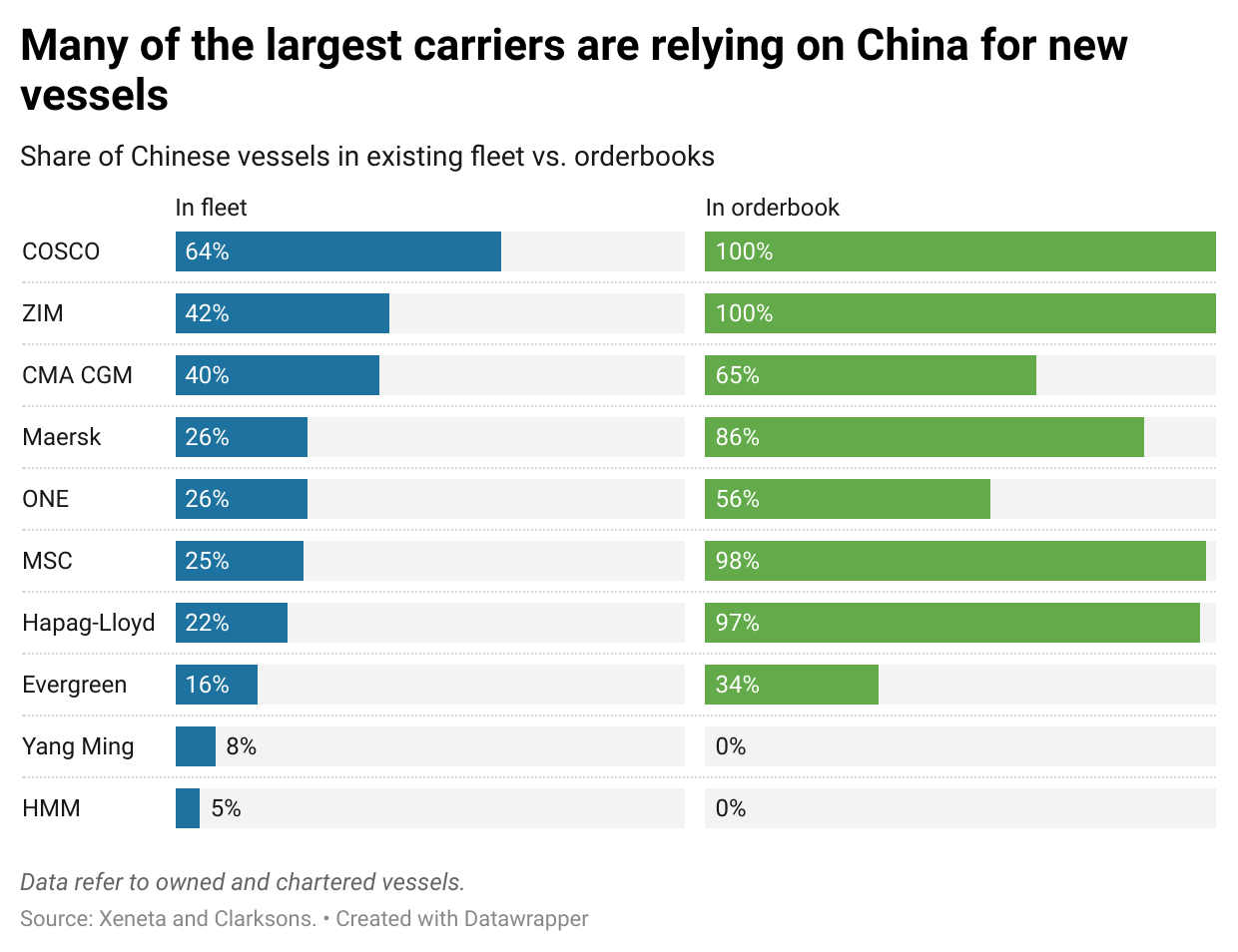
Chinese vessels accounted for around a fifth of all U.S. port traffic in 2024, according to data from supply chain firm VesselBot. The vessels make up around a quarter of Maersk, Hapag-Lloyd and MSC fleets, suggesting they could eliminate Chinese ships from U.S. routes, he said.
Others, like the China-based COSCO, Israel’s ZIM and France’s CMA CGM, which rely on China for 64%, 42% and 40% of their respective fleets, could have a harder time, however.
COSCO and CMA CGM did not respond to questions on whether they would be able to rotate Chinese-made ships off of U.S. routes or whether they would pass along the port fees.
Ag isn’t necessarily in the clear
Even if many of the largest ocean carriers can effectively skirt the new port fees by reallocating ships to U.S. routes, the new shipping landscape could have implications for U.S. ag exporters.
China produces the largest container-carrying vessels in the world and dominates carriers’ order books for new vessels. More than 80% of Hapag-Lloyd, MSC and Maersk’s outstanding orders are with Chinese shipyards, according to Xeneta data. Meanwhile, all of COSCO and ZIM’s outstanding orders are for Chinese ships.
If a carrier substitutes a large Chinese-made ship for a smaller South Korean-made ship, it could introduce supply constraints in the future, said Peter Friedmann, executive director of the Agriculture Transportation Coalition.
“I don't think there's going to be immediate, drastic impacts because the ships are changed,” Friedmann said, particularly given the current slump in Chinese purchases of U.S. ag products. But down the road, he added, the situation could become more acute.
Craig Fuller, CEO and founder of FreightWaves, a supply chain and logistics analysis firm, said that carriers could use the new fees as cover to create the conditions to raise prices, even if they don’t introduce a specific surcharge to cover the fees.
“The most effective way for them to gain pricing power is to pull capacity off of the lanes,” Fuller said.
“They're going to use this event to exploit the conditions with their customers,” he added. “I have no doubt about that.”
Bulk vessels paint a similar picture
Dry bulk vessels, which transport around 80% of U.S. soybeans and substantial volumes of other U.S. grains, received a carveout from the new fees. Vessels that arrive in the U.S. empty and those with bulk capacity below 80,000 deadweight tons won’t face any charges under the regulations.
But Alejandra Castillo, president and CEO of the North American Export Grain Association, said she worries that it will preclude the largest dry bulk vessels from servicing U.S. ag exporters.
Kamsarmax ships, named because they are the maximum size vessels that can use Port Kamsar in Guinea, frequently have capacities above 80,000 deadweight tons, and can be as large as 90,000.
“They usually are between 82,000 to 85,000,” Castillo said, adding that a large share of the newest ships coming onto the market to replace the older Panamax models are above USTR’s 80,000 deadweight ton threshold.
The market is already beginning to respond, Castillo argued.
Freight costs are “beginning to creep up” ahead of the Oct. 14 deadline, Castillo said, but she added that it could still take another week or two before the full cost burden of the fees on dry bulk freight comes into focus.
It is still unclear “how the fee structure and the formula will affect the availability and cost of bulk vessels,” she said. “We're monitoring it closely right now, but we really won't see the full impact until the implementation goes into play.”
Accordingly, Castillo has been pressing USTR to extend the carveout to the higher tonnage dry bulk vessels since the guidance was published in April, but to no avail.
 Alejandra Castillo (LinkedIn photo)
Full steam ahead
Castillo isn’t the only one pressing USTR to rethink its guidance and provide more relief for U.S. ag exporters. Friedmann said the Agriculture Transportation Coalition has been conveying its concerns to USTR as well as to USDA.
GOP Rep. Dusty Johnson also told Agri-Pulse last week that he has also been hearing from farmers in his home state of South Dakota that the fee proposals may not have provided sufficient cover for U.S. agricultural interests.
April’s regulations stepped back from some more extreme proposals USTR initially proposed for charging Chinese vessel owners and operators. The final rules, Johnson said, were “closer to the Goldilocks position,” adding that they’re “not there yet.”
“There's still a fair amount of concern,” he said. “I don’t think the current proposal is at a perfect spot.”
“We want to rebuild an American shipbuilding industry. That's going to take quite a while, and I think we want to be open to the idea that we need a better way to mitigate the upfront harm if we want to realize the back-end benefit,” Johnson said.
Castillo said she has received no indication from USTR that it will update the guidance or delay its implementation beyond the Oct. 14 start date. Other lobbyists also told Agri-Pulse that they would be surprised if the agency further waters down the proposals ahead of implementation.
“I don't anticipate any changes at this point,” said Jonathan Gold, vice president of supply chain policy at the National Retail Foundation. He added, however, that “things could certainly change in the coming after that goes into effect.”
USTR did not respond to a question from Agri-Pulse on whether it plans to adjust the regulation before implementation.

