
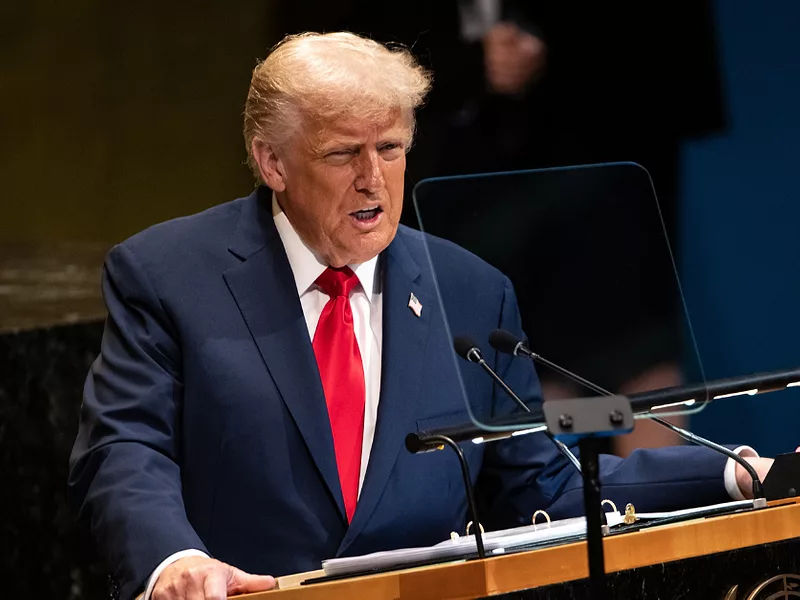
President Donald Trump used his appearance at the United Nations General Assembly in New York on Tuesday to cudgel the European Union into mirroring U.S. tariffs on countries buying Russian energy.
“The United States is fully prepared to impose a very strong round of powerful tariffs,” Trump said. The comments echoed those he and other officials made earlier this month in which they called for new duties on China and India over their continued purchases of Russian oil.
“For those tariffs to be affected, European nations … would have to join us in adopting the exact same measures,” Trump added.
The president also raised the EU’s ongoing purchases of Russian energy when he sat down with European Commission President Ursula von der Leyen later in the day.
Take note: In a new analysis, Atlantic Council Deputy Director Charles Lichfield notes that Trump’s ask that Europe weaponize its trade policy is likely unpalatable to EU leaders. It is against their interests to be seen as so dependent on the U.S. “that they have no say on their commercial relations with India and China,” Lichfield writes.
Lawmakers seek ‘equitable allocation’ of rural hospital funding
Ten Republican House members are urging the Department of Health and Human Services to ensure a $50 billion program for rural hospitals goes specifically to rural healthcare providers.
In a letter, the lawmakers also are asking for the fair distribution of funds “regardless of political affiliation.” The lawmakers are from states with Democratic governors.
"During the approval process of state applications, we urge HHS and CMS to ensure funds are distributed to rural communities with the greatest need, making rural America healthy again regardless of political affiliation,” they said.
The lawmakers include Reps. Dan Newhouse and Michael Baumgartner of Washington, David Valadao, Doug LaMalfa and Jay Obernolte of California, Pete Stauber, Brad Finstad and Michelle Fischbach of Minnesota, Juan Ciscomani of Arizona, and Gabe Evans of Colorado.
USDA gives details on new export promotion funding
USDA will launch a new trade promotion program with funding Congress allocated in the “One Big Beautiful Bill” Act signed in July. The department also has plans to create a new type of trade mission.
Beginning in fiscal 2026, the $285 million in additional trade promotion spending Congress authorized will go to launching the “America First Trade Promotion Program,” USDA says.
Cut through the clutter! We deliver the news you need to stay informed about farm, food and rural issues. Sign up for a FREE month of Agri-Pulse here.
As part of a “three-pronged” approach to boosting farm exports, USDA also plans to launch supplemental trade missions focused on the idea of reciprocal trade. “Trade Reciprocity for U.S. Manufacturers and Producers” missions, or T.R.U.M.P missions, will “maximize high-return, low-risk agricultural export prospects,” USDA says.
The department also plans what it describes as a more muscular approach to export financing.
“Advancing these programs, as supplements to our existing programs, ensures the health, prosperity, and security of rural America, our farmers, ranchers and producers,” says USDA Undersecretary for Trade Luke Lindberg.
 Ag Secretary Brooke Rollins riding with Animal and Plant Health Inspection Service cattle fever tick riders along the Rio Grande River June 18 (USDA Photo). USDA defends Taiwan export figures
A USDA spokesperson sought to clarify comments from Agriculture Secretary Brooke Rollins last week touting opportunities for increased exports to Taiwan after it sparked confusion.
Rollins said in a post to X that Taiwan had committed to $10 billion in U.S. “agriculture buys over the next 4 years, including soybeans, corn, wheat & beef.” X Users quickly pointed out that Taiwan already buys more U.S. ag products than that over a four-year period.
A USDA spokesperson told Agri-Pulse that the $10 billion figure refers to Taiwan’s “total purchase commitment over the next four years.” The spokesperson disagreed with the characterization that this would represent a slowdown in ag exports, however.
“Taiwan previously purchased $1.9 billion of U.S. soybeans, corn, wheat, and beef,” the spokesperson said. Accordingly, the spokesperson argued $10 billion in purchases of just these commodities would represent a “25% increase over historical levels.”
RIF issue returns to judge
Federal agency reorganization plans could be reviewed by a court after a ruling from the 9th Circuit Court of Appeals in San Francisco. The appeals court remanded to the district court the matter of whether the Agency RIF and Reorganization Plans (ARRPs) should be filed in court. The Trump administration is expected to continue to oppose the plaintiffs’ efforts to have them submitted.
U.S. District Judge Susan Illston ruled in May that the Trump administration cannot carry out the RIFs, but the Supreme Court stayed her injunction. The 9th Circuit’s brief order says its denial of the government’s request to quash the discovery request “accords with the longstanding presumption that district courts have broad latitude to control discovery matters.”
EU strikes trade deal with Indonesia
Indonesia and the European Union have inked a trade deal after almost a decade of negotiations. Both sides aim to ratify the agreement by 2027.
Why it matters: The pact includes protections for 221 EU geographic indicators, according to a summary from the European Commission.
The deal will eventually eliminate over 98% of tariffs, the summary says. Among the European sectors set to enjoy tariff-free access are processed foods, most dairy products and meat products.
Copa and Cogeca, which represent EU farmers and cooperatives, said they would hold off on endorsing the deal until text has been released.
Rural vet listening sessions planned
USDA will hold two sessions next week to hear from stakeholders on the shortage of rural veterinarians.
The events are from 3-4 p.m. on Sept. 29 and Sept. 30. To register, go here.
USDA recently released a strategy to address the lack of rural vets, a longstanding problem caused in part by the high cost of veterinary school.
“A low percentage of veterinary school students come from rural areas or express interest in rural practice, and an even lower percentage of recent veterinary school graduates enter into production animal medicine,” the Animal and Plant Health Inspection Service said in announcing the listening sessions. “These are concerning trends and exacerbate the rural veterinary shortage.”
Final Word
“Our market development programs are bringing the bounty of American agriculture to people around the world, helping millions of hardworking American farmers, ranchers, and producers connect their safe, high-quality products with growing export markets.” – USDA Undersecretary for Trade Luke Lindberg, announcing $8.3 million in new funding to help specialty crop producers boost foreign sales.
Steve Davies, Oliver Ward and Noah Wicks contributed to today’s Daybreak.


