
A growing number of states are seeking Agriculture Department approval to restrict purchases of soft drinks, candy and other sugary foods through the Supplemental Nutrition Assistance Program as the “Make America Healthy Again” movement gains political steam.
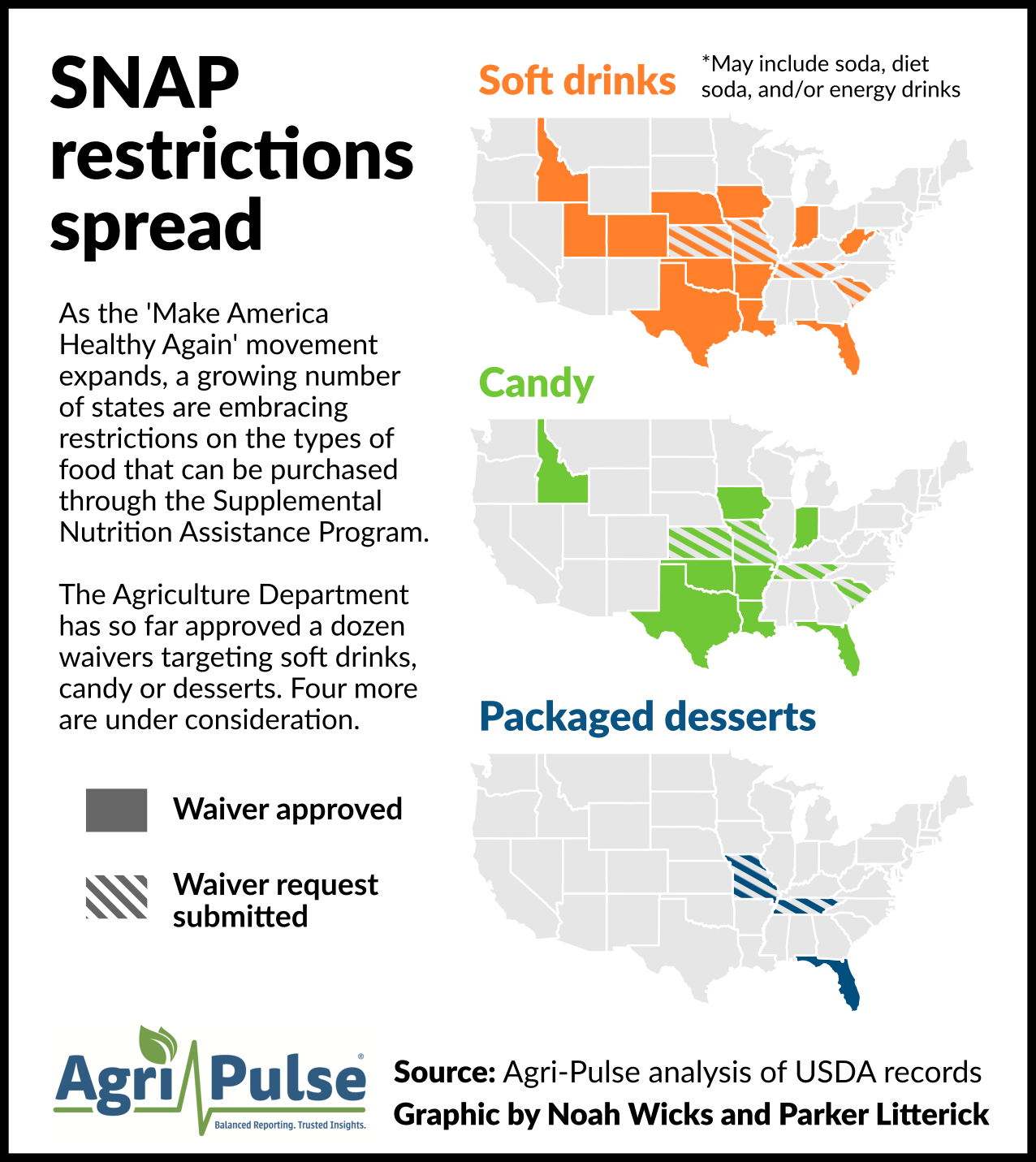
USDA has so far approved requests from a dozen states for SNAP restrictions of various kinds and is considering four more, according to an Agri-Pulse analysis of federal and state documents. All seek to restrict sales of certain soft drinks and several also target candy purchases.
“Since my confirmation, our department has encouraged states to think differently and creatively about how to solve the many health issues facing Americans,” Agriculture Secretary Brooke Rollins told reporters in June. “One way is by not allowing taxpayer-funded benefits to be used to purchase unhealthy items like soda, candy and junk food.”
Recent data on the types of food SNAP recipients choose to buy is limited, but a USDA study analyzing 2011 transactions at several grocery stores found that approximately 20 cents out of every dollar SNAP households spent on food purchases went towards sweetened beverages, desserts, salty snacks, candy and sugar. More than 9% of the SNAP household purchases analyzed in the study were for sugar-sweetened beverages, while 6.9% of expenditures were for prepared desserts, 3.43% for salty snacks, and 2.1% for candy.
USDA data show 41.7 million people participated in SNAP as of May. Roughly 29% (12.4 million) are in states that have proposed SNAP food restrictions, according to the Agri-Pulse analysis.
Reforming the SNAP program to limit sugary foods and drinks aligns with the Make America Healthy Again movement's focus on decreasing the consumption of ultra-processed foods, added sugars and artificial dyes. The idea has been publicly supported by major MAHA figures, including Health and Human Services Secretary Robert F. Kennedy Jr.
“If MAHA didn’t exist, this wouldn’t be happening,” said Craig Gundersen, an economist at Baylor University.
The spread of SNAP food restrictions may also to some degree be driven by incentives included in a rural health fund Republican lawmakers created through the One Big Beautiful Bill to allay concerns over potential hospital closures resulting from Medicaid cuts. States' efforts to enact waivers are considered as part of the Rural Health Transformation Program's criteria for determining how much funding they receive.
State SNAP restrictions: What's being banned and where
Rural hospital funding tied to SNAP waiver incentives
The concept of SNAP food restrictions has seen some Democratic support in the past, but Republican-led states are driving the current effort, submitting 15 of the 16 waivers to date. Colorado is the only state with a Democratic governor to have done so.
“You’ve just heard of three, four, five, six governors doing it. Another three or four are ready to,” Indiana’s Republican Governor Mike Braun said back in June as he tallied up states that had requested waivers.“This should cascade across the country, and with this kind of energy, this kind of enthusiasm, that’s how we fix the underlying issues.”
Cut through the clutter! We deliver the news you need to stay informed about farm, food and rural issues. Sign up for a FREE month of Agri-Pulse here.
Brandon Lipps, co-founder of Caprock Strategies and a former deputy undersecretary for Food, Nutrition and Consumer Services at USDA, believes that a political shift sparked by the MAHA movement is enabling the spread of SNAP restrictions across states.
While SNAP restrictions have generally been left to Congress to debate in the past, the MAHA movement is now “using states to force this change up,” Lipps said. He believes bipartisan support for “moving Americans towards a more nutritional diet” — one of MAHA’s core priorities — has helped the idea gain steam.
“The political shift that allowed for this to happen for the first time is really the convergence of the MAHA wing of the MAGA movement with the nutritional positions of a lot of Democrats,” Lipps said, adding that as a result, “the political headwind is very strong and the resistance is very weak.”
Current proposals vary — and more states could join in
Lipps believes that at least half of U.S. states will eventually submit SNAP food restriction waiver requests to USDA. He expects all will be approved.
Ohio plans to submit a request sometime before Oct. 28, Ohio Department of Job and Family Services Communications Director Bill Teets told Agri-Pulse in an email. The National Grocers Association has flagged Alabama, Alaska, California, Delaware, Mississippi, Montana, New Hampshire, Pennsylvania, South Carolina, Virginia and Wyoming as other states likely to consider restrictions.
Current proposals vary significantly, both in complexity and in types of products covered. For instance, Oklahoma’s restriction applies to nearly all naturally or artificially sweetened beverages, including flavored water. But Louisiana’s only applies to carbonated beverages and specifically exempts flavored carbonated water.
When it comes to candy, Indiana’s restrictions cover most varieties. But in Idaho, products that contain flour are exempt. So while SNAP recipients would be barred from using their benefits on a Twix bar in one state, they would be allowed to do so in the other.
In addition to soft drinks and candy, Florida has also received USDA approval to limit SNAP purchases of “prepared desserts,” which it defines as “processed, shelf-stable, ready-to-eat, pre-packaged sweet food intended for immediate consumption without any further preparation.” Missouri has proposed a ban on similar products.
Tennessee’s restrictions, which have yet to be approved by USDA, would bar SNAP recipients from using their benefits on “processed foods” that list sugar, corn syrup, high fructose corn syrup as the first ingredient. They also apply to beverages that list those ingredients first or second on their labels.
For a breakdown of every state's proposed restrictions, click here.
Petitions to alter product eligibility in state SNAP programs are not new. In 2011, New York proposed a waiver to limit sugar-sweetened beverage purchases. USDA denied the proposal, which it found was too large in scope for a pilot program and had an insufficient evaluation design, presented conformity challenges for grocers, and could potentially increase stigmatization of participants, according to its letter to the state.
N Parke Wilde (Tufts University photo)ow, as a new set of petitions crops up nearly 15 years later, some experts are raising similar concerns.
“This is much more than a pilot if whole substantial states are on the list,” said Parke Wilde, a Tufts University economist and former director of design for the SNAP Healthy Incentives Pilot program.
Food manufacturers — facing combined pressures from the SNAP waivers, potential changes to school meals, and a broader Trump Administration crackdown on product ingredients — are likely to shift their strategies for marketing and formulation of food products to some degree, but it’s unclear how substantial those changes will be, Lipps said. Much of that will depend on how long the MAHA movement maintains its political power.
“I think we’ll see some short-term shifts,” he said. “They’ll be more minor than major. But the bigger question is: How long does it sustain?”
Some nutrition advocates see potential in restrictions, others worry about enrollment declines
Thomas Farley, a former commissioner of health for New York City and Philadelphia, believes the waivers hold the potential to limit shoppers’ consumption of junk foods. He pointed to a pair of studies that, according to his analysis, suggest consumers could buy between 41% and 51% less sugary foods and beverages with SNAP restrictions in place.
“I’m hopeful that people will come around to supporting this idea because we do have what I consider to be a crisis of obesity in this country and we are very much in need of approaches for solving that,” said Farley, who helped work on New York’s 2011 proposal to limit soda purchases through SNAP.
 Thomas Farley (LinkedIn photo)
In their waiver requests, states pointed to other studies that indicate SNAP restrictions could improve participants’ health outcomes. One conducted by scientists at Stanford University and the University of California, San Francisco, found that banning sugar-sweetened beverage purchases in SNAP is “likely to significantly reduce obesity prevalence and type 2 diabetes incidence.” Another by researchers at Harvard and Bailit Health Purchasing suggests similar outcomes when restrictions are paired with incentives for fruit and vegetable purchases.
But Gundersen, the Baylor University economist, worries the restrictions will lead to a decline in SNAP participation, which could cause more low-income Americans to be food insecure. Use of SNAP already comes with stigma for participants, and having to sort restricted items from eligible ones at the checkout line will only add to that, he said.
“You can't really measure the stigmatization,” he said. “So somebody may say, ‘Oh, yeah, it's working great.’ But you haven't looked into the hearts of those who are being really hurt by this.”
Gundersen said food restrictions would make SNAP more closely resemble the Women, Infants, and Children (WIC) nutrition program, which funds the purchase of specific types of foods for pregnant women and children of up to four years old.
 Craig Gunderson (Baylor University photo)
He noted that while more than 78% of eligible infants receive food through WIC, participation falls to 64% for one-year-olds, 44.2% for two-year-olds, 41.4% for three-year-olds, and 24.7% for four-year olds — an indication that children have less taste for the program’s limited food options as they outgrow formula.
“Do we want SNAP to look like WIC?” Gundersen asked. “I don’t want SNAP to look like WIC. And that’s really my concern is they’re moving that direction.”
Wilde, the Tufts University economist, believes effectively designing a policy to reduce obesity and chronic disease rates requires providing people “with the resources to purchase healthy foods at the same time as you limit incentives to buy unhealthy foods.” For example, he said SNAP restrictions on sugar-sweetened beverages “has a kind of coherence and sense of public interest purpose” in states that also have a sugar-sweetened beverage tax.
“But if you just have a sugar-sweetened beverage limitation only for low-income Americans and not for middle-income and high-income Americans and only taking something away and not adding resources, it just looks like sticking it to a constituency that’s not all that politically powerful,” he added.


