
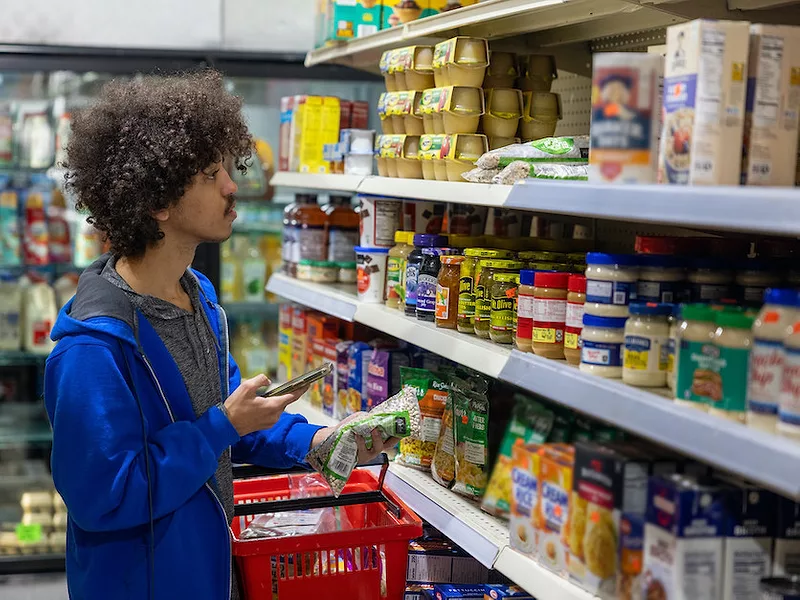
Tom Mulholland is in a time crunch.
New Supplemental Nutrition Assistance Program purchasing restrictions are set to take effect in Iowa on Jan. 1, and the independent grocer is only beginning to parse through the roughly 4,000 products on his shelves to figure out which apply. He’s not yet sure if the ban includes ice cream bars or potato chips, so he’s waiting on the Iowa Health and Human Services Department for clarification on those and other products he has questions about.
Unless his store’s software system gets an upgrade, Mulholland expects he and his staff will need to spend 20 hours or more “on the damn computer” typing out the 12-digit product codes for items subject to new restrictions and then checking boxes that classify these products as SNAP-ineligible. But first, he must compile a list of banned items, all while dealing with an influx of shoppers looking to buy turkey, ham and other year-end staples as the holiday season approaches.
“We’ve got two months to go, basically, and I’m nowhere near ready,” said Mulholland, who operates Mulholland Grocery in Malvern, Iowa. “And I’m betting that that’s the way most stores are.”
Retailers around the country are scrambling to figure out how to accommodate a wave of new SNAP restrictions limiting purchases of soft drinks, candy and other sugary products in a dozen U.S. states next year. Nine USDA-approved SNAP waivers are set to take effect in January, leaving grocers, supermarket operators and convenience store owners racing against the clock to become compliant, despite confusion over what items fall within the definitions for restricted products.
“We need more guidance from the states,” said Margaret Mannion, the director of government relations for the National Association of Convenience Stores. “I don’t think that our folks are getting the amount of information that they’re looking for. And as we get closer and closer to Jan. 1, those panic alarms are going off.”
Grocers seeking guidance amid confusion over definitions
Twelve states have officially secured USDA approval to bar SNAP recipients from using their benefits on soft drinks, while eight have done the same for candy, according to an Agri-Pulse analysis of federal and state documents. Florida has also gotten approval to restrict SNAP purchases of “prepared desserts,” which it defines as “processed, shelf-stable, ready-to-eat, pre-packaged sweet food intended for immediate consumption without any further preparation.”
Definitions vary significantly between states. Some restrictions apply to nearly all kinds of sweetened beverages, while others only apply to carbonated ones. Granola bars may be considered candy in some states, while in others, products containing flour — like Twix bars — are not.
Cut through the clutter! We deliver the news you need to stay informed about farm, food and rural issues. Sign up for a FREE month of Agri-Pulse here.
 Stephanie Johnson (LinkedIn photo)
Under the new rules, Stephanie Johnson, vice president of government relations and political affairs for the National Grocers Association, expects between 10,000 and 20,000 items to be restricted per state, at a minimum. Retailers will need to sift through their products, figure out which ones apply, and then flag those in their point-of-sale systems to ensure they can’t be purchased using SNAP dollars — but many are hesitant to even begin the process amid confusion over current definitions.
“I probably ought to be a little more proactive, but have been kind of sitting on the sidelines saying ‘surely they’ll decide these things,’” Indiana grocery and convenience store owner Mike Planalp said of SNAP officials in his state. “But it doesn’t seem like they’re going to.”
Planalp isn’t quite sure whether the restrictions apply to marshmallows, one of many products he says falls into a “gray area.” If stores were left to decide themselves, interpretations could differ, he said. This could frustrate customers who may not be able to use SNAP benefits on an item in one store only to discover another across the street that would allow that purchase.
"Our customers are coming in, they're going to be confused. We're going to be confused. And we're put in the role of being the enforcer on this, which I don't believe should be our job," said Planalp, who owns six Save-A-Lot food stores, a small independent grocery store and a convenience store.
Joe Lackey, the president of the Indiana Grocery and Convenience Store Association, has seen “mass confusion” among retailers trying to navigate the new restrictions. He said state officials have provided little guidance so far. Even he can’t quite figure out exactly what falls into the categories of a “soft drink” or “candy”.
“It’s a mess,” Lackey said.
Some states, like Oklahoma and Idaho, are making lists of specific products that will include barcode numbers for each, easing retailers’ burdens in trying to interpret the restrictions on their own, Johnson said. But others have signaled an unwillingness to do so, she added.
Shannon McCord, who owns Ideal Market in Superior, Nebraska, is thankful that his state is compiling its own product list. Without it, implementing the new SNAP requirements would be “1,000 times more expensive” for McCord, since he’d need to sort through the nearly 20,000 items on his shelves to piece together which are restricted.
“If they left it up to the individual store owners to figure out what’s allowable and what’s not, that would be a death blow to mom and pop stores,” McCord said.
Meeting new requirements to take money, labor
The costs of implementing waivers could add up, Mannion said. Piecing together which products are banned, integrating technology needed to limit purchases, and training staff to understand the new rules will require time, money and manpower — which small retailers in particular may struggle to provide, she said.
“You have to think about it from the mind of somebody who's not only the owner of the store, but they're HR, they're the checkout person, they're IT, they're the janitor,” Mannion said.
A report released by the National Grocers Association, the National Association of Convenience Stores and FMI-The Food Industry Association in September estimates that SNAP purchasing restrictions will require retailers to pay up to $1.6 billion up front for software upgrades, labor and other one-time costs. Maintaining compliance will cost around $759.1 million each year, according to the analysis, which was done by Timothy Richards of Badger Economics.
Updating point-of-sale systems — which enable grocers to ring up items, properly apply taxes, and track what customers have purchased — to ensure SNAP-ineligible products are flagged at the check-out line is one major factor behind these expected costs. Many retailers will not only need to pay one-time costs to have new software installed on their computers, but also for future software updates, according to the report.
Supercenters are expected to see the highest time and labor costs for upgrading point-of-sale (POS) systems. The report estimates that supercenters could pay for 200 hours worth of labor per store for first-time updates and 110 hours per week for ongoing upgrades. In comparison, small retailers are expected to pay for up to 40 hours of labor for initial updates per store and 20 hours per week for continued updates.
Although supercenters will pay more for the time and labor associated with system updates, the costs don’t change much in proportion to the size of the store. According to the report, many of these costs, including updating POS systems and hiring IT help, are fixed, which means small retailers will have to do the same amount of work to comply as larger retailers, but will have less revenue to absorb the expenses.
 Jeff Klaus (LiinkedIn photo)
As retailers scramble to update software systems, Jeff Klaus, general manager for Retail Data Systems, believes point-of-sale companies are likely to see more customers. He said most should be able to accommodate the changes easily, noting that several have already successfully revamped stores’ systems to comply with sales tax changes in certain states.
“We had to go through and redo all the taxation for hundreds of stores — and nobody even knows we’re doing it,” Klaus said, referring to Retail Data Systems’ work to change point-of-sale systems after Kansas removed a state sales tax on food earlier this year.
On top of buying software, the report suggests retailers will also need to pay to train their employees on the requirements, market the new rules to customers, and monitor their stores to ensure compliance.
Restricting products could lead to loss in sales for retailers
In addition to the added costs associated with implementing the waivers, store owners are also expecting to see sales of restricted products fall. While McCord, the Nebraska grocer, said SNAP purchases only represent around 5% of his sales, losing some of this business still could have an impact in a time when “money’s tighter than it's ever been.”
“It’s not a lot,” McCord said of his SNAP sales, but added that “when you’re dealing with a 1% profit margin, every little bit helps.”
According to the FMI, NACS and NGA report, supercenter operators expect to lose about $10,000 in revenue per store per week from lost sales due to the restrictions. Each supermarket, by contrast, is slated to lose an estimated $8,420 in weekly sales, while each convenience store is predicted to lose around $1,330 each week.
McCord also fears he may lose customers to what he calls “border bleed.” His store is located just three miles from the Kansas border, where a waiver has been proposed but not yet approved by USDA. With Nebraska’s restrictions set to take effect on Jan. 1, he worries locals will choose to buy groceries out of state.
“If a customer comes in and finds out they can’t buy their 24-pack of Coca Cola with their EBT card, then they’re just going to start shopping in Kansas for their groceries instead,” he said.
Mannion is also not sure whether restrictions would apply to online purchases from a store in a state without a waiver that are delivered to a state with a waiver. She called it a “compliance headache” and said NACS has asked USDA for additional guidance.
Both McCord and Planalp, the Indiana grocer, told Agri-Pulse they’d like to see the federal government impose uniform SNAP food restrictions nationwide, rather than letting states craft varying proposals. In the meantime, they’re hoping for more specifics on what products are covered as they rush to get their stores ready by Jan. 1.
“I just don’t know what the right thing to do is right now,” Planalp said. “And I don’t imagine in two months, I’m gonna know much more.”


