
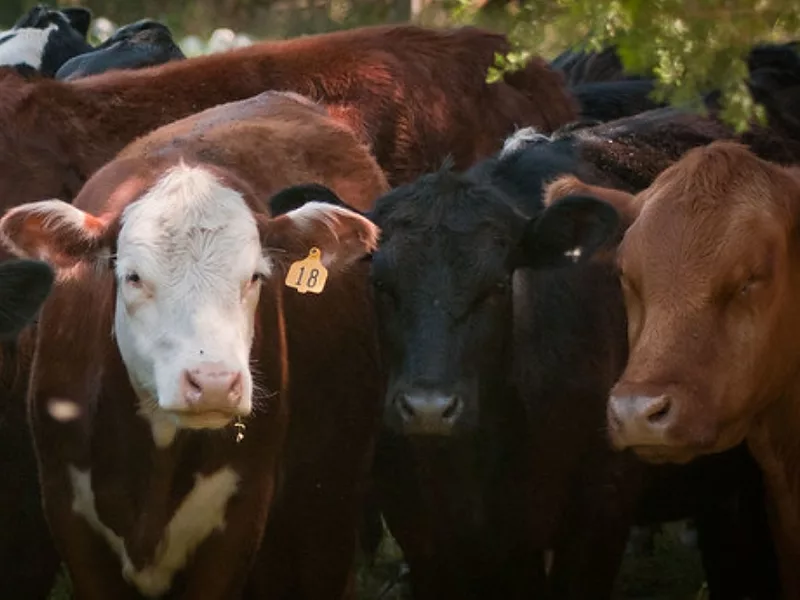
Trump’s beef comments spark market volatility, alarm producers
USDA rolled out its 13-page plan for boosting domestic beef production. It includes a broad mix of steps from expanding grazing on federal lands to reducing regulatory costs. Read about the plan here.
The plan’s release comes as the cattle industry is feeling the fallout from President Donald Trump’s suggestion the U.S. could import more beef to lower prices, and his strong comments directed at the sector on Wednesday.
“The president's remarks today, it definitely caught a lot of people off guard,” Kent Bacus, director of government affairs at the National Cattlemen’s Beef Association, said Wednesday evening. “It is not helpful when the president says things like that.”
The beef industry earlier this week pushed back on Trump’s idea to import more beef from Argentina. On Wednesday, the president said on Truth Social that the “only reason” ranchers are enjoying high profits is because of his tariff policies.
The fallout: Bacus said that cattle futures markets for both feeder and live cattle had fallen after the president’s comments. “Those are important risk management tools for us,” Bacus said during a panel discussion Wednesday, moderated by Agri-Pulse Publisher Sara Wyant. Bacus said the industry uses futures markets to hedge risk.
Accordingly, market volatility caused by the president’s comments is “very disturbing,” Bacus said.
 Kent Bacus (LinkedIn photo)
Ag negotiator hearing set for next week
Trump’s pick for chief ag negotiator in the Office of the U.S. Trade Representative, Julie Callahan, will appear before the Senate Finance Committee next Wednesday.
Callahan has been at the agency since 2016 and is currently assistant USTR for agricultural affairs and commodity policy. She’ll appear at the nominations hearing alongside Jeffrey Goettman, Trump’s pick for a deputy USTR.
Callahan has already been in contact with lawmakers and their offices. Finance Committee member Sen. Bill Cassidy, R-La., told Agri-Pulse his office has communicated with Callahan multiple times since her nomination and that he discussed how to protect Louisiana shrimpers from Indian imports.
Take note: Callahan may not pick up much Democratic support. Finance Committee Ranking member Sen. Ron Wyden, D-Ore., met with Callahan this month, according to an aide. The senator reportedly “communicated his frustrations about the administration’s lack of transparency and consultation with Congress on trade.”
For more on Julie Callahan’s trade priorities, revisit her remarks and Q&A with Agri-Pulse at this year’s Ag and Food Policy Summit, available here.
New EU proposal would only delay deforestation rules for small firms
The European Commission says that only small businesses will have until the end of next year to comply with new deforestation rules. The rules will apply to larger firms from the end of this year.
The EU’s environment commissioner had previously floated a one-year delay for all covered firms until the end of 2026.
Why it matters: Timber growers in the southern U.S. opposed the rules, which would apply to U.S. timber exports taken from land converted to ag uses.
But, but, but: U.S. forest owners are warning the delay and efforts to simplify the rules probably won’t apply to them. The small business delay only refers to businesses exporting to Europe directly. In the U.S., timber growers sell to larger companies that then export to Europe.
The adjustments also don’t exempt U.S. growers from additional reporting requirements.
Cut through the clutter! We deliver the news you need to stay informed about farm, food and rural issues. Sign up for a FREE month of Agri-Pulse here.
It is a “missed opportunity that fails to resolve the widely recognized challenges with the Regulation,” the National Alliance of Forest Owners said in a statement. “With these simplification proposals, the EU acknowledges the issues with the law but limits relief to EU-based operators.”
FSA offices to open today with partial service
Farm Service Agency offices are opening Thursday with “limited staff,” Kansas Farmers Union Executive Director Nick Levendofsky said Wednesday on a call including Kansas farmers and state Agriculture Secretary Mike Beam.
Separately, David Senter, president of the American Agriculture Movement, told Agri-Pulse he heard that each FSA office would be staffed by two people who would only be processing commodity program payments.
Both said they had heard from friends in FSA.
Ag Secretary Brooke Rollins said Tuesday that FSA would resume “core operations” and blamed Democrats for the now 22-day government shutdown.
Rep. Sharice Davids, D-Kan., who hosted the call, said the offices should have reopened earlier, but added that due to the shutdown, “Without crop or market reports, producers are being forced to make major financial decisions in the dark.”
New North Carolina map could make it tough for House Democrat Don Davis
A new congressional map approved by the Republican-controlled North Carolina legislature on Wednesday could make it even tougher for House Ag Committee Democrat Don Davis to hold on to his already-competitive seat in next fall's election.
The plan would add some Republican territory currently represented by Greg Murphy to Davis’s swing district, making it redder overall, according to an analysis by Larry Sabato’s Crystal Ball.
Davis, who had been in several tight races for the seat, called the new map “beyond the pale” in a statement released Tuesday after the bill had initially passed the North Carolina Senate.
Take note: Republicans and Democrats in other states like Texas, Missouri and California are also weighing redrawing their maps as both parties vie for control of the House.
U.S. biodiesel sector: Close tariff ‘loophole’
Clean Fuels Alliance America wants the administration to close what it calls a tariff “loophole” that allows biodiesel imports to skirt the new country-specific reciprocal tariffs.
In a letter to U.S. Trade Representative Jamieson Greer, the trade association says diesel and renewable diesel are treated the same under Trump’s tariffs and are subject to a carveout.
This exemption, Vice President of Federal Affairs Kurt Kovarik argues, is undercutting domestic biodiesel, renewable diesel and sustainable aviation fuel producers.
“We ask that you support U.S. biomass-based diesel producers and farmers by again modifying the order and imposing consistent tariffs on imported renewable diesel,” the letter reads. “Simultaneously, we ask that in trade negotiations you seek greater market access in global markets for U.S. biodiesel, renewable diesel, and SAF.”
Final word
"The USDA is supposed to be the front line of defense for producers across the United States, protecting against these threats, whether it be [New World screwworm], avian flu, African Swine Fever, or invasive fruit flies," a group of Democratic senators led by Senate Ag Committee Ranking Member Amy Klobuchar wrote to Deputy Ag Secretary Stephen Vaden on Wednesday. USDA's "department-wide reorganization plan could disrupt critical animal and plant health activities," they said.
Oliver Ward and Noah Wicks contributed to today’s Daybreak.


