
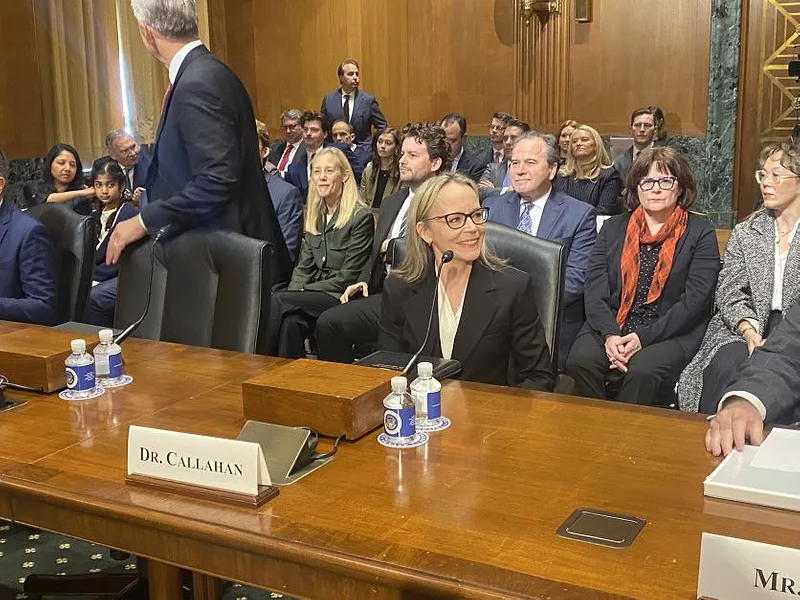
President Donald Trump’s pick to serve as the chief agricultural negotiator at the Office of the U.S. Trade Representative, Julie Callahan, told senators on Wednesday that the administration is seeking concessions in return for expanding a tariff-rate quota for Argentinian beef.
“Negotiations with Argentina are underway,” Callahan said during a Senate Finance Committee hearing for her and three other administration nominees.
The Trump administration has suggested that it could quadruple a 20,000-ton tariff-rate quota that allows Argentinian beef to enter the U.S. at a reduced duty rate. Callahan pointed out that Argentina maintains tariffs on U.S. beef, as well as non-tariff barriers that hamper exports.
“My intention in the negotiation with Argentina is this will not be a one-way conversation about beef. We would like to see beef access into Argentina as well,” she said.
Argentinian officials left a meeting with their U.S. counterparts earlier this month under the impression that a trade deal would be announced in the near future, according to reports in the Argentinian press.
But Callahan said she had no specific timeline for when the negotiations would wrap up.
Callahan has worked in USTR’s Office of Agricultural Affairs since 2016 and currently serves as assistant USTR for ag affairs and commodity policy, where she has been closely involved in U.S. ag trade policymaking across the three administrations.
Argentinian beef imports featured prominently in Callahan’s hearing for her new role, with multiple Democratic senators pointing to widespread industry opposition to the plan and concerns over lower Argentinian production standards. But Republicans also sought reassurance from the chief ag negotiator nominee on the plan.
“What assurances can you provide us that Argentine beef imports won't undercut prices for American ranchers?” Wyoming GOP Sen. John Barrasso asked Callahan.
Cut through the clutter! We deliver the news you need to stay informed about farm, food and rural issues. Sign up for a FREE month of Agri-Pulse here.
“My intention,” Callahan replied, is “to ensure that our agricultural trade deficits turn into surpluses and that U.S. cattlemen have access to markets around the world.”
The Argentinian beef issue also came up in a closed-door meeting on Tuesday between Senate Republicans and Vice President JD Vance, according to one senator who attended. Senators emphasized to the vice president that there are alternative courses of action that could help ease beef prices without relying on imports.
“We are hoping the administration will go after the packers – the monopoly of these packers that play a significant role in terms of the price,” Montana Republican Sen. Steve Daines told reporters outside the Finance hearing.
Sen. Roger Marshall, R-Kan., also told Agri-Pulse on Monday that he believes more could be done to address consolidation in the meatpacking sector.
“We have three packing plants that control about 80-90% of the industry,” Marshall said. “My ranchers are making $2.40 a pound, but we're selling it for $15 a pound. So, somewhere between the rancher and the grocery store, somebody's making a lot of money.”
Democrats also used Wednesday’s hearing to highlight the administration’s recent financial support for Argentina, arguing that the U.S. is helping a key competitor in global soybean markets. The assistance announcement landed last month as the country shipped around 20 shiploads of soybeans to China, rankling U.S. soybean producers.
In one of the livelier moments of Wednesday’s hearing, Democratic Sen. Elizabeth Warren, Mass., asked Callahan to acknowledge that U.S. soybean farmers are hurting because of Trump’s trade frictions with China and that Argentina had stepped in to provide China with soybeans during its U.S. purchasing freeze.
Callahan eventually agreed that China is buying soybeans from “Latin America,” but declined to name Argentina specifically.
“If you can't answer that question, I don't see how you can represent American soybean farmers,” Warren replied.
Callahan also fielded multiple questions on how the administration plans to use trade policy to benefit individual commodity producers. Sen. Maria Cantwell, D-Wash., pointed out that although Trump and Japanese officials announced a critical minerals deal during the president's Asia trip this week, and the two sides held discussions around finalizing a trade pact announced earlier this year, there have been no details published on whether the Japanese will reduce barriers to U.S. potato exports.
Trump’s chief ag pick said that the potato issue is one she is “personally familiar with” and that she is “committed to resolving” the issue.
A potato industry figure told Agri-Pulse earlier this month that they are aware the administration is pushing to get potato market access included in the Japan deal.
Callahan also indicated that she is concerned that U.S. lamb imports are undercutting U.S. producers and expressed an interest in reversing the domestic sheep industry’s long-running decline in U.S. market share.
“We have farmers – second- and third-generation farmers – that are at risk of losing their ranches,” Callahan said. “They're being outcompeted by imports.”
R-CALF, a trade association that represents U.S. sheep and cattle producers, has long pushed for using U.S. trade policy to support domestic sheep farmers. Most recently, it called on the Commerce Department to launch an investigation into the impacts on U.S. national security of relying on lamb and mutton imports.
Callahan also said in response to a question from Marshall that if confirmed she would look for increased export opportunities in new commodities and emerging value-added products, like soybean meal. U.S. production of soybean meal, which is a byproduct from crushing soybeans to process soybean oil, is growing as more soybeans are being used for biofuel production.
The U.S. needs to “maximize the products that we have,” Marshall stressed to Agri-Pulse after the hearing.
At times, Callahan also became a sounding board for senators to raise trade policy concerns that lie outside of her purview. Iowa Republican Chuck Grassley urged Callahan and Jeffrey Goettman, Trump’s pick to serve as a deputy USTR, to carry the message to their Commerce Department colleagues that the U.S. should lift countervailing duties on imported phosphate fertilizer to reduce the economic strain on farmers.
Similarly, Ranking Member Ron Wyden, D-Ore., said that he’d been hearing from farmers in his state that tariffs on inputs, from ag equipment to fertilizers, are contributing to rising costs.
“What are you doing about the tariffs that are jacking up input costs?” Wyden asked.
Callahan stressed that her priorities lie in getting as many individual tariff agreements with countries completed as quickly as possible.
“I understand the urgency of getting these agreements over the finish line rapidly, so that we can open opportunities for U.S. farmers and ranchers,” she said.
Wyden declined to answer a question from Agri-Pulse after the hearing on whether Callahan had done enough to secure his support.
For more news, go to Agri-Pulse.com.

