
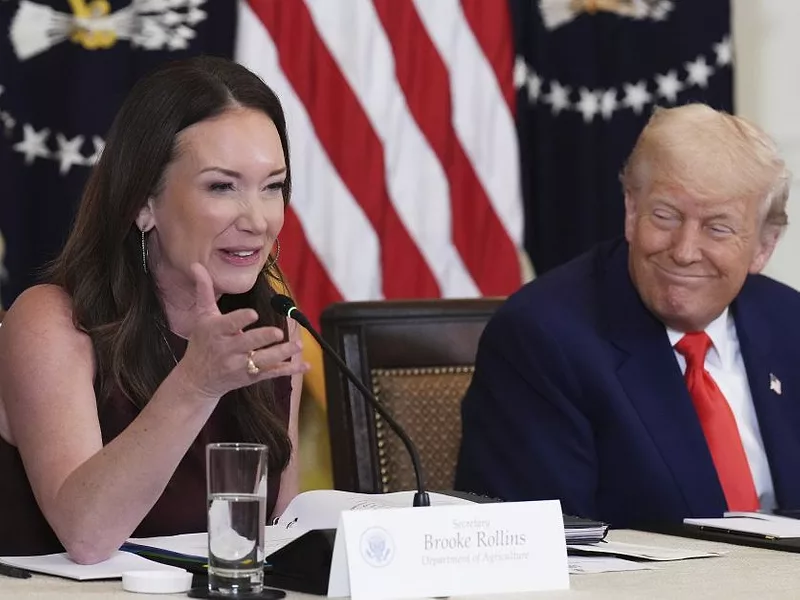
Agriculture Secretary Brooke Rollins said Thursday that beef imports from Argentina under an annual import quota could rise by four to five times current levels. A White House official told Agri-Pulse Argentina's tariff-rate quota would be raised to 80,000 metric tons.
In an interview on Fox News, Rollins said President Donald Trump is considering raising a tariff-rate quota that currently allows 20,000 tons of beef from the country to enter at a reduced tariff rate each year.
“The president has mentioned up to 100,000,” Rollins said, adding it could be “20,000 every quarter.” This would constitute a four or fivefold increase.
The White House official declined to provide a timeline for the announcement or to answer a question on whether the administration is seeking agricultural trade concessions from Argentina in return.
USDA did not immediately respond to Agri-Pulse's questions on the subject.
U.S. beef producers have been vocal in their opposition to increasing imported beef products to lower prices, prompting Trump to hit back in a pair of Truth Social posts on Wednesday.
In her Thursday morning interview, Rollins addressed the back and forth between the president and U.S. ranchers, arguing “there is frustration on both sides.”
“I was with the president yesterday and he is very, very frustrated because everything he’s done to cut taxes, to bring down costs,” Rollins said.
The administration on Wednesday rolled out a plan to boost domestic cattle production, rebuild U.S. inventories, and promote beef consumption – which did not include an announcement on increasing imports.
The plan was met with some support from the industry, but cattle groups on Wednesday continued to urge the administration to back down from its Argentina import plan.
“Rather than turning to risky imports, we urge the administration to support long-term solutions that preserve herd health, incentivize an expansion in domestic beef production and protect the livelihoods of American ranchers,” the Texas and Southwestern Cattle Raisers Association said in a statement.
Cut through the clutter! We deliver the news you need to stay informed about farm, food and rural issues. Sign up for a FREE month of Agri-Pulse here.
Rollins defended the Argentina import plan by pointing out that even if the country increased its low-tariff exports to 100,000 tons, it would only add a small fraction to overall U.S. beef imports.
“This is not a massive influx,” Rollins said. In 2024, the U.S. imported some 4.6 billion pounds of beef and veal. Argentina accounted for around 2% of those imports.
“I think everybody is way overreacting,” Sen. Roger Marshall, R-Kan., told Agri-Pulse on Wednesday. Even if Argentina were to receive a fourfold increase in its tariff-rate quotas, he added, “it won't even come near to replace the amount of beef we're not importing from Mexico – live cattle – because of the screwworm. Not even come close to it.”
Feeder cattle imports from Mexico are currently at a standstill because of a New World screwworm outbreak in the country. Mexican feeder cattle imports remained in line with recent annual averages in 2024, the last full year of data, despite a five-week border closure at the end of the year. They were, however, down around 60% year-over-year from January to May of 2025.
Marshall also argued that much of the imported U.S. beef does not compete with domestic producers because it is lower-quality meat destined for products like hamburgers.
“We don't have a lot of hamburger to meet the needs, so we have to import some from somewhere,” Marshall said. “So, I don't understand why the markets are overreacting.”
Glynn Tonsor, a professor in Kansas State University’s department of agricultural economics, agreed that if the increase in Argentinian imports is limited to the expanded quota volumes, it would have only a small impact on U.S. prices. Once the market adjusts, he said, some of the added imports from Argentina will likely displace other countries' products, softening any impacts on domestic producers further.
Sen. Deb Fischer, R-Neb., told Agri-Pulse on Thursday that even if the administration is only lifting the TRQ to 80,000 metric tons, she's still anxious.
"I'm just really concerned," Fischer said. "I hear from my cattle ranchers how worried they are and concerned about it," she added. "We feel it's not the way to go."
Senate Ag Committee Chair John Boozman, R-Ark., also said he has texted with Rollins on the issue in recent days.
"She's looking at this very hard," Boozman said.
Tonsor charged that the administration's focus on supply-side causes of soaring beef prices misses many of the demand-side factors that are driving soaring beef prices, including a more favorable views of high-protein diets among consumers, falling rates of vegetarianism and veganism, and the rising popularity of weight-loss drugs.
"Public demand is strong. So we should expect prices to be higher when the public values something, and they're bidding more for it," Tonsor said in an interview. "Most people are not acknowledging the strong consumer demand part."
Lydia Johnson and Philip Brasher contributed to this report.

