
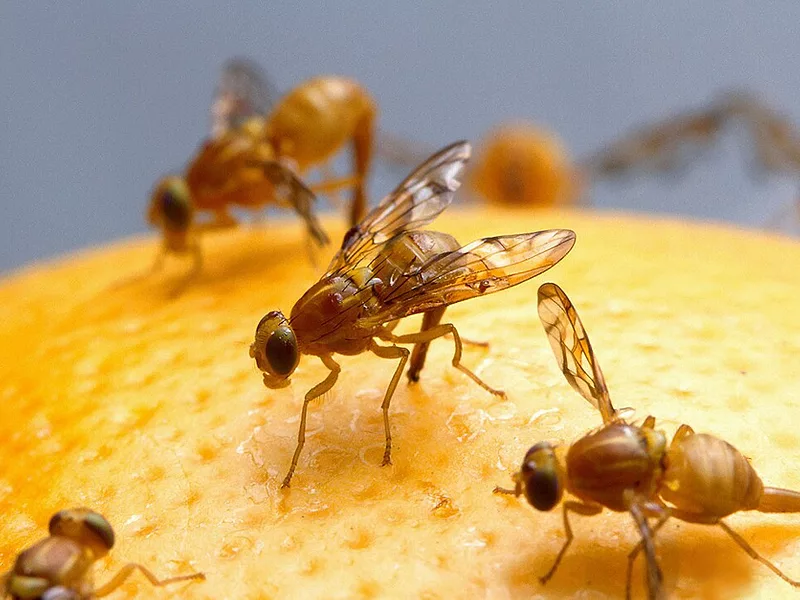
California agriculture is once again bracing for invasive fruit fly incursions as new quarantines follow last year's sweeping eradication victories. For growers, the surge is raising concerns that California’s shift away from conventional chemistries could narrow emergency options as climate change accelerates pest threats.
The state recently navigated its largest invasive fruit fly outbreak in history. According to the California Department of Food and Agriculture, the 2023 breeding season saw 957 detections, up from 109 in 2022 and 60 in 2021, including first-ever U.S. detections of Queensland and Tau fruit flies. University of California research estimates oriental fruit fly establishment could lead to $44 million to $176 million in crop losses and broad trade impacts.
Officials ultimately eradicated the outbreaks, but the response exposed capacity strains and a system vulnerable to climate-driven repetition. More than $24 billion in California commodity value is considered at risk.
 Casey Creamer, Citrus Mutual (Brad Hooker/Agri-Pulse photo)
Quarantines return amid climate-driven pest pressure
California and USDA lifted large quarantine zones in 2024, only to impose new ones in Southern California and the San Francisco Bay Area after the return of the Mediterranean fruit fly and the first detection of the Caribbean fruit fly in 40 years.
The pattern reflects what growers describe as a new baseline of persistent, travel-driven and climate-enabled incursions.
“It feels like the last three years we've been on this fruit fly,” said Casey Creamer, president of California Citrus Mutual, in an interview. “We saw virtually none of these pests coming into California during the shutdown with COVID. We have some of these every year, but the pace and the scale of them have gotten bigger.”
Quarantine rules require compliance agreements, sanitation, fruit processing and movement controls — critical for trade but disruptive to harvest logistics.
“We start to get really concerned as they get closer and closer to commercial citrus production,” said Creamer.
Don’t miss a beat! It’s easy to sign up for a FREE month of Agri-Pulse news! For the latest on what’s happening in Washington, D.C. and around the country in agriculture, just click here.
State officials say response speed will only grow more critical as warming conditions accelerate fruit fly lifecycles and expand habitat into northern counties and higher elevations.
Long-running tension over tools
California’s eradication program largely relies on sterile insect techniques and ground-applied protein baits mixed with Spinosad, a naturally derived compound widely adopted in organic systems.
 Matthew Allen, Western Growers (Brad Hooker/Agri-Pulse photo)
The rise in detections has renewed attention to state legislation and regulations that have limited the use of critical pest control tools. One of the latest bills to do so, Assembly Bill 363, signed into law in 2023, banned most nonagricultural neonicotinoid uses starting this year.
Matthew Allen, vice president of state government affairs for Western Growers, told Agri-Pulse that “it is concerning we just don't have a tool in use that would help to suppress” invasive insects in general within residential orchards, where most of the fruit fly detections have originated.
More than a dozen agricultural associations opposed AB 363 and negotiated exemptions for certified applicators and for local emergencies and quarantines. Yet the author, Assemblymember Rebecca Bauer-Kahan, D-Orinda, rejected calls to amend the language so that the Department of Pesticide Regulation would only set new rules if the scientific review warrants them.
Environmental groups backing the measure argued consumers are unwittingly turning their gardens into “bee death traps” and that DPR has moved too slowly to curb the use of neonicotinoids.
Prevention vs. suppression
In a statement to Agri-Pulse, CDFA Plant Health and Pest Prevention Services Director Victoria Hornbaker noted that the department does not use neonics in fruit fly programs, relying instead on sterile release for Mediterranean and Mexican fruit flies as well as for navel orangeworm and on biocontrol for Asian citrus psyllid, pink hibiscus mealybug, glassy-winged sharpshooter and various weed species.
Creamer said sustained investment in inspection and parcel screening systems, among other prevention efforts, is critical as travel and e-commerce increase vector pathways.
“You can spend money on prevention or you can spend money on dealing with the problems,” he said. “For the last two or three years, we've spent way more money on trying to eradicate fruit flies than we have on suppressing them in the first place.”
He pointed to programs like Don’t Pack a Pest and homeowner citrus disease outreach as vital, since backyard trees and unsanctioned fruit movement continue to seed outbreaks near commercial acreage.

