
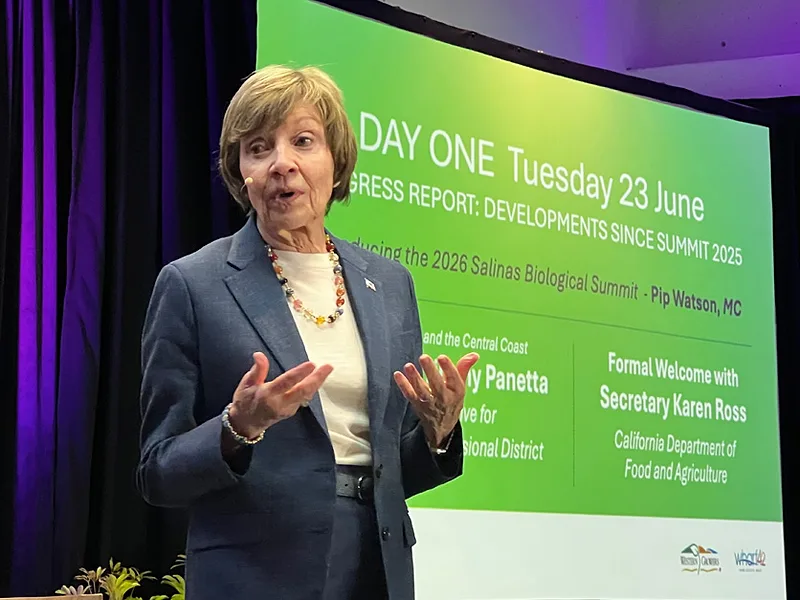
California agriculture must move faster to develop and deploy biological pest control tools as invasive species, climate change and the loss of conventional products put more pressure on growers, Karen Ross, secretary of the California Department of Food and Agriculture told a crowd of farmers, entrepreneurs and researchers gathered at the Salinas Biological Summit on Tuesday.
“Finding more tools at a time when there’s more pressures is absolutely fundamental to what we do,” Ross said, framing biologicals as part of a broader effort to protect farm productivity, ecosystems and rural communities.
Ross traced the challenge to her early career, when she helped explain aerial malathion treatments during a Mediterranean fruit fly outbreak in Los Angeles. More than three decades later, she said California still depends on prevention, early detection and rapid response while confronting new pests, longer pest seasons and public concern about unfamiliar control practices.
That makes trust especially important when eradication efforts extend beyond farms into urban communities, Ross said. Agencies must improve their science and field practices while explaining why interventions are needed.
Cut through the clutter! We deliver the news you need to stay informed about farm, food and rural issues. Sign up for a FREE month of Agri-Pulse here.
Ross highlighted CDFA’s revived Biologically Integrated Farming Systems and Biologically Integrated Orchards Systems grants, which support on-farm research involving growers, pest control advisers and cooperative extension. Applications have increased significantly, she said.
She also pointed to CDFA’s adaptive integrated pest management work and support for the IR-4 Project, which helps move crop protection products toward registration for specialty crops. Ross said USDA has paused IR-4 funding and called the program crucial despite its low profile.
“They’re not the big sexy dollars that get a lot of attention, but they’re on the ground, they’re equipping our farmers and ranchers,” she said.
Ross cited more than $690 million invested through California climate-smart agriculture programs covering soil health, water-use efficiency, livestock methane reduction, energy efficiency and replacement of older farm engines.
She said CDFA and research partners are aligning priorities through the California Agricultural Research & Innovation Program, with pest management, soil, water, biomass and automation among its focus areas.
Ross closed by noting that $20 million from the state’s $10 billion climate bond will support the California Invasive Species Council. CDFA will oversee the funding as agencies seek safer and more economical responses to pests.
“Not one of those solutions will happen because we created policy or heavy body building reports,” Ross said, making light of the heft of new reports from the department. “They are about working in partnership with our academic institutions, with our workforce and with partners across the country and around the world.”

