
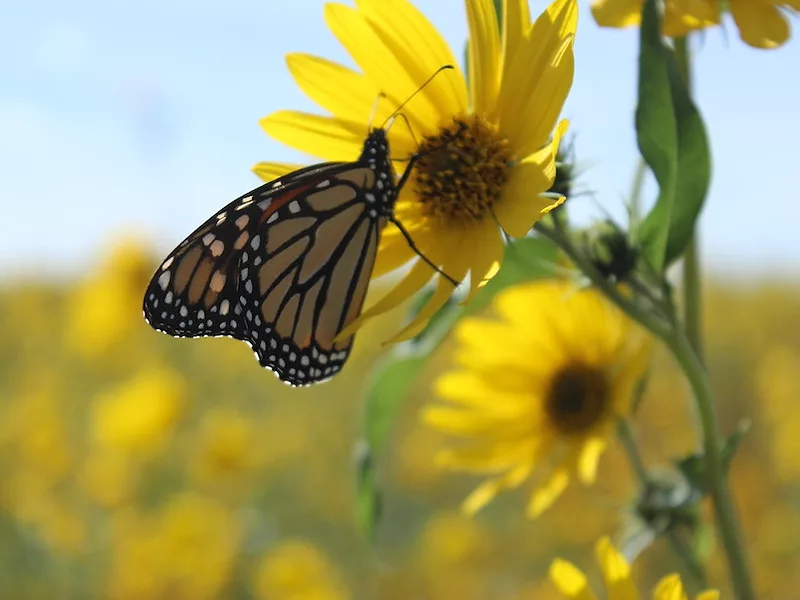
A proposal to list the monarch butterfly as threatened under the Endangered Species Act is not likely to be finalized any time soon, experts say.
The Fish and Wildlife Service issued its proposal to list the monarch butterfly as threatened last December under a deadline set in a legal agreement with environmental groups. The proposed listing suggested exempting several agriculture-related activities from the ESA’s prohibition against species “take,” including livestock grazing, rangeland haying and fire management.
Nearly a year has since passed. Jessica Fox, executive director of Fox Strategies and Consulting and the creator of the ‘Power in Pollinators' initiative, said at the recent Family Farm Alliance conference in Reno, Nevada, that the proposal “is on deck to be one of the largest rulemakings in ESA history.” But she said she is skeptical that a final rule will be released in December.
Under the text of the ESA, FWS is generally supposed to finalize listing determinations and regulations within one year of an initial proposal.
“It's not going to be finalized in December,” Fox said. “The rulemaking may not be finalized in this entire administration, but the issue will come back around again.”
 Jessica Fox (LinkedIn photo)
She added that the service's conclusion that the monarch deserves to be listed under the ESA is “not likely to change at this point."
Since the 1980s, the butterfly’s eastern migratory population has declined by about 80%, while the western migratory population has dropped by more than 95%, “putting the western populations at greater than 99% chance of extinction by 2080,” according to a FWS news release.
According to the proposed rule, the main threats to the two populations come from habitat loss. Eradication of milkweed, on which the monarch lays its eggs, has also been a threat, it says.
While the rule would allow some on-farm activities that disrupt milkweed to continue, FWS’s proposal emphasizes coordination with states to develop “large-scale conservation” plans encouraging landowners to add and maintain milkweed and nectar plants on their land. It also suggests programs offered by the USDA Natural Resources Conservation Service and Farm Service Agency could help bolster habitat for the species.
Fox added that it’s not yet clear whether FWS will also look at pesticide use under the ESA rulemaking or if the Environmental Protection Agency will do it under the Federal Insecticide, Fungicide and Rodenticide Act. The proposed rule had sought comment on how pesticide use should be addressed.
Fish and Wildlife Service California-Nevada Regional Director Paul Souza could not attend the Family Farm Alliance conference but submitted remarks that were read onstage by former Klamath Water Users Association Executive Director Paul Simmons. While Souza’s remarks pointed to the challenges posed by the monarch’s decades-long declines, they emphasized that the agency wants to cooperate with agricultural producers to reverse the trend.
“The monarch butterfly offers another wonderful opportunity to showcase how farmers and ranchers lead the way in conservation,” Souza’s statement said. "My agency can use creative approaches to the ESA, such as 4(d) and conservation benefit agreement[s].”
The 4(d) rule allows FWS to issue regulations it deems "necessary and advisable" to protect threatened species, offering the agency some flexibility to tailor its approach to each at-risk species it seeks to preserve. In the case of the monarch rule, FWS's proposal suggests using 4(d) to incentivize landowners to create new habitat without the fear of unintentional ESA violations.
Conservation benefit agreements commit property owners to help conserve a species in exchange for assurance from the Fish and Wildlife Service that it will not mandate they change their management activities without consent.
Don’t miss a beat! It’s easy to sign up for a FREE month of Agri-Pulse news! For the latest on what’s happening in Washington, D.C. and around the country in agriculture, just click here.
The Center for Biological Diversity, the Center for Food Safety, the Xerces Society for Invertebrate Conservation and Lincoln Brower, an entomologist, submitted an initial listing petition to FWS in 2014. It wasn’t until 2020 that the agency published a 12-month finding that said listing was "warranted” but “precluded by higher priority actions,” according to a notice it published at the time.
A year later, the Center for Biological Diversity filed a lawsuit accusing FWS of “dragging its feet” regarding listings of 10 species, including the monarch butterfly. In accordance with a 2022 settlement, FWS released its listing proposal in December 2024.
However, Fox noted that legal deadline applied to the proposal and not the final listing. While she said stakeholders are looking to December to see whether a final rule is released, she questioned that it would be done by then, noting that there is no current legal deadline requiring FWS to finish it.
“What they were legally required to do was to propose the listing,” she said. “There is no legal hook any longer for Fish and Wildlife Service to finalize the listing. So, it could sit there a really long time and nothing could happen with it.”
 Kari Fisher (LinkedIn photo)
In an email to Agri-Pulse, Jonathan Wood, the vice president of law and policy at the Property and Environment Research Center, pointed out that a final monarch rule does not appear on the spring 2025 agency rule list published by the White House Office of Management and Budget.
"That's a signal that FWS isn't actively working on it and doesn't have an internal deadline,” Wood said.
At the conference, Kari Fisher, senior counsel for the California Farm Bureau, said a conservation benefit agreement is in development, but emphasized that “nothing is finalized.” She said it could clarify coverage for California producers under both the Federal ESA and the California Endangered Species Act.
Under the agreement, landowners would have to conduct certain land management activities, like establishing pollinator habitat, to receive take coverage, Fisher said. She noted that ten pollinator species in California, including monarchs, would be included.
“This isn’t just a monarch issue,” Fisher said. “This is a pollinator issue in general."

