
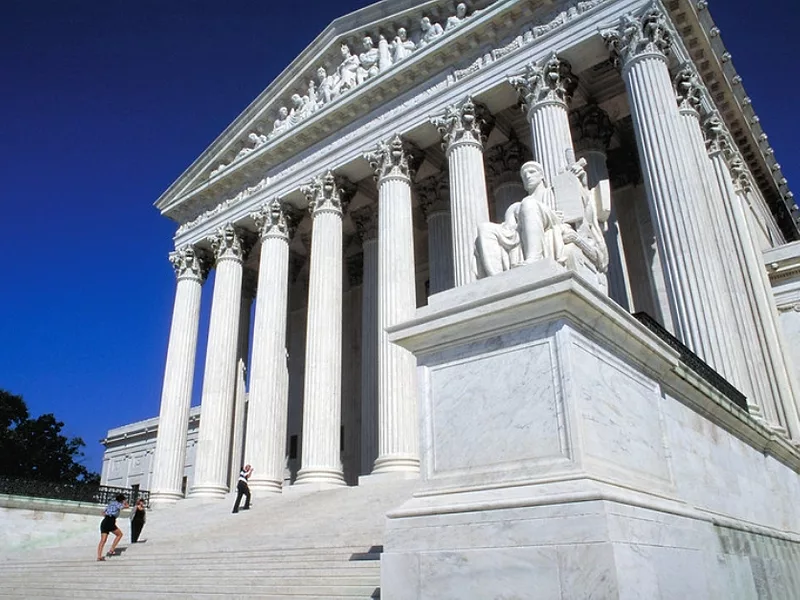
The Supreme Court will hear oral arguments today in a historic case challenging the president’s use of emergency powers to impose tariffs. Ahead of the hearing, Treasury Secretary Scott Bessent reiterated that the tariffs serve a legitimate national security purpose.
“It’s a matter of national security,” Bessent told CNBC Tuesday. “And this is one of the president’s signature policies. It’d be very unusual for the Supreme Court to overrule a president’s signature policy.”
Why it matters: One of the legal theories the case could hinge on is the “major questions” doctrine – the idea that Congress must be explicit when it delegates powers used to make major economic policies.
The Justice Department will argue that this doctrine has never been applied to national security or foreign policy matters.
Take note: Even if the tariffs are struck down, Bessent and others are already signaling they could use other powers to reimpose many of the tariffs.
“I think you would see greater uses of 301 and 232 tariff process,” Iowa GOP Sen. Chuck Grassley said Tuesday, referring to two alternate tariff statutes. Both require an investigation, however, and take longer than emergency powers to impose duties.
But, but, but: President Donald Trump’s critics are also ready for what comes next. Senate Ag Committee Ranking Member Amy Klobuchar, D-Minn., said Tuesday that she anticipates further “misuse” of tariff statutes if the court rules against the president.
During an event hosted by Farmers for Free Trade on the National Mall, she pledged to fight Trump tariff policy “in court, we fight it in Congress, and we are fighting it with our constituents.”
Bangladesh to ramp up soybean imports
Five Bangladeshi companies say they’ll buy around $1.25 billion of U.S. soybean products over the next year. That’s up from around $350 million in 2024.
In a statement, the U.S. Soybean Export Council, or USSEC, which inked the deal with the five companies, said Bangladesh is the strongest market for U.S. soybeans in South Asia.
USSEC CEO Jim Sutter touted the deal’s potential for new partnership opportunities between “Bangladesh’s industries and U.S. soy.”
Updated market access tracker
President Donald Trump returned from a whirlwind Asia trip last week with several new trade deals in tow and having made progress on multiple ongoing trade negotiations. Check out this week’s newsletter for an updated breakdown of all the deals’ agriculture measures.
SNAP partial funding plan has states scrambling
Cities and nonprofits whose lawsuit led to USDA’s decision to disburse partial SNAP benefits for November are asking a federal judge in Rhode Island to force the department to provide full benefits.
Don’t miss a beat! It’s easy to sign up for a FREE month of Agri-Pulse news! For the latest on what’s happening in Washington, D.C. and around the country in agriculture, just click here.
They filed a motion Tuesday with U.S. District Judge John McConnell Jr., who set a hearing on the matter for Thursday.
“[I]t is now clear that due to defendants’ course of conduct, and by their own admission, undertaking a partial payment plan at this point cannot meet the court’s directives or adequately remedy the harm plaintiffs are suffering,” they said in their court filing. They said McConnell should “temporarily enjoin and compel defendants to release the withheld funding, in its entirety, for November SNAP benefits.”
McConnell ordered USDA to provide at least partial benefits for November, and USDA issued guidance Tuesday to states. But in many cases, states are using antiquated computer systems to implement the partial funding plan and implement new SNAP work requirements contained in the One Big Beautiful Bill Act.
Read more in our story on Agri-Pulse.com.
Agri-Pulse photos from Farmers for Free Trade event. The group concluded its 11-state RV tour on the National Mall in Washington, where farmers spoke on the challenges incurred by new U.S. tariffs.
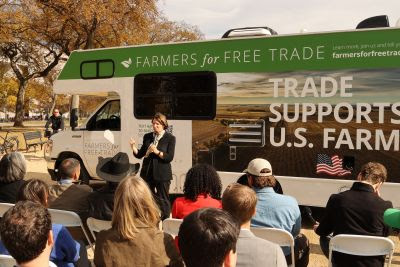 Sen. Amy Klobuchar at the Farmers for Free Trade event.
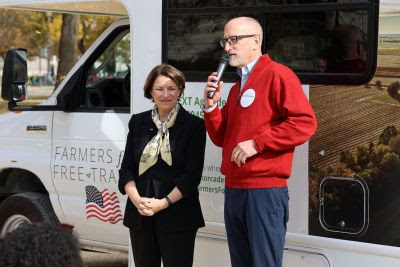 Klobuchar and Farmers for Free Trade Executive Director Brian Kuehl.
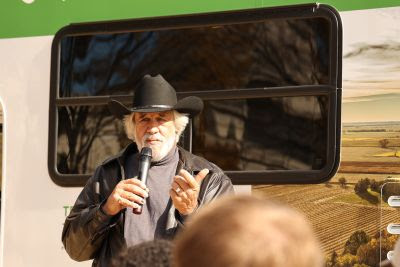 Ohio farmer Chris Gibbs speaking at the Farmers for Free Trade event.
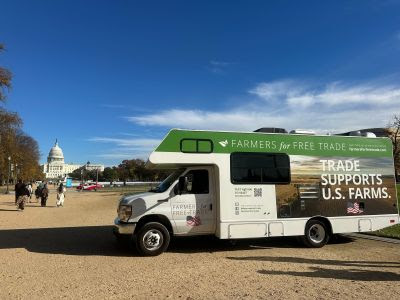 The Farmers for Free Trade RV on the Mall in Washington (Photos: Oliver Ward and Parker Litterick)
Shutdown sets a record (and it’s not a good one)
The government shutdown is officially the longest ever as of today, even as Democrats wrestle in private on a possible path forward.
“We’re exploring all the options,” Senate Minority Leader Chuck Schumer, D-N.Y., said after an extended closed-door meeting with his colleagues Tuesday.
“We’ve been asking for months for Trump to get involved and he hasn’t been. The fault of the shutdown falls on his shoulders. He’s refused to discuss anything.”
Other Democrats were saying relatively little about the discussions. “No updates. In process,” Sen. Tim Kaine, D-Va., told reporters outside the Capitol’s LBJ Room, where the senators were meeting.
By the way: Sen. John Kennedy, R-La., doubts Democrats would end the shutdown for the promise of a vote on Affordable Care Act subsidies and no guarantee to extend them. He said Democrats would lose the vote and come away with nothing. “I’ve got to see it to believe that Schumer will let them throw in the towel,” Kennedy said.
Hormel to cut 250 jobs as part of restructuring
Minnesota-based Hormel Foods announced Tuesday that it’s cutting 250 corporate jobs as part of a restructuring effort.
A Hormel press release said the restructuring “reflects the company’s ongoing focus on balancing cost discipline with reinvestment in areas in areas critical to its future.”
Hormel Foods president John Ghingo says the company "remains focused on growth – and growth requires continued investment."
Interim Hormel CEO Jeff Ettinger says “each person who is leaving has contributed to our organization, our culture and our success” and that the company is “grateful for everything they’ve done.”
Swifter action on climate change needed, UN says
National goals to reduce greenhouse gas emissions worldwide “have barely moved the needle,” the United Nations said Tuesday.
“Nations remain far from meeting the Paris Agreement goal to limit warming to well-below 2°C, while pursuing efforts to stay below 1.5°C,” the UN Environment Program said.
“Available new climate pledges under the Paris Agreement have only slightly lowered global temperature rise over the course of this century, leaving the world heading for a serious escalation of climate risks and damages,” the U.N. said, summarizing the report.
The Paris climate agreement set a goal of limiting temperature rise to 1.5°C, or 2.7°F, above pre-industrial levels by 2100. The Intergovernmental Panel on Climate Change says beyond that level, the effects of climate change would be much more severe.
Final word
“Costs are what's killing agriculture … One of those increased costs is the tariff increase that have come from the parts, the machinery, the raw materials that I use as a producer.” – Ohio farmer Chris Gibbs, speaking at the Farmers for Free Trade event, where he also said, “Right now we are underwater in corn and soybeans.”
Philip Brasher, Oliver Ward and Noah Wicks contributed to today’s Daybreak.


