
Tuesday is a federal holiday to honor our veterans, so Daybreak will not be published.
The longest government shutdown in history is nearing an end after Senate negotiators agreed on a new stopgap spending bill. The Senate voted Sunday night to advance the legislation, clearing the path for approval, despite the opposition of most Democrats.
The bill also takes care of some unfinished business important to ag and food policy. The legislation includes the fiscal 2026 funding bill for the Agriculture Department and Food and Drug Administration. Most of the rest of the government will only be funded through January under the legislation.
Also in the bill is a one-year extension of expired farm bill programs.
Take note: Senate Democrats had demanded that Republicans agree to an extension of expiring Affordable Care Act insurance subsidies. But all they got out of Senate Majority Leader John Thune, R-S.D., was a promise to hold a vote on the issue in December.
Sen. Adam Schiff, D-Calif., called the deal to reopen the government “a setback.”
“From my point of view, it was about fighting for two things, fighting for affordable health insurance for people and also fighting for a language in the bill that would prevent them from violating the agreement later, by rescissions and impoundments [of congressionally approved funding],” he said.
For more on the spending deal and the FY26 USDA-FDA spending bill, go to Agri-Pulse.com.
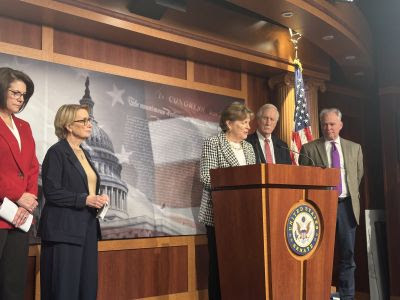 Five of the key eight senators who voted on Sunday night to advance a stopgap measure to reopen the government: (L to R) Catherine Cortez Masto, D-Nev.; Maggie Hassan, D-N.H.; Jeanne Shaheen, D-N.H.; Angus King, I-Maine, and Tim Kaine, D-Va. (Agri-Pulse photo)
SNAP benefits remain stayed; USDA tells states they’re responsible for ‘unauthorized’ payments
The Trump administration ordered states late Saturday to halt distribution of full Supplemental Nutrition Assistance Program benefits.
USDA Deputy Undersecretary for Food, Nutrition and Consumer Services Patrick Penn told state SNAP directors in a memo that “states must immediately undo any steps taken to issue full SNAP benefits for November 2025.”
Some states had done that after a district judge ordered USDA Thursday afternoon to make the funding available, but before the Supreme Court stayed the lower court’s orders late the next day.
USDA had promptly appealed to the 1st Circuit Court of Appeals Thursday but did not seek an emergency stay of U.S. District Judge John McConnell’s order until Friday morning. Later on Friday, Penn issued a memo saying USDA was “working towards” providing full benefits.
The memo to states “made no reference whatsoever either to its appeal of the District of Rhode Island’s temporary restraining orders or to its motion to stay those orders pending appeal,” said a letter to the court on Sunday, signed by Andrea Joy Campbell, attorney general of Massachusetts.
Acting in response to the district judge’s order, the state of Wisconsin acted to get full benefits activated on EBT cards at just past midnight Friday.
The government said no states should have acted based solely at McConnell’s direction.
The district court’s order requiring payment of full benefits remained stayed by the Supreme Court late Sunday evening. Justice Ketanji Brown Jackson issued the order, allowing the appeals court to resolve the government’s motion pending appeal.
Trump floats tariff ‘dividend’
President Donald Trump says that all Americans, excluding the highest earners, could receive at least a $2,000 tariff “dividend.”
In a post to Truth Social on Sunday, the president reiterated a previous pledge to widely distribute tariff revenues, even as the Supreme Court weighs the legality of his new duties.
Tariff revenues ballooned to $195 billion during the fiscal year ending Sept. 30, more than doubling the previous year’s total of $77 billion. But Trump and other officials have also suggested the revenue could be used for several policy goals including:
Paying down the almost $38 trillion in U.S. debt – which Trump also said was a priority in his Sunday social media post.
Funding tariff support for farmers.
Paying military salaries and topping up food nutrition program funding during the government shutdown
Directing refund checks to Americans.
Cut through the clutter! We deliver the news you need to stay informed about farm, food and rural issues. Sign up for a FREE month of Agri-Pulse here.
Arkansas lawmakers: Delay EU trade pact adoption over deforestation rule
Arkansas’ congressional delegation is urging administration officials to hold off on implementing Trump’s trade pact with the European Union over concerns about its upcoming deforestation rules.
Starting January, large and medium-sized companies will have to prove their supply chains for a variety of commodities, including timber, are deforestation-free to access the EU market. Smaller companies will have an extra year to comply.
But, but, but: In the U.S. timber industry, large exporters buy product from landowners and smaller firms, meaning much of the industry will be subject to the new regulations from the end of the year.
As part of the EU-U.S. trade pact negotiated this summer, the EU agreed to work to address U.S. concerns that the regulations would impose new compliance burdens on U.S. firms and growers.
“Despite the European Commission's Oct. 21st statement, which recognizes the negligible risk of U.S. timber production to global deforestation, the EU has made no significant reform to the regulation and is speeding up the timeline for implementation,” the lawmakers warned in their letter to U.S. Trade Representative Jamieson Greer.
Ag Committee Chair John Boozman, R-Ark., was among the signatories.
Bayer goes after ‘pseudoscience’ in new campaign
Bayer says it’s launching a U.S. campaign to push back on “fearmongering and pseudoscience.”
The initiative, dubbed “Science Delivers,” encourages Americans to challenge misinformation and focus on the power of evidence-based knowledge. The campaign comes as Bayer faces a raft of litigation against its glyphosate-based weedkiller Roundup, costing the ag technology giant billions of dollars and causing it to consider ceasing production.
Bayer says claims that glyphosate, the world’s most widely used pesticide, causes cancer are without merit and at odds with decades of scientific studies.
Final word
“This bill doesn’t do anything to arrest the healthcare catastrophe in any meaningful way.” – Sen. Chris Murphy, D-Conn., after voting against the continuing resolution.
Philip Brasher and Oliver Ward contributed to today’s Daybreak.


