
The World Bank is doubling down on agriculture’s potential as a global development vehicle in hopes that greater investments in smallhold farms will boost jobs, prosperity and food security in emerging economies.
Analysts see the move as a return to tried-and-tested development methods after several decades of agriculture playing a smaller role in global development.
A smallhold farm is a small-scale farm typically ranging from less than two and a half acres to around 25 acres.
“Agriculture has always been central to development,” World Bank President Ajay Banga said during the bank’s annual meetings in Washington last month. “The challenge is, how do you make it a driver of jobs? How do you make it a driver of income and how do you get to food security at scale?”
At the meeting, Banga launched the bank’s latest development initiative, known as AgriConnect – an effort to implement his pledge to double the bank’s annual investment in agribusiness to $9 billion by 2030. The initiative will see the bank partner with the Inter-American Development Bank, African Development Bank, the International Fund for Agricultural Development (IFAD) and private companies like Bayer to boost productivity and incomes and protect farmers from exploitation.
AgriConnect, Banga said, will help address the gulf between the 1.2 billion young people set to reach working age across developing economies in the next decade and the 400 million jobs set to be created.
The effort will feature three pillars of focus, Banga added: improving infrastructure, policy adjustments and mobilizing private capital to magnify the bank’s investments.
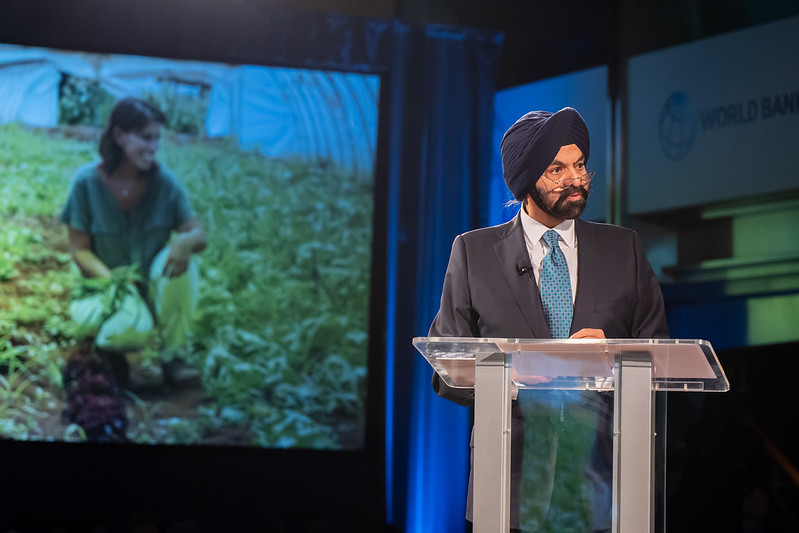 Ajay Banga speaks at an event in Washington last month launching AgriConnect (World Bank photo)
Several industry heavy hitters are backing the initiative. Last month's Washington event featured Alphabet and Google President Ruth Porat and Bayer CEO Bill Anderson. Bayer signed a memorandum of understanding to boost its regional processing capacity of climate-resilient seeds, develop crop insurance options and offer skills training.
Analysts say the effort to move smallholder farmers back to the center of international development represents a return to form that holds promise for global development, as long as the initiative avoids several pitfalls.
A back-to-basics approach
The Green Revolution of the 1960s and 1970s saw many developing economies adopt new plant breeding techniques from internationally funded agricultural research centers, spurring an increase in global standards of living.
The economic benefits spread far beyond agriculture. Research from Douglas Gollin, a development economics professor at Tufts University, and others finds that a10% increase in the adoption of high-yield crop varieties led to 10-15% gains in per capita GDP.
“The Green Revolution, in many ways, was the original effort at smallholder-agriculture-based economic development for both poverty reduction and to stimulate the structural transformation of low-income agrarian economies,” said Chris Barrett, a professor of applied economics and management at Cornell University.
In Barrett’s telling, the global development community has shifted its focus from smallholder farmers in the intervening decades.
Food prices fell substantially and the share of the malnourished global population plummeted. This progress, Barrett said in an interview with Agri-Pulse, led to complacency from international bodies.
“Governments just stopped making an effort to stimulate agricultural development in the global south,” Barrett said – instead, focusing on manufacturing industries and institution building.
“The World Bank is returning to prioritizing domestic agricultural productionmarkets,” Barrett added. “That is a recipe that has worked well in the past,”
It’s easy to be “in the know” about what’s happening in Washington, D.C. Sign up for a FREE month of Agri-Pulse news! Simply click here
Gollin, the Tufts University professor, told Agri-Pulse that the initiative also goes beyond previous efforts focused on smallhold farmers with a new focus on “commercialization.”
In his Washington presentation, Banga said that AgriConnect seeks to give farmers tools to turn yield and production growth “into a business that produces higher incomes for smallholder farmers and more opportunity across entire economies.” Put differently, he wants farmers to be able to scale.
This breaks with past efforts, Gollin said. Previous initiatives sought to address food security by supporting local farmers to meet local needs. A new focus on scale and commercialization among smallhold farmers, he added, is more “capital intensive” and advances a line of thinking that acknowledges the role trade can play in supporting development and food security.
 Douglas Gollin (Tufts University photo)
Avoiding pitfalls
Colin Christensen is the global policy director at One Acre Fund – a social enterprise that supplies farmers in East Africa with financing and training to increase yields and profits. He pointed out there are vast potential upsides to a fresh initiative to support smallholder farmers in the region.
Some 50 million families in sub-Saharan Africa work on smallhold farms, which provide 80% of the continent’s food, according to One Acre Fund’s website.
A focus on job creation is also long overdue, Christensen argued. He noted that efforts to raise profits for smallholder farmers in recent decades have approached the issue as a poverty-tackling measure, rather than a developmental goal.
He said he’s seeing signs of development assistance “getting back to basics in a way that could be really catalytic.”
But Christensen said the latest initiative from international organizations should avoid some of the pitfalls that have plagued other development efforts.
“How they do this is really going to matter,” Christensen said.
Whenever multiple large institutions are involved in an initiative, Christensen said, bureaucratic inefficiencies can proliferate, he argued. Will the organizations come up with “innovative, cost-efficient ways of delivering value to farmers?” he asked, “or do all of these big institutions just sort of get in each other's way [and] eat up a lot of costs.”
Another industry source working on the African continent granted anonymity to speak frankly about the new initiative said the program’s success will also depend on whether there is sustained buy-in from the institutions involved.
“What you really want to build is … ventures on the ground,” the source said. “Those big institutions can struggle to do that.”
Investing in short-term projects that might have to shutter when budgeting priorities in Washington or Rome shift won’t deliver the certainty needed on a sufficient timeline to provide lasting growth, they added.
The World Bank did not respond to a request for comment.
A spokesperson for IFAD, one of the organizations working with the bank on AgriConnect’s implementation, told Agri-Pulse in an email that initiative planning has “just begun,” and that details are limited.
The group has pledged to lift the livelihoods of at least 70 million smallholder farmers by 2030.
“It is about achieving true transformative impact in the rural and fragile areas where poverty and hunger are most acute but where the returns to society are greatest,” the spokesperson said.
A rising tide lifts all boats
The World Bank initiative comes as the U.S. has frozen or withdrawn funding for agricultural research on boosting global crop yields. Freezing Feed the Future funding has left U.S. support for the Consultative Group on International Agricultural Research – a network of agricultural research institutions – in limbo; meanwhile, most U.S. labs remain closed while the State Department weighs their future.
“The termination of Feed the Future programming has left a real gap,” said Gollin.
Barrett says U.S. farmers and policymakers have a stake in lifting foreign agricultural producers out of poverty and boosting incomes.
“The U.S. food economy, the growth for commodities comes from increasing demand for food in the Global South, in the places where populations and incomes are growing,” Barrett said.
The Green Revolution of the 1960s and 1970s, he said, saw South Korea emerge as a major buyer of U.S. ag commodities and food products, having previously relied on U.S. aid. Agricultural economies that see improved living standards and incomes, Barrett said, will increase food imports. Accordingly, he said, American farmers have a stake in any effort to support smallholder farmers in developing economies.
South Korea could represent “the future of quite a few countries in Africa, Latin American, Asia,” Barrett said, “so long as their populations can go through this structural transformation.”

