
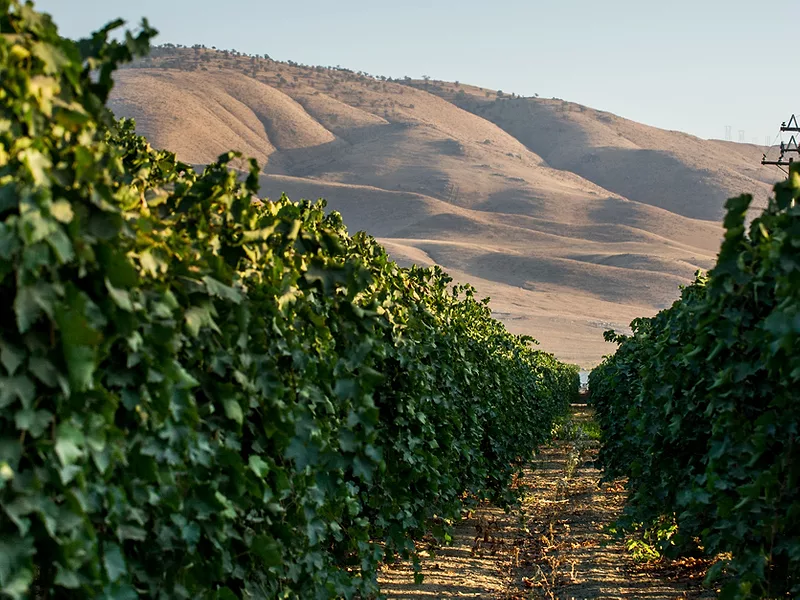
California winegrape growers are calling this year’s harvest a breaking point for the industry — a year of exceptional fruit quality overshadowed by severe financial strain, widespread unharvested acreage, mounting vineyard removals, and a market saturated with bulk wine imports. Growers across every growing region said they are entering 2026 bruised but hopeful that forced supply reductions and new industry tools may help restore balance — though the path remains uncertain and uneven.
“Growers face contract uncertainty, weather challenges, rejections — both in the field and at the test stand — and, ultimately, a whole lot of fruit that was left on the vine to rot,” said Natalie Collins, president of the California Association of Winegrape Growers, in a postharvest briefing with reporters.
Collins added that since the market downturn accelerated last fall, 38,000 acres of vineyards have been removed and more are underway, creating an economic ripple that impacts trucking companies, nurseries, equipment providers, labs and local tax bases.
Growers on the CAWG board described the season as the most difficult in three decades. Some operations turned to personal savings. Some exited vineyards entirely. Others shifted permanently to almonds, walnuts or row crops.
The industry is racing to rebuild demand, secure fairer trade conditions and adopt new tools to improve transparency and planning and avoid repeating the cycle as other wine-producing countries encroach on California’s market share.
The smallest crush since the ’90s
Jeff Bitter, president of Allied Grape Growers, said that while the industry anticipated a challenging season, few expected this scale of disruption.
“It was a pretty painful harvest for most growers, particularly those who did not have a contract,” said Bitter. “We saw difficulty even at the highest end of the market, with regard to market activity, lack of buyers, grapes being left unpurchased, unharvested. It really was a statewide phenomenon.”
Wineries asked to take a year off from purchases, renegotiate terms or cut tonnage. In some cases, he said they told growers: “I don't know how I'm going to pay for these grapes.” And even where contracts held, buyers frequently declined to take the full volume. Smaller buyers, squeezed by consolidation and slow sales, were the first to retreat. The result was that growers across the state saw fruit hang through October and into November.
While the California Department of Food and Agriculture will not deliver the official estimate until February, Bitter estimates the crush is likely to come in at less than 2.5 million tons, making it the smallest since 1996. For growers accustomed to 3.2 to 3.4 million tons in a typical year, the sudden drop signals a forced shock to the system.
Yet Bitter hoped the reduction may finally help unwind the industry’s “inventory bubble.”
“We certainly did not crush anywhere near what we produced,” he said, before striking a note of optimism. “We did not add inventory to the system. We reduced inventory overall by having such a short crush.”
His assessment was that the industry may emerge from this contraction better positioned, if sales stabilize and if buyers return to normal purchasing behavior. But, he cautioned, “it really is going to be a question of whether or not the pricing is economically sustainable.”
Across regions, growers echoed the pain along with the silver linings in fruit quality.
Central Coast: “The grape market was and is incredibly challenging this year,” said Gregg Hibbits, who chairs the board and runs the investment firm Grapevine Capital Partners in San Luis Obispo. Hibbits estimated 20-30% of the grapes on the Central Coast would go unharvested and relayed accounts of spot buying “at incredibly distressed pricing,” despite strong wine quality.
 Natalie Collins, CAWG (Agri-Pulse photo/Fred Greaves
Lodi and interior: “2025 was easily the worst conditions for winegrapes in our area in my lifetime and likely for the career of my father as well,” said Aaron Lange, who manages vineyard operations at LangeTwins Family Winery and Vineyards in Acampo. Lange reported leaving 15% of his family’s crop unpicked and saw “zero buyer activity” until late in the season, even for their prized chardonnay. “The best-case scenario for many of us was selling our crop at far below sustainable pricing and, very ironically, to wineries which require sustainable certification for the fruit.”
Natalie Collins, CAWG (Agri-Pulse photo/Fred Greaves
Lodi and interior: “2025 was easily the worst conditions for winegrapes in our area in my lifetime and likely for the career of my father as well,” said Aaron Lange, who manages vineyard operations at LangeTwins Family Winery and Vineyards in Acampo. Lange reported leaving 15% of his family’s crop unpicked and saw “zero buyer activity” until late in the season, even for their prized chardonnay. “The best-case scenario for many of us was selling our crop at far below sustainable pricing and, very ironically, to wineries which require sustainable certification for the fruit.”
North Coast: “This was a tough year,” said Cameron Mauritson, vineyard manager at Mauritson Farms in Healdsburg, adding that even premium retailers wavered. “Many buyers are just not buying what they need. Even if they think they need it, they seem hesitant to want to pull the trigger.”
Napa Valley: Johnnie White, co-owner of Piña Vineyard Management in St. Helena, described “very good yields — the large crop kept getting bigger” and exceptional quality but significant late-season deterioration after rain. “Many grapes left hanging on the vine began to deteriorate and mold,” triggering insurance claims, which were critical for the valley this year.
It’s easy to be “in the know” about what’s happening in Washington, D.C. Sign up for a FREE month of Agri-Pulse news! Simply click here
Despite the hardships, growers reported unusually balanced, high-quality fruit, with some saying flavor development outpaced sugar accumulation, a sign of potential stylistic finesse for vintage wines. But for growers, quality alone does not pay labor, fuel, regulatory compliance or land costs.
Historic vineyard removals, long-term replanting bets and a new acreage map
In response to oversupply and prolonged losses, growers have accelerated vineyard removals, particularly in regions competing directly with low-priced imports and bulk blends.
Lange said Lodi removed about 9% of the standing acreage this year and expects another 5,000 to 8,000 acres to come out next year, depending on financing and market signals.
Hibbits said the Central Coast will also cut acreage and hold off on planting.
“I don't think we're going to plant anything,” he said. “That’s pretty surprising on a portfolio our size.”
Mauritson said the North Coast is seeing removals as well as replanting by experienced operations betting on the long game.
“They're old pros. These are family growers that have been around for a long time. They know their craft,” he said. “They're feeling there's light at the end of the tunnel.”
White framed replanting as a strategic reset and an opportunity to remove virus-compromised blocks and reestablish quality for future contracts.
To guide these decisions, CAWG has launched a first-of-its-kind vineyard mapping platform using advanced remote sensing, artificial intelligence and on-the-ground field verification to capture block-level detail across the state. The analysis identified 477,475 standing acres and 38,134 acres removed between October 2024 and August 2025, establishing what Collins described in a statement as “a shared, credible foundation for regional benchmarking, market planning and informed policy” and “a reliable baseline to understand change, promote transparency and plan responsibly for the future.”
The tool allows growers and the industry to evaluate both active acreage and abandoned blocks — a key challenge in prior datasets — and compare removals and plantings by county, viticulture areas and crush districts.
“This mapping gives us a new level of spatial accuracy, showing what’s actually planted and where,” said Collins.
CAWG and Land IQ are hosting webinars to help the industry interpret the data and integrate it into long-term planning and policy decisions.
 Jeff Bitter (Allied Grape Growers photo)
Competition, trade pressure and consumer preferences
“We can't forget the serious import issue we have here in California,” said Lange. “Bulk wine is coming from other countries around the world and really substituting purchases of wine grapes in 2024 and 2025 to the tune of hundreds of thousands of tons each year.”
Bitter said bulk imports rose 17% through July, despite abundant California supply.
“There's too much imported bulk coming in, given the amount of wine we have in tank domestically,” he said, criticizing a duty drawback program and trade policy that “made it favorable for domestic wineries to create relationships with foreign suppliers.”
Growers stressed the need to strengthen the California brand and emphasize regional identities for Sonoma, Napa and Lodi that reinforce quality and support local sourcing.
To help address the demand challenge, the Wine Institute has launched the Share Wine Co-Lab, a digital hub designed to “help the wine community connect with a new generation of wine consumers.” The platform includes messaging tools, consumer insights and best practices for engaging younger drinkers as part of a broader effort to reverse declining consumption trends and compete with spirits, beer and ready-to-drink beverages.
The initiative encourages wineries to experiment with new formats, storytelling and engagement strategies and to collaborate rather than compete in reaching emerging audiences.
Fragile optimism and the policy fights ahead
Collins urged growers to continue engaging policymakers.
“It really takes grassroots, on-the-ground communication to get these points across,” she said.
The growers emphasized resilience and community and a belief that California’s wine industry will endure through structural change.
“We grow an amazing product here,” said Morten. “I am optimistic for 2026. But I'm also concerned that this is going to play out differently for different regions of the state.”
Despite the volatility, most expressed cautious hope that 2025 marked the bottom of the downturn and that the industry is now positioned to climb back toward balance.
As White put it: “If you're not optimistic as a farmer, then you shouldn't be farming.”

