
China is deepening its stranglehold on key amino acids and vitamins, the feed industry warns in a new report, amplifying the financial risks to U.S. farmers.
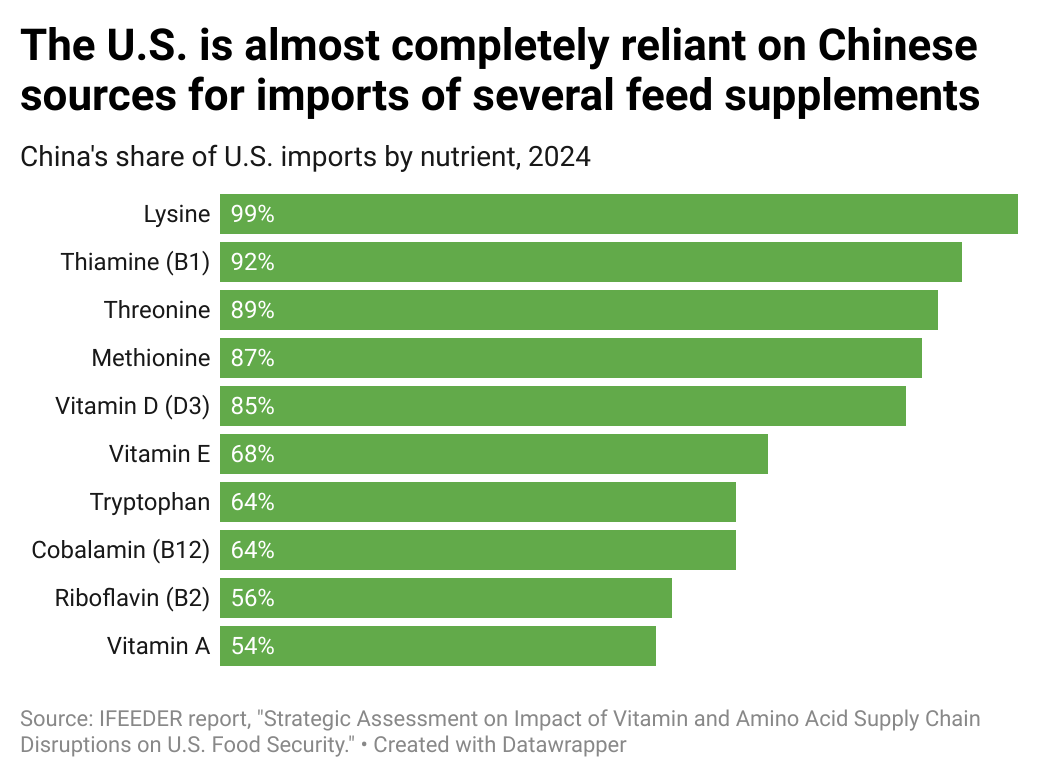
Analysis from the Institute for Feed Education and Research published Thursday shows that China now accounts for 80% of U.S. imports or more for five key feed supplements, with another five relying on China for more than 50% of imports. In the case of Lysine, which supports livestock growth, the U.S. is almost fully reliant on China for its imports.
“For years, we've been cautioning that China's dominance in this market creates significant risks,” Constance Cullman, president and CEO of the American Feed Industry Association, told reporters. “But what we learned with this research is that dominance is growing.”
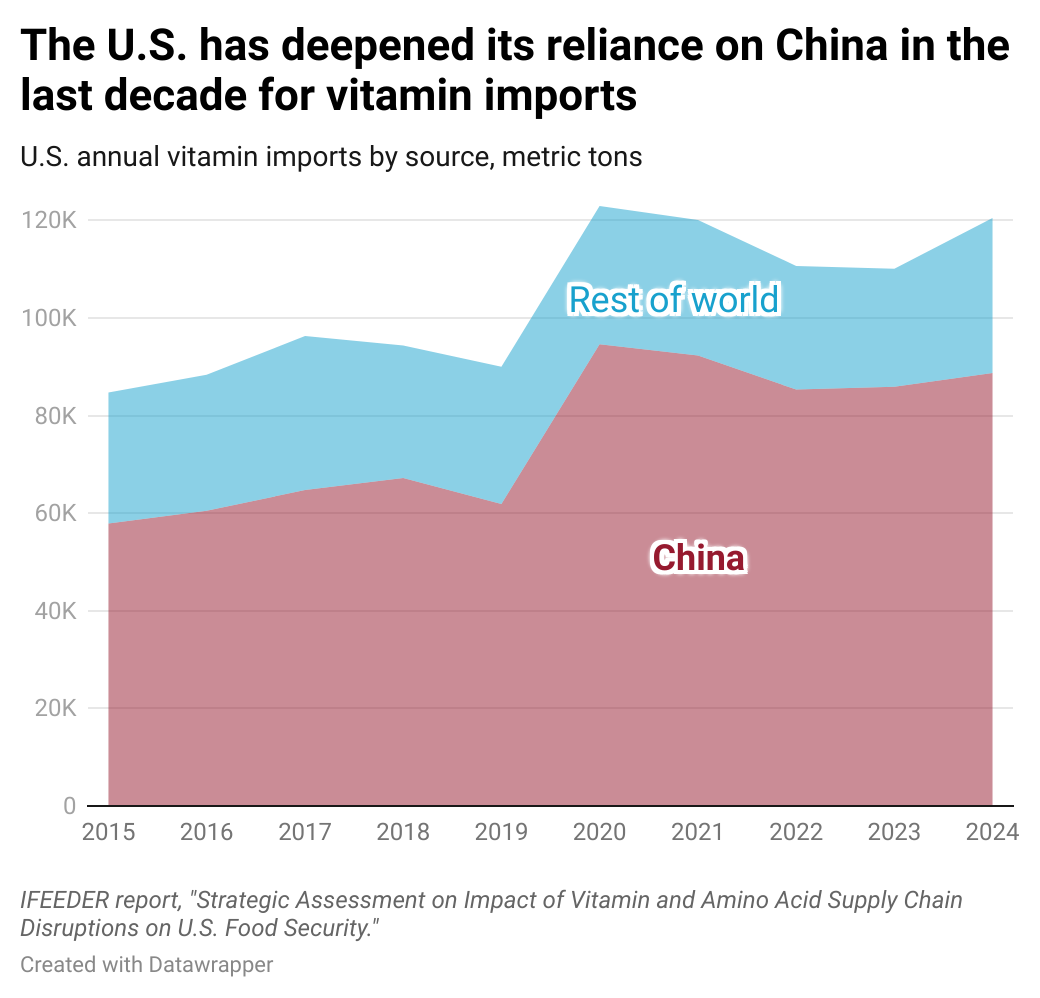
Between 2015 and 2019, around 68% of U.S. vitamin imports came from China, for example. But between 2020 and 2024, that figure rose to more than 76%.
Driving China’s expansion of its vitamin and amino acid manufacturing is targeted government support and a concerted policy effort to drive prices down through oversupply and increase its market share, said Spencer Parkinson, president and CEO of Decision Innovation Solutions, a consultancy.
From 2020, Chinese prices for key vitamins and amino acids plummeted. Between 2015 and 2019, Chinese vitamin prices hovered around 18% below their top five competitor countries, according to the report. By 2024, it had fallen to 34% below their competitors.
With Chinese prices so far below their competitors, the U.S. reliance on China for these ag inputs is only set to deepen, said David Miller, chief economist at Decision Innovation Solutions.
Over the short run, farmers might see some benefit from lower costs of feed supplements, but Miller said that the long-term dangers of relying on a geopolitical adversary for key farm inputs are manifold.
“In the long run that works to push other suppliers out of the market,” Miller said, which he argued would be dire for competitiveness.
The report examined the potential impacts on farmers if rising costs or export restrictions forced them to scale back supplementation. The report finds that the results of vitamin B and the amino acid methionine would be the most consequential.
Methionine is the most supplemented amino acid in broiler production, with around 40% of the amino in the animal’s diet coming from supplementation, according to Lara Moody, executive director of the Institute for Feed Education and Research.
Even a 20% reduction in methionine supplementation would lead to almost a full percentage-point increase in broiler mortality rates, a three percentage-point reduction in meat yield, and add four days to the average time taken to bring the animal to market.
It’s easy to be “in the know” about what’s happening in Washington, D.C. Sign up for a FREE month of Agri-Pulse news! Simply click here
An 80% reduction, meanwhile, would bring the mortality rate close to 10% - almost a four percentage-point jump – and reduce the meat yield by around 14 percentage points. The animal would also take around 15 days longer to come to market. For layers, the reduced supplementation could spur a more than 10 percentage-point fall in egg production.
For vitamin B, an 80% reduction in supplementation in market hogs would lead to a 70-day slowdown in bringing pigs to market and a fall in the meat yield by around 100 pounds per animal.
Cullman argued that these scenarios are not necessarily hypothetical. She said the COVID-19 pandemic and the resulting trade disruptions showed the risks of highly concentrated supply chains. It would be a mistake hold off on taking steps to diversify import sources and expand domestic production until another crisis occurs, she said.
“Disruptions can cascade throughout the food system,” Cullman told reporters. “So, we don't want to wait for another crisis to act.”
There are already efforts underway in Congress to strengthen U.S. resiliency for critical agricultural inputs. The Securing American Ag Act, introduced in the House and Senate earlier this year, would direct the Agriculture Department to analyze U.S. dependency on China across an array of ag inputs, including feed and its components, fertilizer, crop protection and seed.
The bills have bipartisan support in both the House and Senate.
Cullman said AFIA has been meeting with officials from the White House’s National Security Council, the Office of the U.S. Trade Representative, the Commer Department’s supply chain center, and USDA to push the issue.
“Once the government is back up and running, which I'm hoping will be in the next 24 to 48 [hours], we'll be able to renew those conversations,” Cullman said.
For more news, go to Agri-Pulse.com.

