
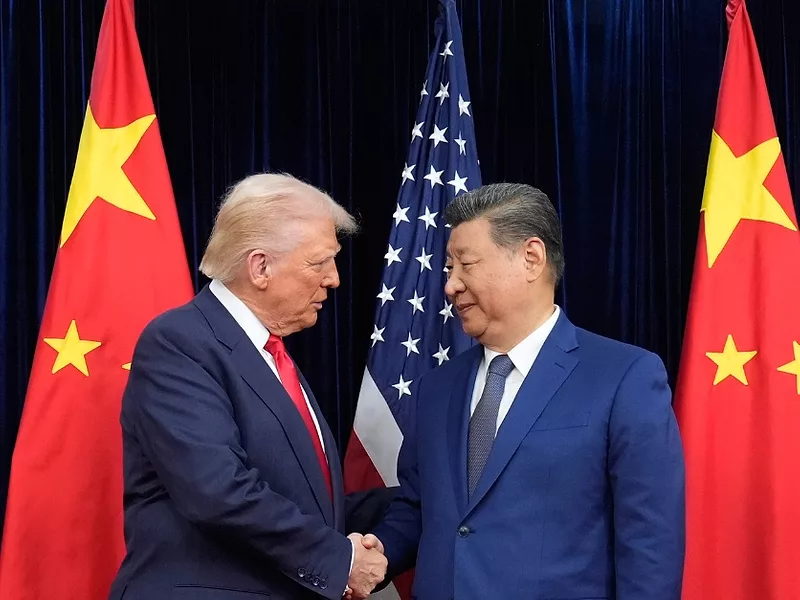
Trump: China commits to ‘tremendous’ ag purchases
President Donald Trump says he has a one-year agreement with China that will include “tremendous” sales of U.S. ag commodities. He didn’t provide any details of the Chinese pledge to reporters after his 90-minute meeting with Chinese President Xi Jinping on Thursday in South Korea.
The administration, in turn, will lower tariffs on China and postpone new port fees applied to Chinese-made and operated ships.
“Tremendous amounts of the soybeans and other farm products are going to be purchased immediately,” Trump said on Air Force One.
Trump also said, “I think the deal will go on for a long time, long beyond the year.”
For more details, read Oliver Ward’s report and follow our ongoing coverage at Agri-Pulse.com.
Senators deliver second tariff repudiation this week
Just ahead of the Trump-Xi meeting, the Senate voted Wednesday evening to end some of the Trump administration’s tariffs.
Senators voted 50-46 on a second resolution to end tariffs on Canada, just a day after a vote on Brazil tariffs. The same four Republicans that voted with Democrats on the first Canada tariff vote did so again – Kentucky Sens. Rand Paul and Mitch McConnell, Alaska’s Lisa Murkowski and Maine’s Susan Collins.
North Carolina’s Thom Tillis voted earlier this week to nix the Brazil tariffs but voted to keep the Canada duties in place.
Take note: Virginia Democratic Sen. Tim Kaine says his colleagues will have another opportunity to express their disapproval with Trump’s tariffs today when a vote on the “Liberation Day” duties comes to the floor.
The House of Representatives won’t vote on any of the anti-tariff measures any time soon. The House previously voted to not hold tariff votes until at least the end of January.
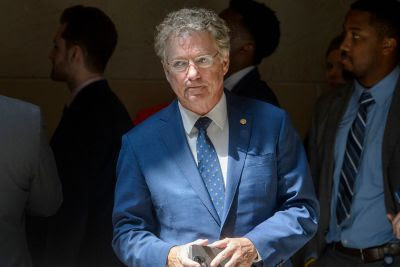 Sen. Rand Paul, R-Ky. (AP photo)
Paul, Cortez Masto file Senate bill to axe coffee tariffs
Sens. Rand Paul, R-Ky., and Catherine Cortez Masto, D-Nev., want to scrap tariffs on imported coffee.The lawmakers on Wednesday filed a Senate version of a House bill that would exempt coffee from recent tariffs. Coffee prices in the U.S. last month were up 19% over the previous year, according to the Bureau of Labor Statistics.“We're seeing significant amounts of costs for coffee because of tariffs,” Cortez Masto said during a Senate Finance hearing Wednesday. “The United States does not produce commercially significant amounts of coffee,” she added, asking, “What is the point of this tax?”
Nebraska pushes back on Colorado’s bid to end South Platte lawsuit
Nebraska’s attorney general on Wednesday pushed back against Colorado’s claim that their ongoing battle over the South Platte River does not yet require Supreme Court intervention.
Nebraska AG Mike Hilgers told the court his state “is suffering today,” because Nebraska has lost water due to Colorado pumping policies. He also alleged Colorado obstructed building the Perkins County Canal and called the state’s assertions to the contrary “a smokescreen."
Hilgers said Nebraska officials have met with their Colorado counterparts 16 times in the last four years to resolve the dispute, but said their efforts were dismissed “as a ‘political stunt’ and a ‘boondoggle.’”
Cut through the clutter! We deliver the news you need to stay informed about farm, food and rural issues. Sign up for a FREE month of Agri-Pulse here.
“If Colorado doesn’t know what a negotiated solution looks like after three years, it doesn’t want to,” Hilger’s filing said.
Vaden takes on USDA’s SNAP analysis
SNAP benefits are set to lapse for the first time ever this week due to the government shutdown. Meanwhile, a USDA tool for estimating the impact of SNAP benefits is becoming something of a partisan issue.
USDA’s Economic Research Service estimates that in a slowing economy every $1 billion in SNAP benefits generates about $1.5 billion in economic activity. The idea is that when income is falling and people become eligible for SNAP, or for higher benefits, the program indirectly “augments the income and spending of producers, processors, distributors, retailers, and their employees,” ERS says.
Minnesota Gov. Tim Walz has drawn the ire of Republicans for asserting that every dollar of SNAP benefits generates as much as $1.80 in economic activity. Deputy Ag Secretary Stephen Vaden criticized Walz on X.
“Too bad it’s complete fiction,” Vaden said of the ERS multiplier. It “comes from an old USDA model built on fantasy economics, a ‘fixed-price world’ with no inflation, no tradeoffs, no limits,” Vaden said.
The House Ag Committee’s GOP staff reposted a similar critique by a George Mason University researcher.
By the way: The National Grocers Association cited the ERS multiplier in a press release Thursday, urging Congress to end the shutdown and free up SNAP benefits.
Inspector general nominee called food bank money a ‘slush fund’
The nominee to be the new inspector general at USDA called $500 million in food bank funding canceled by the Trump administration a “slush fund” in a letter to Democratic Sen. Raphael Warnock, the senator said at an Agriculture Committee hearing Wednesday.
The Georgia senator questioned John Walk, currently a senior adviser to Ag Secretary Brooke Rollins and USDA’s judicial officer, about a letter signed by Walk in May. Inspectors general are charged with investigating waste, fraud and abuse.
Asked whether he stood by his characterization, Walk said he didn’t remember the letter.
“I would have to go back and look. I do not have an awareness,” he said, prompting Warnock to ask, “You don’t remember your own letter?”
President Trump fired inspectors general across the federal government in January, including USDA’s Phyllis Fong. In a subsequent lawsuit, a federal judge said the firings were illegal because Trump did not provide notice to Congress but the judge did not order the IGs to be reinstated.
Walk’s comments came at a confirmation hearing that also included Mindy Brashears, nominated to be undersecretary for food safety, and Yvette Herrell, the nominee to be assistant secretary for the Office of Congressional Relations.
Final Word
“She was impressive. She did a good job. She shows that she understands the issues well. She's been engaged, and I'm very confident that she'll aggressively negotiate for agriculture.” – Senate Finance Committee Chair Mike Crapo, R-Idaho, on Julie Callahan’s appearance before the Senate Finance Committee. Callahan is Trump’s pick for chief ag negotiator in the Office of the U.S. Trade Representative.


