
The global trade outlook for U.S. soybeans is mixed as the Agriculture Department on Friday slightly lowered its earlier export forecast amid tough competition from South America, despite a pending U.S.-China trade deal.
The decline forecast hits as USDA expects U.S. soybean shipments to China to increase for the rest of the current marketing year. The White House says China has committed to buying 12 million tons of U.S. soybeans in the last two months of the year alone, and 25 million in the next calendar year.
But those higher sales to China could be tempered by lower sales to other foreign markets where the U.S. no longer holds a sizable price discount versus competitors, USDA said on Friday in its first monthly ag outlook report since September.
USDA's World Agriculture Supply and Demand Estimates, or WASDE, was released after a six-week U.S. government shutdown led to a pause in crucial ag data, leaving farmers and traders in the dark on the appetite for American crops right in the middle of key harvest times. The market also is nervously awaiting for China to confirm a new U.S.-China trade deal, including those key purchase commitments, that the White House has hailed as a victory for U.S. producers.
USDA's forecast for U.S. soybean exports was slightly pulled back by 50 million bushels to 1.64 billion, while corn shipments were raised 100 million bushels to 3.1 billion, a record if realized, reflecting orders on the books to date, according to the report.
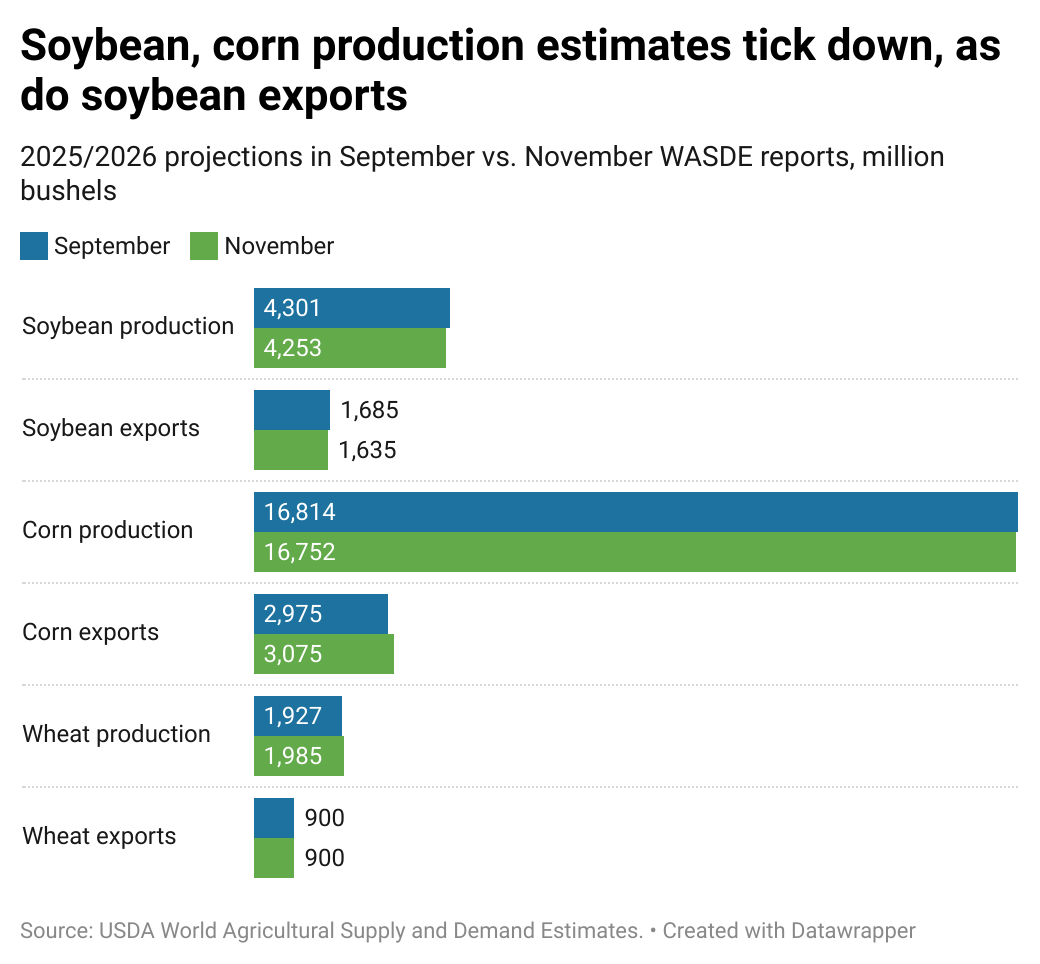
The average yield for 2025-26 soybeans is now 53.1 bushels per acre, down a bit from September's estimate of 53.5 and roughly in line with market expectations. The corn yield is seen at 184 acres a bushel, down from 186.7 from the last report but trimmed less than expected, according to Zaner Ag Edge chief market analyst Karen Braun.
USDA also expects larger supplies of wheat globally on higher output for most top producers, including the EU, the U.S., Australia, Russia and Canada.
Although USDA left its estimates for wheat exports unchanged from the September release, Tanner Ehmke, lead economist for grains and oilseeds at CoBank, told Agri-Pulse the global wheat glut could drag on exports in future reports.
"That's something we're going to have to watch if they're going to raise world production as much as they did," Ehmke said.
The department offered a crucial caveat to November's WASDE, however, noting that some of the data sources usually used to prepare the report were not available this month due to the government shutdown.
Cut through the clutter! We deliver the news you need to stay informed about farm, food and rural issues. Sign up for a FREE month of Agri-Pulse here.
"Changes to the U.S. balance sheets continue to reflect all U.S. government data available at the time of publication, but this month, in some cases, that information was limited," a note accompanying the report read.
Corn, soybean and wheat futures in Chicago were all down as of midday Friday.
The WASDE wasn't the only data published Friday. Commodity traders were hoping the publication of USDA’s daily export sales for the shutdown period would also offer fresh clues on whether China had resumed purchasing soybeans in earnest and whether the 12 million-ton purchase target for the rest of 2025 might be attainable.
The data release shows U.S. has sold 332,000 million tons of soybeans to China since Oct. 30 – the day before presidents Donald Trump and Xi Jinping met in Malaysia to hash out a deal to lower trade tensions.
There were also two sales to “unknown destinations” totaling 335,000 tons.
It is worth noting that the daily export sales only includes transactions larger than 100,000 metric tons of one commodity sold to a trading partner in a single day. Once the USDA publishes its weekly export sales report, additional transactions may show up.
But the market appeared unimpressed.
“‘No sign of big China buying in soybeans,” Allendale chief strategist Rich Nelson said.
Shawn Arita, a former USDA senior economist who is now a professor at North Dakota State University, also noted that China’s pace of purchases will need to significantly accelerate if it is going to fulfill the commitments the White House wants.
“The buying pattern shows little acceleration post-announcement,” Arita told Agri-Pulse in an email, “and U.S. price competitiveness has collapsed against South America.”
Arita pointed out that to meet the 12 million commitment, China would need to average 1.35 million tons of soybean purchases a week until Dec. 31. Right now, based on the verified sales in the daily export sales data, it is averaging around 179,000. If the "unknown" destinations end up being China, it brings the average buying pace to around 370,000 a week.
"Either way, China's current pace is really low relative to the 12 [million] MT pledge," Arita added.
For more news, go to Agri-Pulse.com.
.webp?t=1762183428)

