
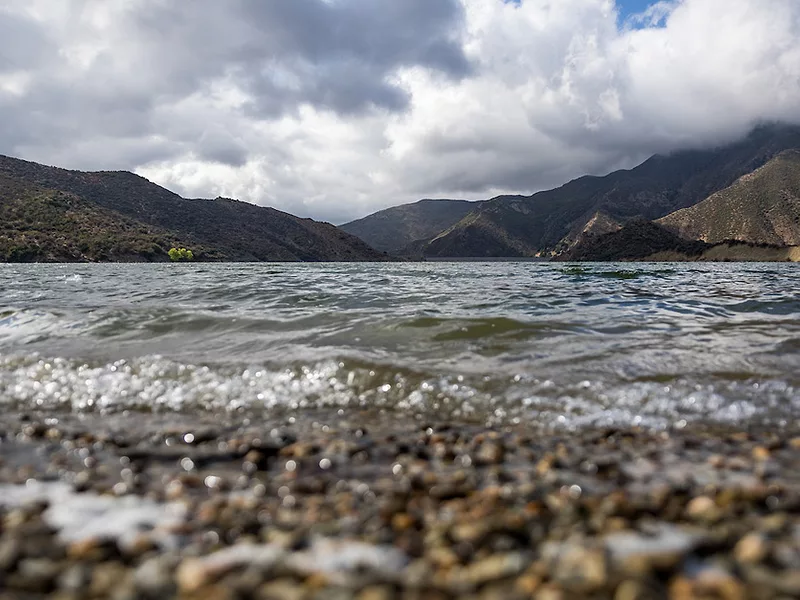
California farm, water and environmental leaders gathered in Sacramento last week for the Public Policy Institute of California’s annual Water Policy Conference as an atmospheric river soaked the capital and a storm of federal uncertainty loomed over the water year ahead.
The conference centered on how California should adapt as federal agencies undergo major downsizing, lose experienced staff, and pull back on funding and services the state has long relied on. Alongside the anxiety, the water experts and policy researchers emphasized emerging opportunities for deeper regional partnerships, smarter state investments and a renewed focus on long-term stability.
PPIC Water Policy Center Associate Director Caitlin Peterson framed the stakes.
“Our biggest partner is undergoing a massive downsizing effort,” said Peterson. “We're just coming out of the longest government shutdown on record, and we don't quite know yet where things are going to land on a number of fronts.”
California relies on the federal government “for so much: for critical data, for services, for the expertise of agencies, staff and for money, to be quite honest — they're a big funder and investor in California's water. Now that partnership is changing.”
She emphasized that California still faces enormous challenges in groundwater sustainability, climate-driven extremes, ecosystem decline and affordability. Research is “the secret sauce” for navigating this period while doing more with less.
Peterson and a team of water experts set out this year to survey the California sector to assess the top research areas. In a report released ahead of the conference, they narrowed the priorities to improve water accounting, find sustainable ways of paying for water, and build climate resilience across urban, agricultural and ecological systems.
It’s easy to be “in the know” about agriculture news from coast to coast! Sign up for a FREE month of Agri-Pulse news. Simply click here.
They warn that California is navigating droughts, floods and ecosystem decline on a scale that demands far more integrated planning across agencies and sectors.
One of the report’s central themes is that California’s local water agencies still lack the basic, standardized information needed to track water availability and use in real time. Improved accounting, the report notes, is essential not only for managing groundwater basins under the Sustainable Groundwater Management Act but also for coordinating surface water operations, assessing ecosystem flows and designing more equitable drought response programs. PPIC researchers also stress that the state must reckon with a widening funding gap. Many communities struggle to maintain drinking water systems, while larger regional projects — from conveyance to habitat restoration — face rising costs and uncertain federal contributions.
With shifting federal budgets, evolving regulatory priorities and more frequent national emergencies competing for resources, California may need to assume greater responsibility for both data systems and infrastructure investment.
 Caitlin Peterson, Water Policy Center (PPIC photo)
Federal cutbacks disrupting daily operations
If Californians needed a vivid picture of what federal pullback looks like on the ground, Cannon Michael provided it.
Michael, who farms on the west side of the San Joaquin Valley as president and CEO of Bowles Farming Co. and chairs the San Luis & Delta-Mendota Water Authority, said early hopes that a new federal administration might unlock additional water supplies evaporated quickly in the face of widespread staff departures and agency restructuring.
“The initial excitement that we found a magical faucet that was going to bring water … has dwindled to the reality that we are being hamstrung by the loss of a lot of really good people in a lot of our federal agencies,” he said.
Michael warned of the repercussions from cutting staff in essential departments like the Bureau of Reclamation’s accounting division.
“You had certain segments of Reclamation being gutted,” he said. “Being able to get contracts signed, to get just nuts and bolts things done, becomes much more complicated.”
He added that the long-term damage may be even more serious, as federal jobs become less appealing to the next generation.
“I worry how many people are going to want to get involved in those jobs as we go forward,” he said, noting that many federal employees are mission driven and carry “a feeling of obligation to serve our government.”
Northern California Water Association President David Guy agreed that the workforce reductions pose real challenges but urged the audience not to view this moment as unprecedented chaos.
“I don't know this is particularly unusual,” said Guy. “There’s always been ebbs and flows. There’s changes in administrations, and you work through this basically every two to four years.”
What is different, he said, is the timing. The federal administration is developing “a really good set of priorities” just as agencies are losing the staff needed to implement them.
“To see that together, is what I see as the challenge,” he said, emphasizing that the people who remained “are good, so let’s help them do that.”
Environmental organizations are already experiencing disruptions as well. Caitrin Chappelle, associate water director at The Nature Conservancy and a former PPIC researcher, said reduced federal staffing at Reclamation — as well as NOAA Fisheries, the U.S. Fish and Wildlife Service and the U.S. Forest Service — is creating data gaps and delays.
“We’ve seen impacts in our ability to monitor and track migratory birds on our preserves and in other places across the state,” she said. “We've started to see some impacts to stream gage data that we rely on for our own projects, but we also rely on to develop foundational science that is used by agencies to manage our rivers and our streams.”
The Nature Conservancy also anticipates “pretty big impacts to our ability to work in federal lands on our forest management and wildfire risk reduction projects.”
Compounding the staffing challenges, she said, are shrinking federal conservation grants — “complete cancelation in some instances” — and deep uncertainty about future permitting timelines.
State Water Project operations are also affected. Alison Collins, who manages science and engineering for the State Water Project at the California Department of Water Resources, explained that California agencies depend heavily on federal data — from the snowpack to stream gages and atmospheric river forecasting — and the loss of federal capacity jeopardizes everyday flood protection and water supply planning.
“Directives from federal agencies are threatening information on data, precipitation, stream flow, weather events,” she said. “State agencies rely on this … to inform our emergency response systems and how we can plan and warn people early.”
She noted that snowmelt accounts for “about 30% of water in California,” making reliable forecasting indispensable.
DWR is now developing redundancies. It is building an in-house forecast model with the Center for Western Weather and Water Extremes at the University of California, San Diego. It is also preparing backup snow courses with the California Conservation Corps and coordinating with other western states facing the same gaps.
Peter Silva, president of a San Diego-based engineering firm, said the moment should push California to modernize.
“We can’t live with them, we can’t live without them,” he said of the federal government. “Maybe it's a paradigm shift, and there's an opportunity. How do we step up as a state or states?”
He argued that California has yet to fully tap private-sector innovation or regulatory incentives that could improve water use efficiency and infrastructure investment.
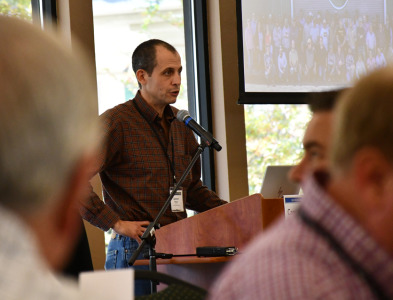 Farmer Cannon Michael (Brad Hooker/ Agri-Pulse)
Regional partnerships gain momentum
Despite the disruptions, the panel emphasized that water managers, farmers and environmental groups are more aligned today than at any point in recent memory.
Guy pointed to major collaborations underway across the Sacramento Valley, with forest health partnerships in the headwaters, new floodplain reconnection projects, progress on Sites Reservoir, and a growing coalition around the voluntary agreements approach to the Bay-Delta Plan, now known as Healthy Rivers and Landscapes.
“It’s these partnerships, and they’re enduring,” he said. “We can insulate ourselves against changes that are going to be coming over the next decade. Right now, it's the federal government. Could be the state government in three years.”
Michael echoed that sentiment, noting that the “core underlying fabric of California water” remains strong.
“We’ve got a great environmental community with a lot of people who are dedicated and very constructive,” he said. “The ag community, for the most part, is very constructive and wanting to work on solutions.”
He pointed to SGMA implementation and the constant coordination among water districts as proof of collaboration. But he also said the moment requires courage.
“We have to keep continuing to have the courage to articulate our priorities to an administration that, in some ways, is a little scary to say something negative about because there can be some serious repercussions,” he said.
Chappelle said the state now has an obligation to use the $10 billion climate bond voters approved last year wisely and transparently. With roughly a billion dollars in proposals already lined up at the Wildlife Conservation Board, she said the funding will move quickly, and “then we’ll be back to where we were.” Long-term, sustainable funding streams are still needed.
She highlighted bright spots like record coho salmon returns on the Mendocino Coast — evidence, she said, of what long-term, partnership-driven restoration can accomplish.
Silva connected California’s challenges to conditions in the Colorado River Basin and northern Mexico, arguing that regional interdependence makes innovation essential. He said partnerships across borders and sectors will be needed as Colorado River shortages deepen.
Preparing for the next governor
Californians will elect a new governor next year who could shape a new water strategy. Collins said the next administration must raise awareness about the essential data systems California depends on and invest in redundancy where federal agencies falter.
Guy said water is not partisan and should not be treated as such. He noted that California invited the federal government to build the Central Valley Project during the Great Depression, and alignment between state and federal governments remains essential.
Chappelle argued California must maintain its core environmental values and focus on long-term goals, not short-term turbulence, citing the controversial Klamath Dam removal as a model for persistence.
Michael went further, saying water stakeholders should present a coordinated agenda to the next governor from day one.
“It would behoove us all to think about that and to have something ready,” he said, arguing water policy is too politicized. “Let’s stop some of this stuff and not sink to the lowest level. Let’s try to keep the eye on the future prize.”

