
|
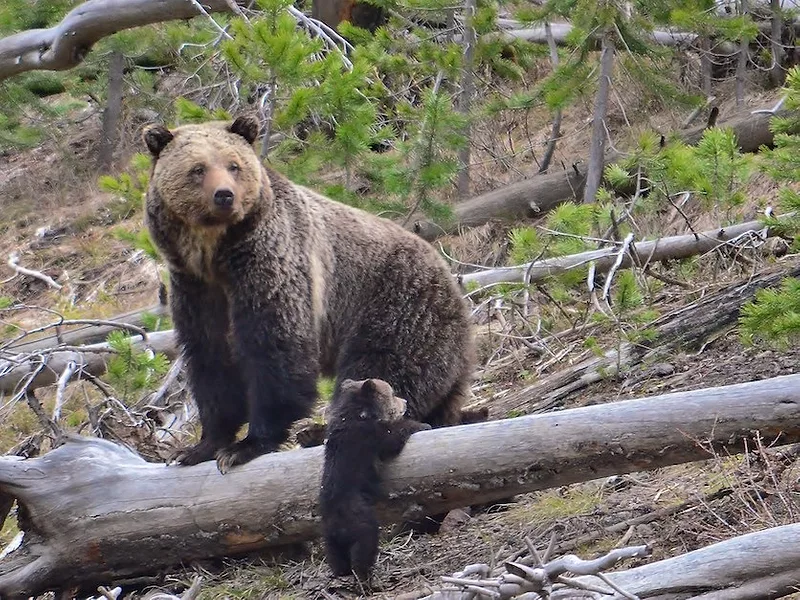
California’s state animal could be edging closer to a comeback — at least on paper.
A new bill in the Legislature would direct the California Department of Fish and Wildlife to study whether grizzly bears could someday return to the state, restoring an apex predator that once shaped California’s ecosystems.
But the idea is colliding with practical questions over whether the state’s wildlife agency — already managing wolves, black bears and mountain lions, and a lengthy endangered species list — has the capacity to take on another large carnivore.
A roadmap for restoration
Senate Bill 1305 would launch the first formal state process in decades to evaluate whether grizzly bears could one day return to California.
Authored by Sen. Laura Richardson, D-South Bay, the bill would establish a California Grizzly Bear Reintroduction Program within CDFW. Rather than immediately releasing bears, the legislation directs the department to develop a roadmap evaluating whether restoration is feasible.
The plan would examine habitat suitability, ecological impacts, potential human-wildlife conflicts and the long-term costs of managing a restored population. CDFW would also be required to consult with tribes and engage rural communities and other stakeholders before presenting its findings to the Legislature.
The grizzly bear — memorialized on California’s flag — ranged widely across the region before being hunted to extinction by the early 20th century. The last confirmed sighting of a wild grizzly in California occurred in 1924.
Managing predators on a tight budget
As wolf populations expand across California, CDFW has had to dedicate staff to monitoring packs, investigating livestock depredations and responding to conflicts with rural communities. That prompted Sen. Catherine Blakespear, D-Encinitas, during a recent budget subcommittee hearing, to ask wildlife officials how grizzlies would fit into the department’s overall efforts with coexistence.
“The recovery and return of wolves to California is incredible from an ecological standpoint and it is not easy on rural communities,” acknowledged Meghan Hertel, just weeks into her tenure as the new CDFW director. “The place we're at right now is trying to figure out how to respond to protecting this amazing species that has made its way back into California — and doing it in a way that still allows people in rural communities to have livelihoods and to be able to go about business.”
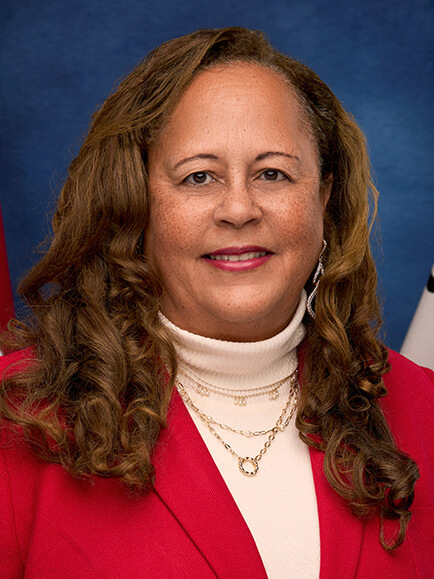 Sen. Laura Richardson, D-South Bay (State Senate photo)
CDFW Deputy Director Chad Dibble explained that the wolf situation has demanded considerable time and resources, especially with outreach efforts to ranching communities.
“We are a small but mighty team of three people,” said Dibble. “Those staff work incredibly hard to respond to incidents of depredation, work with the ranchers to talk about preventative measures and solutions that they can apply on their landscapes to help prevent depredation events.”
Interested in more news on farm programs, trade and rural issues? Sign up for a four-week free trial to Agri-Pulse. You’ll receive our content - absolutely free - during the trial period.
Staff have also been collaring and tracking pack movements, while coordinating constantly and meeting with county managers. He pointed out that CDFW has now launched a workshop series to evaluate the wolf compensation program.
A coalition of agriculture and rural groups, meanwhile, is urging Gov. Gavin Newsom to commit $30 million to the wolf program, warning that the existing funding has failed to keep pace with a growing population and rising livestock conflicts. The groups said the state’s $3 million wolf-livestock compensation pilot program, launched in 2021, was exhausted by March 2024. Subsequent budget allocations — including $600,000 in 2024 and $2 million last year — forced CDFW to narrow compensation largely to confirmed livestock deaths, eliminating most support for nonlethal deterrents.
“We recognize in a budget limited era that we're not going to be able to do everything,” added Hertel. “We are trying to bring everyone together to find a path forward here. But resources are short to be able to reply to this challenge. As we think about the return of any top apex predators, there will be similar challenges.”
She cautioned that CDFW has not taken a position on reintroducing grizzlies and the department declined to comment on pending legislation.
The discussion unfolded against a challenging fiscal backdrop.
According to the Legislative Analyst’s Office, the governor’s proposed budget projects multiyear deficits ranging from $20 billion to $35 billion annually and warns the state faces structural budget challenges that could force difficult spending choices.
Overall spending for departments within the California Natural Resources Agency is expected to decline sharply in the coming year due to the expiration of one-time funds and bond allocations that boosted recent budgets.
The agency oversees an enormous portfolio — managing roughly 100 million acres of land, hundreds of rivers and lakes, and more than 1,000 miles of coastline.
Within that system, the Department of Fish and Wildlife carries one of the most complex missions: protecting species, managing hunting and fishing, responding to wildlife conflicts and implementing environmental laws.
A Senate committee staff report advises lawmakers that “since the 1950s, CDFW’s funding base has shifted away from hunting and fishing license revenue, creating a long-term problem of insufficient and uncertain revenues to keep pace with program demands. Since 2001, the Legislature has enacted approximately 400 pieces of legislation impacting the department’s policy or regulatory programs.”
The list of mandates is only growing longer.
Last month the California Fish and Game Commission voted to list several mountain lion populations in Southern and Central California as threatened under the California Endangered Species Act due to risks including habitat fragmentation and genetic isolation.
That decision will likely require new habitat protections and scientific monitoring programs — further increasing CDFW’s workload.
Blakespear, meanwhile, has filed legislation to reestablish CDFW’s human-wildlife conflict program to “educate the public about wildlife and minimize human-animal confrontations,” according to her website.
Impacts on rural communities
Since wolves returned to California naturally in 2011 after nearly a century of absence, the economic impacts have been significant. A University of California analysis has found that a single wolf pack operating in Sierra Valley caused about $2.6 million in combined costs to ranchers and government agencies over seven months in 2025. The Beyem Seyo pack killed or injured 92 domestic animals during that period, while agencies spent more than $2 million on nonlethal hazing efforts before several wolves were euthanized.
During that conflict alone, CDFW staff logged about 18,000 hours over four months attempting to haze wolves and prevent further livestock attacks.
Combined with expanding populations of black bears, mountain lions and coyotes, the wildlife conflicts have intensified disputes over how aggressively the state should manage predators that kill livestock, attack pets and occasionally threaten people.
“The department — for better or worse, at a lot of levels — often feels like it's become the state's animal control service,” former CDFW Director Chuck Bonham told the commission last year.
Ranchers oppose grizzly proposal
Livestock groups say the proposal highlights a growing divide between conservation goals and the realities facing ranchers already dealing with multiple predators.
The California Cattlemen’s Association told Agri-Pulse in a statement that it strongly opposes SB 1305.
“Ranchers already share the landscape with several apex predators,” said Kirk Wilbur, CCA vice president of government affairs.
Ranchers are increasingly suffering livestock losses from the growing populations, he explained, warning that another large predator would compound those pressures.
“We know from the Rocky Mountain states that grizzly bears can be even more devastating to ranchers,” he said, adding that requiring CDFW to prepare a reintroduction plan “would be a disservice to Californians — rural, urban and suburban alike — as it would strain limited department resources that could otherwise be devoted to planning, conservation and management for California’s existing wildlife populations.”
A study finds room for grizzlies
Much of the momentum behind the recent push to consider grizzly restoration stems from a 2025 scientific study examining whether the species could once again survive in California.
The report was produced by a group of wildlife researchers and conservation scientists who evaluated the state’s remaining habitat, food sources and ecological conditions. They concluded that California still contains large areas capable of supporting the animals.
The study found that about 34.5% of the state — roughly 140,000 square miles — contains habitat that could potentially support grizzly bears, particularly in remote mountain regions with abundant food sources and relatively low human density.
Researchers identified three broad landscapes that could support grizzly populations if restoration were pursued: the state’s northwestern forests, portions of the Sierra Nevada, and parts of the Transverse Ranges in Southern California. These areas include large tracts of federal and state lands where human development remains relatively limited.
“On the eve of the Gold Rush, there was about one grizzly bear in California for every 11 people,” Peter Alagona, an environmental studies professor at the University of California, Santa Barbara, and lead author of the report, told commissioners during a 2024 hearing marking the centennial of the grizzly’s disappearance.
 CDFW Dir. Meghan Hertel (CNRA photo)
Before European settlement, California likely supported as many as 10,000 grizzly bears, making it one of the species’ strongest population centers in North America. But intensive hunting and habitat loss rapidly wiped them out. The last confirmed wild grizzly in California was killed in Tulare County.
Alagona cited survey data indicating that only about one-quarter of Californians know the species has been eradicated. But when informed about the bear’s disappearance, roughly two-thirds of respondents said they might support its return.
Following Alagona’s new report last year, tribal representatives and conservation advocates urged the commission to explore reintroduction.
“The grizzly is our official state animal. It’s on our flag,” said Brendan Cummings, conservation director at the Center for Biological Diversity, which commissioned the study. “But without the animals actually in the state, the flag is to me just a memorial — a reminder of our flaws and failures.”
Octavio Escobedo III, chair of the Tejon Indian Tribe, stressed that the grizzly holds deep cultural meaning for many Native communities.
“The study shows that the grizzly can thrive once again in California and that their extermination was a choice the state made and their eventual return will be also,” said Escobedo.
A leadership shakeup
The debate over grizzly restoration is unfolding during a leadership transition at CDFW.
Chuck Bonham stepped down as director at the end of 2025 after nearly 15 years leading the agency. During his tenure the department managed the return of wolves and expanded programs aimed at balancing wildlife conservation with rural concerns. In early 2026 Gov. Gavin Newsom appointed Meghan Hertel as the department’s new director. Yet her tenure could be limited, since Californians will elect a new governor — with new priorities — in November.
Whether California ultimately moves toward studying or restoring grizzly bears will likely fall to Hertel and her team to evaluate — and to a Legislature still grappling with how many predators the state’s wildlife system can realistically manage.

