
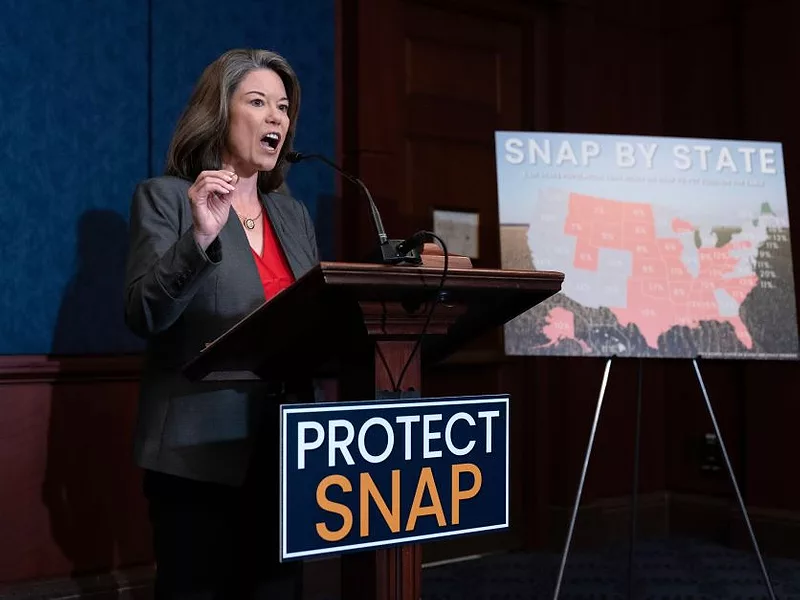
House and Senate Democrats strongly criticized the Trump administration and congressional Republicans for attacks on SNAP as they announced legislation to undo cuts to the program in the One Big Beautiful Bill Act.
At a press conference at the Capitol Thursday, Sen. Ben Ray Luján, D-N.M., and Rep. Angie Craig, D-Minn., the ranking member of the House Agriculture Committee, said the $187 billion in cuts to the Supplemental Nutrition Assistance Program over 10 years would throw millions off the program and hurt farmers who provide food to it.
Craig, in particular, went after Agriculture Secretary Brooke Rollins for mounting a “propaganda campaign” against SNAP that Craig said she would be “fighting … every step of the way.”
Rollins has said recently that USDA is looking closely at the program, which she has called “corrupt,” and said USDA would be requiring recipients to “reapply.” Asked about the latter comment, a USDA spokesperson said the agency is in part relying on the program’s regular certification process.
“Secretary Rollins wants to ensure the fraud, waste, and incessant abuse of SNAP ends. Rates of fraud were only previously assumed, and President Trump is doing something about it," the spokesperson said. "Using standard recertification processes for households is a part of that work. As well as ongoing analysis of state data, further regulatory work, and improved collaboration with states.”
Craig said, however, she isn’t sure specifically what USDA is doing with SNAP.
“We're hearing off the record that … people don't know what the hell they're talking about at the moment,” she said. “In fact, I think they're trying to take credit for the already very strict standards and the actual low fraud rate in the SNAP program.”
It’s easy to be “in the know” about what’s happening in Washington, D.C. Sign up for a FREE month of Agri-Pulse news! Simply click here
Katie Bergh, a senior policy analyst at the Center on Budget and Policy Priorities, said on X last week, “Aside from the fact that SNAP participants already have to periodically recertify for benefits — usually every 6 or 12 months — SNAP rules also prohibit states from arbitrarily shortening a household's certification period to force them to reapply early.”
In a commentary released Thursday, CBPP Vice President for Food Assistance said Rollins has been “falsely labeling [SNAP] ‘corrupt’ and ridden with ‘fraud.’ In reality, SNAP has one of the most rigorous eligibility determination systems of any federal benefit program and SNAP participants must verify their eligibility regularly to stay connected to the program.”
“It wouldn't surprise me at all if in three months, Brooke Rollins doesn't go on TV and say, 'Oh my gosh, we have a 1.6% fraud rate in the SNAP program, isn't that amazing?'” Craig said. “I think they're just pointing out exactly how the program already runs, pretending that they're doing that when it's been in place for years, and now, in three months, they'll claim the error rate is 1.6% and take a victory lap. And when they do, we'll be right here to point out that that's exactly where it started.”
Craig and Luján said cuts to SNAP in the OBBB would take money out of farmers’ pockets – $25 million annually, according to Craig.
And Lujan said rural groceries will be hit hard. “No one's been talking about rural grocery stores,” he said. “Over 10%, 20% of the revenue that goes to these local grocery stores comes from SNAP beneficiaries. Think about the smallest towns all across America who worked hard just to get that grocery store.”
Crystal FitzSimons, president of the Food Research & Action Center, said FRAC and 1,500 other groups are backing the bicameral legislation, titled the “Restoring Food Security for American Families and Farmers Act of 2025.” Text of the bill is here.
The bill would have little no chance of passing this Congress, but it gives Democrats an issue to rally around heading into the 2026 mid-term elections.
The OBBB’s shifting of more administrative costs to the states means that some states will drop out of the program, FitzSimons said.
In addition, changes to the eligibility rules, such as new work requirements, “will cause millions of people to lose access to the program completely,” FitzSimons said.
Time limits that will restrict access to new groups, such as veterans, youth transitioning out of foster care, older adults and parents with children 14 years of age and older, “are going to start hitting in a couple months, and so families are going to start losing benefits,” she said.
Craig signaled to her Republican colleagues that she would not be shy about engaging them on SNAP.
“I'm warning my Republican colleagues, if you bring your propaganda to the Ag Committee when we start getting back on the House side, every single lie that you tell while your mouth is moving, I am going to call it out,” she said.
Others who spoke at the news conference included Majority Leader Chuck Schumer, D-N.Y., Sen. Jeff Merkley, D-Ore., and Rep. Jahana Hayes, D-Conn.
For more news, go to Agri-Pulse.com.

