
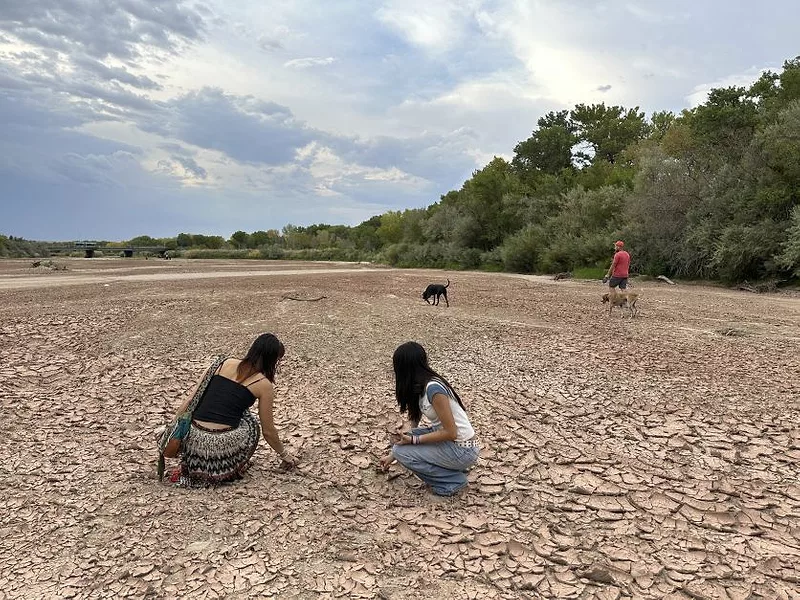
It’s been a dry few years for Mike England.
The south Texas farmer has cut back his acreage significantly amid diminished shipments of Rio Grande water that Mexico is treaty-bound to provide to the U.S. Much of his land now lies fallow, though he’s tried to grow what cotton, milo and hay he can in recent years. He stopped planting sugar cane after the local sugar mill shuttered last year, largely due to farmers lacking the water needed to support the thirsty crop.
And as England scales back, his debts only accrue.
“Each year you farm without water, you’re going that much further into the hole,” England said. “Crop insurance isn’t going to pay your expenses back.”
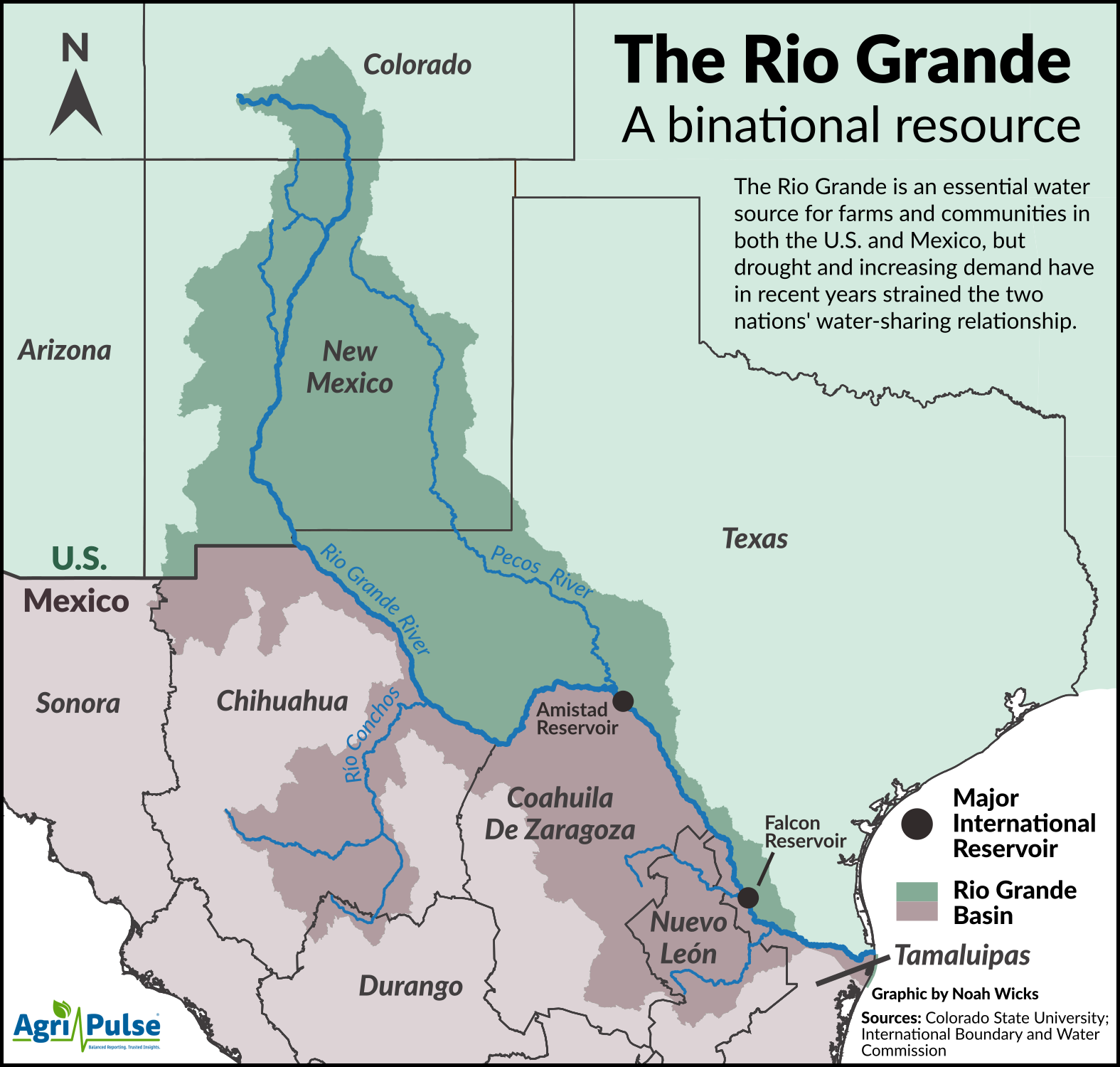
Snaking from Southern Colorado’s San Juan mountains to the Gulf of Mexico, the Rio Grande cuts a 1,885-mile path across the U.S. and Mexico, making it an essential water source for farms and communities along its path. But while both nations have a long history of sharing the river’s flows, that relationship has in recent years been challenged by a lag in deliveries from Mexico that has left Texas farmers struggling to sustain their crops — and operations.
Under a binational agreement known as the 1944 Water Treaty, Mexico has agreed to supply 1.75 million acre feet of water to the U.S. every five years. But when the most recent 5-year cycle ended on Oct. 25, Mexico had only delivered 884,861 acre-feet — less than half of what it owed.
After discussions with Mexican officials over the shortfall, Agriculture Secretary Brooke Rollins and U.S. Deputy Secretary of State Christopher Landau announced Friday that Mexico plans to release 202,000 acre-feet of Rio Grande water, with deliveries to begin this week.
Mexican President Claudia Sheinbaum told reporters last week that she and other Mexican officials were working on a delivery plan that “would not put the population and agricultural production in Mexico at risk but also allows us to help the United States.” It involves deliveries through December and in the years ahead, she said.
The two governments are currently in negotiations over "a series of actions to meet the treaty obligations" but "concur on the importance of continuing to work cooperatively within the framework of the 1944 Water Treaty," according to a joint communiqué released Friday.
President Donald Trump had previously threatened in a Truth Social post to impose a 5% tariff on Mexico if it did not release 200,000 acre-feet by Dec. 31. In a statement Friday, Agriculture Secretary Brooke Rollins reiterated the possibility of the tariffs should Mexico fail to make the deliveries.
Cut through the clutter! We deliver the news you need to stay informed about farm, food and rural issues. Sign up for a FREE month of Agri-Pulse here.
"Although this is a step in the right direction, President Trump has been very clear: if Mexico continues to violate its commitments, the United States reserves the right and will impose 5% tariffs on Mexican products," she said.
Lack of deliveries tests U.S.-Mexico relationship
The establishment of the 1944 treaty gave the U.S. a right to flows from tributaries that feed the Rio Grande in the U.S., as well as one-third of flows from a specific set of Mexican tributaries. To fulfill these rights, Mexico agreed under the treaty to supply 1.75 million acre feet of water to the U.S. every five years, with aims to provide roughly 350,000 acre-feet per year.
Historically, Mexico has generally waited until seasonal rainstorms fill its reservoirs before diverting water to the U.S., making large payments at various points within the 5-year span instead of set payments each year. In the early decades of the treaty, this approach "more or less" went "swimmingly," since Mexico was generally able to make its payments by each cycle's end without the need for a time extension, said Stephen Mumme, a professor of political science at Colorado State University.
But this rainstorm-driven approach has not translated well to the droughts of recent decades, said Carlos Rubenstein, a water consultant who formerly served as Rio Grande watermaster for the Texas Commission on Environmental Quality. On top of failing to make its 2020-2025 payment, Mexico ended the 1992-1997, 1997-2002, and 2010-2015 cycles with deficits, which it paid off in the cycles that followed, according to a 2022 report commissioned by the United States Section of the International Boundary and Water Commission, which represents the U.S. in Rio Grande water talks.
"Mexico has banked on the weather forever," Rubenstein said. "That is the problem."
In the most recent cycle, Mexico's deliveries got off to a slow start. It had given the U.S. only around 61,198 acre-feet of water in October 2021, when the first year of the cycle ended, according to data Agri-Pulse obtained through a Freedom of Information Act request. By October of the following year, that had grown to 302,328 acre-feet — less than one year’s worth of water, despite being the culmination of two years' worth of deliveries.
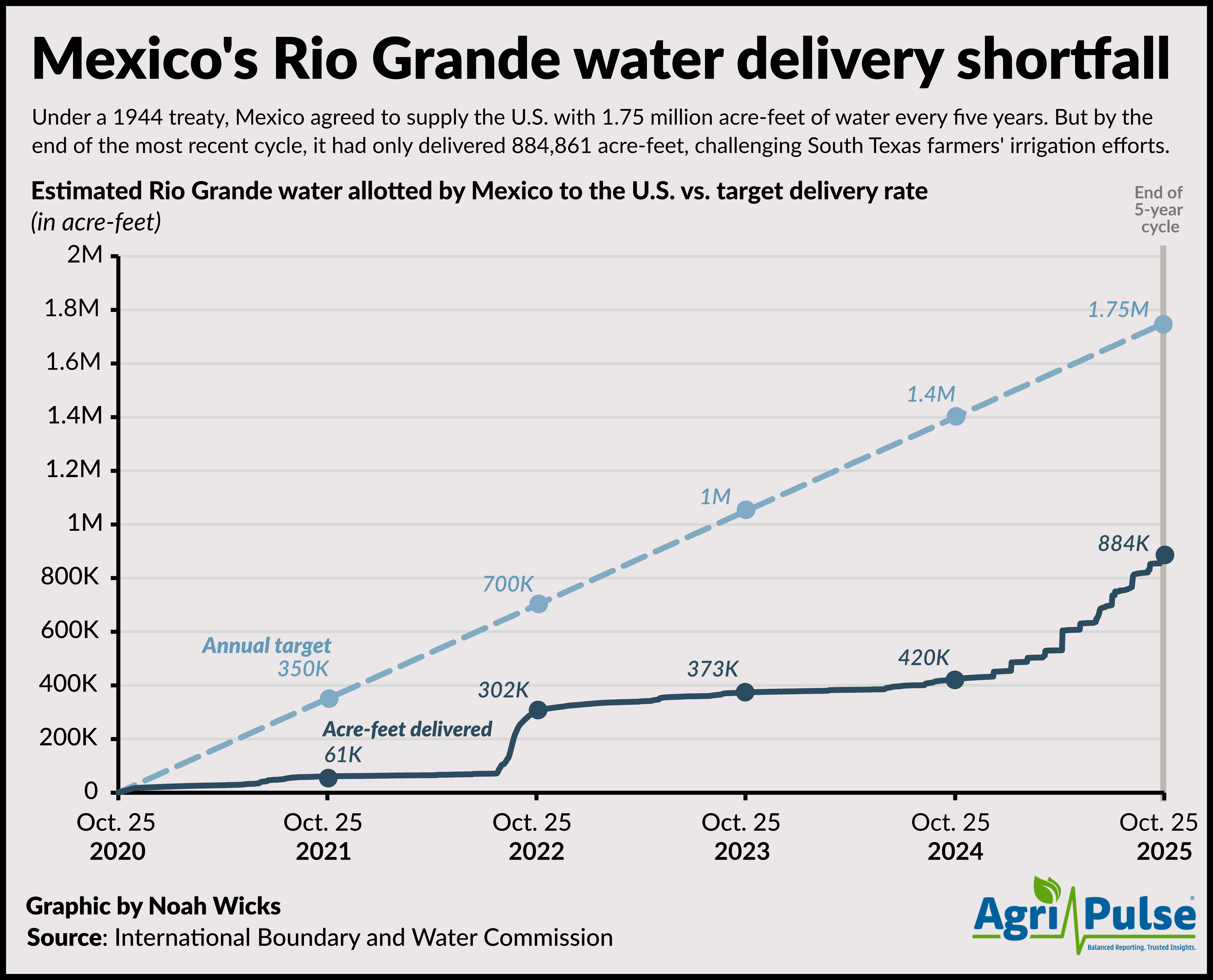
That slow pace continued through 2023 and much of last year, with Mexico having only delivered 420,674 acre-feet by October 2024. After Maria Elena Giner, former U.S. commissioner of the IBWC, and her Mexican counterpart, Adriana Reséndez, signed a “minute” agreement in November 2024 that loosened the water transfer rules Mexico was bound to, deliveries ramped up, with the nation having provided 630,231 acre-feet by May 31 of this year.
Despite the uptick in deliveries, Mexico was years behind. As summer turned to fall, it became increasingly clear that the U.S.’s southern neighbor would fail to hit its 1.75 million acre-foot target in time. When the cycle ended on Oct. 25, Mexico had provided just 884,861 acre-feet to the U.S., around 50.6% of expected minimum seasonal deliveries, according to a slide from an IBWC presentation obtained by Agri-Pulse.
Mumme pointed to increasing Mexican consumption of Rio Grande water and drought as reasons for the shortfall in deliveries, two factors he said have been "intermingling to create stresses on the water delivery system."
"What we have is this mixed picture of rising demand for water and drought intermingling," Mumme said, adding that "the Texans understandably are very unhappy about this, because farmers are literally losing their livelihood in the valley because of the inability to have a reliable water supply."
If Mexico fails to make its payments within a particular five-year cycle due to "extraordinary drought," the treaty does allow for water debts to be carried over and paid in the following five-year cycle, on top of that cycle's normal payments, according to Giner, the former IBWC commissioner. However, because "extraordinary drought" lacks a definition under the treaty, it has been a recent point of contention between both countries because Mexico had some water available at various points in the last cycle that it did not provide to the U.S., she added.
“They had water to share,” she said, noting that in the third and fourth years of the current cycle, “their reservoirs were full, and they chose to keep the water.”
Delivery shortfall challenges Texas irrigators
Amid the lack of deliveries, Texas farmers have been scaling back. Brian Jones, who farms corn, milo and cotton, said he's only planted roughly half of his normal acreage in recent years due to a lack of water access.
"I'm supposed to be a 100 percent irrigated farmer," Jones said. "And for the last three years, basically, I've been planting half my farm because I don't have enough irrigation water to take care of the whole thing."
Lower Rio Grande Valley growers were slated to lose an estimated $993.2 million last year due to irrigation water shortages, in large part driven by the lack of Rio Grande water deliveries, according to a report published by Texas A&M economists.
As a lack of water access challenged South Texas sugar growers, the state's only sugar mill closed down in 2024. Tudor Uhlhorn, chair of the co-op, told Agri-Pulse last year that prior to the mill's closure, the amount of sugar produced by growers in the valley had fallen, going from 124,000 tons in the 2021/2022 crop year to 76,000 in the 2023/2024 crop year.
Had it not been for $280 million the Agriculture Department provided to farmers earlier this year to offset losses due to the lack of Mexican water deliveries, England, the South Texas farmer, said “a good bunch” of Rio Grande Valley farmers would have gone out of business earlier this year. But the assistance only served to prolong farmers’ debts, he added. If water does not come soon, many still face a dim financial future, he said.
“I am not ungrateful for this,” England said of the payments. “But it’s sure not the healing that we all thought it was gonna be.”
Earlier this fall, several Texas farmers and commodity group leaders submitted comments to the office of the U.S. Trade Representative requesting 1944 treaty enforcement mechanisms be considered in negotiations over future iterations of the United States-Mexico-Canada Agreement.
In a comment, Wallace Webb, the executive director of the Cotton and Grain Producers of the Lower Rio Grande Valley, said "Mexico has been betting on a very unreliable gamble that they can delay water payments for five, or even ten, years hoping that a tropical system will bail them out of debt and allow them to meet the treaty obligations." He also argued that the 1944 treaty has "been nothing more than a handshake agreement," and said Mexico has been increasingly using more of the river's water for irrigated acreage within its borders.
Webb urged USMCA negotiators to make "full compliance" with the 1944 water treaty an "integral requirement for favorable trading status in the renegotiated USMCA," along with a "full dispute resolution and penalty process, including trade sanctions and tariffs" for any non-compliance with the 1944 water treaty.
Dale Murden, the president of Texas Citrus Mutual, said the state's citrus industry is "on the brink of disaster," noting that even if the state were to receive an average annual rainfall, citrus trees "will only receive half the irrigation they need to survive, let alone produce fruit."
"This chronic stress, combined with recent freezes, has crippled our ability to recover, with production tonnage down 25 percent for some growers," he wrote in a public comment. "As our members have stated, 'You can't turn the orchards on and off.' Without a reliable water supply, our trees will die."
For more news, go to Agri-Pulse.com.
.

