
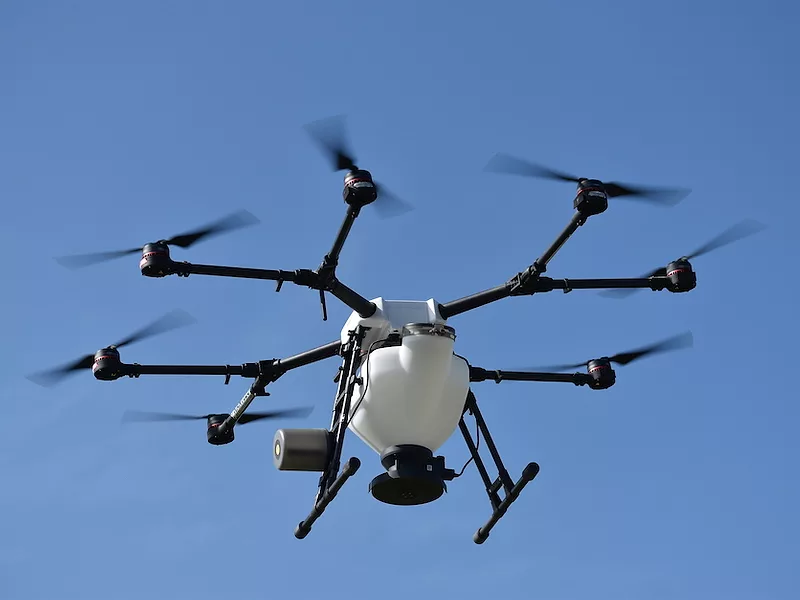
The Trump administration has imposed a ban on new foreign-made drones, spurring an outcry from both American farmers and China.
The Federal Communications Commission said on Monday that drones and related critical parts made outside of the U.S. pose an "unacceptable" national security risk and are prohibited going forward. The agency also cited a need to bolster protection around upcoming major public events, like next year's celebration of the U.S.'s 250th birthday and the 2028 Summer Olympics in Los Angeles.
China, home to the world's largest maker of drones, strongly criticized the decision, accusing Washington of "overstretching the concept of national security and making discriminatory lists to go after Chinese companies."
"The U.S. should stop its wrong practice and create a fair, just and non-discriminatory environment for Chinese companies," Lin Jian, a Chinese Foreign Ministry spokesperson, said on Tuesday.
U.S. agriculture groups also are speaking out. Timing of the ban hits as many farmers are financially struggling in part due to high production costs, making precise application of crop protection products and fertilizers especially important. Such precision increasingly has been accomplished by using drones, also known as unmanned aerial systems (UAS).
"Foreign-manufactured drones represent a significant majority of the agricultural drone market, and sudden restrictions on their use without available domestically manufactured alternatives risk adding new financial and operational burdens for farmers already facing tight margins and market uncertainty," the American Soybean Association said in a statement Tuesday.
Republican Sen. Rick Scott of Florida called the ban a "huge step forward" in getting Chinese drones out of the country and supporting American manufacturers.
Sen. John Hoeven, R-N.D., said given the growing role of drones both in the military and commercial sector, such technology from Chinese-controlled firms pose a "real risk" to the U.S. and needs to be limited.
"That’s why we’re working to expand our domestic UAS industry to meet the needs of the U.S. economy, including our agriculture sector," Hoeven, a member of the Senate Agriculture Committee and Unmanned Aerial Systems Caucus, said in an emailed statement. "Such efforts will reduce our reliance on foreign-manufactured technology while giving the U.S. a competitive advantage in the UAS sector.”
Earlier this month, U.S. lawmakers dropped language from defense legislation to study national security risks of drones made by China’s DJI Technologies and Autel Robotics. Under the scrapped provision, import restrictions would kick in if an assessment wasn’t completed in a year.
The American Spray Drone Coalition, which advocates for access to advanced drone technology to help farmers, said the FCC's action "is so much bigger than a ban on new DJI models."
"It places that same ban on all new foreign made drones as well as critical components, even those coming from U.S. allies," coalition President Eric Ringer said in an emailed statement to Agri-Pulse.
While the FCC said the ban applies to new device models and doesn't prevent consumers from using drones they already possess, "there is uncertainty about long term availability and options in the future, as every single drone available to farmers contains at least some components from foreign countries," Ringer said.
He also noted that the administration indicated there will be a waiver process and urged it to quickly provide details "as every manufacturer is likely to need some level for waiver for new drone models or new components in existing drones."
Oliver Ward also contributed to this report.
.webp?t=1762183428)
