
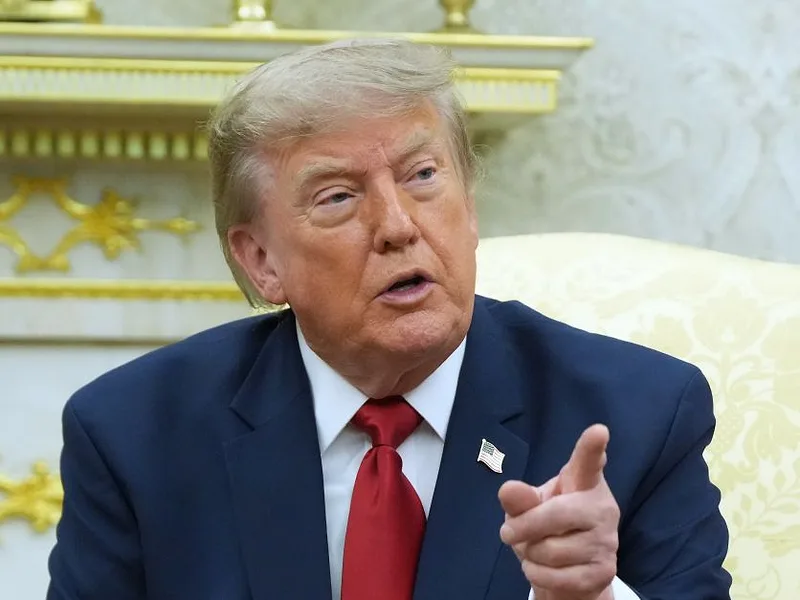
Following objections from lawmakers and shipping executives, President Donald Trump is scrapping a plan to charge a 20% fee on cargo moving through the Strait of Hormuz in exchange for U.S. protection in the war-fraught region.
The “reimbursement fee” announced Monday will be replaced with pro-U.S. trade and investment deals "that the various Gulf States will be making into the United States," Trump said in a social media post late Tuesday morning. “Those Investments will be MASSIVE but, at the same time, extraordinarily good for them, and their future,” he said.
Oil prices pared gains on Tuesday after surging a day earlier.
Trump said Tuesday oil is “flowing like never before” thanks to the U.S. military, and that the strait “is open to ALL Ship traffic except for Iran.” He also reiterated that the U.S. intends a "full blockade" on ships coming to and from Iranian ports, "or carrying anything have to do with Iranian cargo."
Trump plans to address the nation on Thursday evening.
The plan to charge a 20% fee in the strait contradicted Secretary of State Marco Rubio, who said last month that "no country is allowed to charge tolls or fees on an international waterway." Sen. John Kennedy, R-La., is among lawmakers who said Monday that the toll would be a mistake. Shipping executives also spoke out against the plan, CNBC reported. The United Nations' maritime agency opposes fees as well.
The strait, a vital trade chokepoint for connecting the Persian Gulf to the open sea, is a key route for roughly a third of global oil and fertilizer needed by farmers to grow the world’s crops for food, fuel and fiber. It’s also a crucial waterway for about a fifth of liquefied natural gas, an important fertilizer feedstock.
The resumption of strikes between the U.S. and Iran is raising fresh concerns about the potential economic and political toll. Republicans are fighting to keep control of the House and Senate in the upcoming November elections. More immediately, it’s far from clear if Congress would have enough votes to pass an $87.6 billion supplemental funding package, requested by Trump, mainly to fund the war with Iran.
Trump wants such legislation to also include two top agriculture items: legalization of year-round, voluntary U.S. sales of higher ethanol fuel blends, known as E15, and an additional round of financial aid – about $11 billion -- for farmers struggling with soaring costs of inputs like fertilizer.
U.S. Central Command says the U.S. completed the latest wave of strikes against Iran at 10:15 p.m. ET on Monday. More than 50,000 U.S. service members are currently deployed across the Middle East, according to CENTCOM.
For more news, go to Agri-Pulse.com.
.webp?t=1762183428)
