
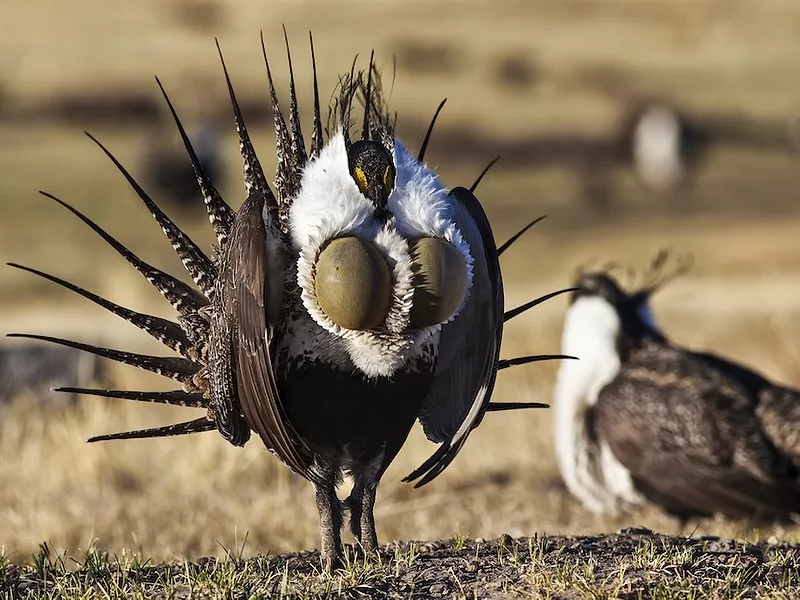
The Bureau of Land Management has released final greater sage-grouse habitat plans for eight states that will remove height benchmarks for perennial grasses, among other changes.
The changes make "more acres available in some areas for development," while "continuing to protect key habitat across approximately 65 million acres of sagebrush lands that sustain more than 350 wildlife species," according to a BLM press release.
The revised plans affect greater sage-grouse protection efforts on federal lands in Idaho, Montana, North Dakota, South Dakota, Nevada, California, Utah and Wyoming.
In Idaho, the indicator for perennial grass height has moved away from 7 inches or more and will instead be determined by "suitable nesting cover," which will be calculated based on ecological site potential and vegetation type. The agency also made similar grass height benchmark changes in California and Nevada.
BLM's plans also provide "management direction" for livestock grazing "to meet or make progress toward meeting the Land Health Standard," which "provides the tools to manage livestock grazing in a fashion consistent with healthy sagebrush systems, which in turn provide suitable habitat for [Greater Sage Grouse]," according to their text.
The plans update habitat management areas, which are used to help determine protections.
Plans for Colorado and Oregon were completed earlier this year, according to a press release.
According to the text of the plans, greater sage-grouse saw range-wide population declines of nearly 40% from 2002 to 2021. More than 87% of areas throughout the range saw declining habitats in these years, though others have seen stable to increaing populations.
Additionally, sagebrush availability declined by around 1.9 million acres (3%) between 2012 and 2018 across all types of land, though nearly 60% (around 1.1 million acres) of the losses occurred in BLM-administered lands, according to the plan.
National Cattlemen's Beef Association President Buck Wehrbein applauded the revised plans in a press release, saying they "recognize the role of cattle producers, as the original conservationists and follows the best available science."
"Without ranchers actively managing millions of acres of western rangeland, there would be less habitat and forage, and grouse populations would be substantially smaller,” Wehrbein said. “This is the blueprint for how management plans should be revised in the future, with a bottom-up approach focusing on input from land managers and rural communities that live alongside wildlife including grouse."
However, Randi Spivak, the public lands policy director for the Center for Biological Diversity, called the plans "reckless actions that will speed the extinction of greater sage grouse by allowing unfettered fossil fuel extraction and other destructive development across tens of millions of acres of public lands" and threatened litigation.
“Every president starting with Obama has screwed over these iconic Western birds and the hundreds of other wildlife species that depend on the beautiful sagebrush sea," Spivak said in a press release. "We’re not letting these dancing birds go without a fight, so we’ll see Trump in court.”

