

|
As the California Legislature returns to Sacramento this week, agricultural groups are bracing for a pivotal second year of the two-year session that will determine the fate of unfinished bills from 2025 and set the policy landscape for farms and ranches heading into 2026.
The return to session is less about a clean slate than unfinished business. Dozens of proposals that stalled or lawmakers shelved in 2025 return to action this month. Next month lawmakers will file more than a thousand new measures, with dozens likely to touch on water, land use, labor, environmental regulation and trade. The compressed timeline — combined with mounting budget pressure amid an estimated $18 billion state budget deficit — is heightening concern among farm advocates that long-running policy fights could intensify quickly. This week Gov. Gavin Newsom will unveil the first draft of his plan for tackling the spending shortfall.
The many policy issues at play were front and center last month at the California Farm Bureau’s annual meeting in Anaheim, where policy and legal staff walked members through what survived, what died and what is likely to return as lawmakers reconvene.
Agriculture enters the new year on defense across multiple fronts.
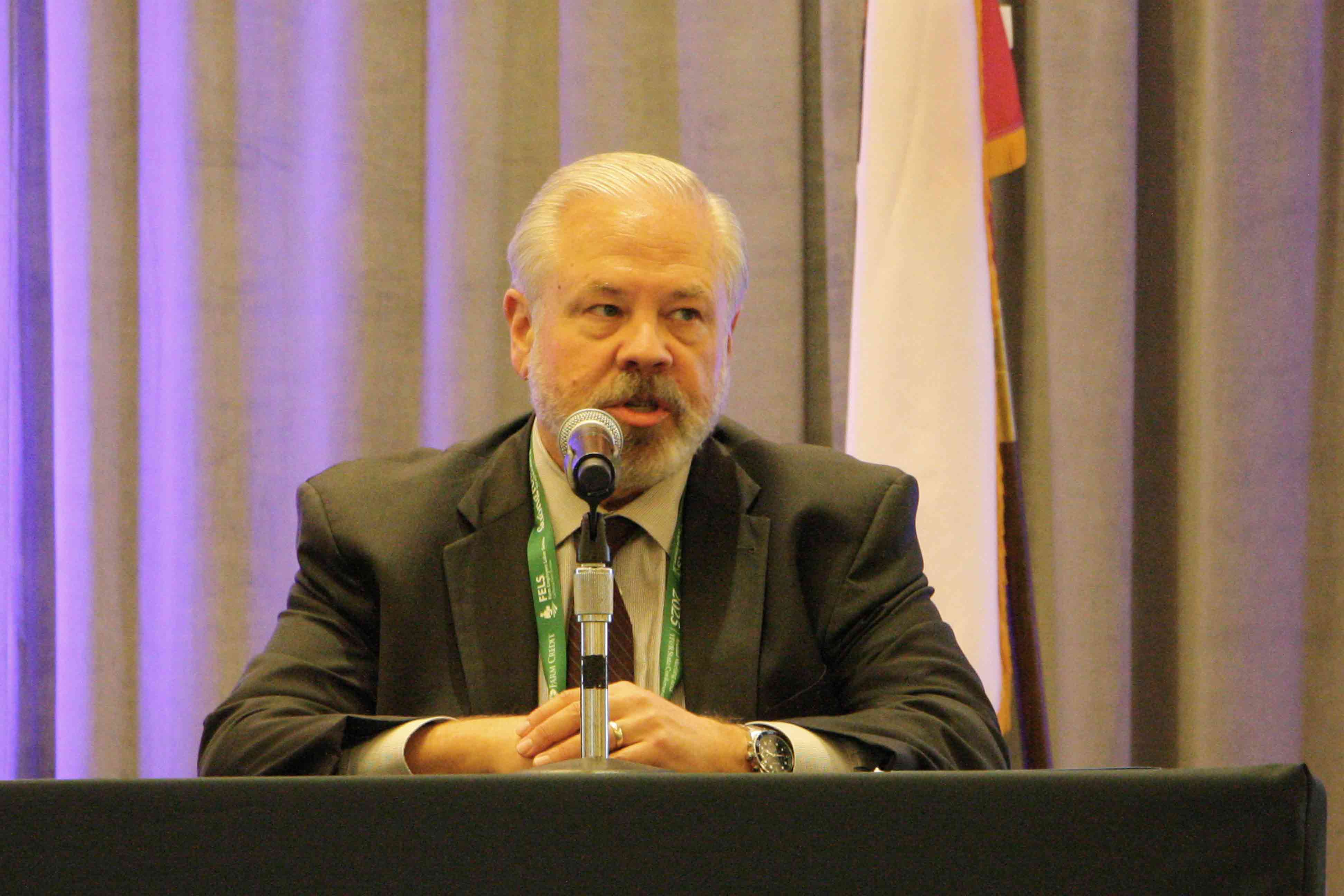 Bryan Little (Brad Hooker/ Agri-Pulse photo)
 Two-year bills give stalled proposals new life
California’s two-year legislative structure allows bills introduced in the first year of a session to carry over if they fail to advance, rather than forcing authors to start over. For agriculture, that means several high-profile proposals that were blocked or delayed last year are returning to life.
Alexandra Biering, who advocates on water legislation for the farm bureau, warned that while several proposals were stopped in 2025, many are expected to resurface.
“They're either fully dead or mostly dead,” said Biering, outlining five bills to watch. “And mostly dead ones can come back, unfortunately.”
Among the measures the farm bureau opposed last year and that Biering expects “to rear its ugly head again” is Senate Bill 601. The legislation seeks to restore federal wetland protections in response to the U.S. Supreme Court’s Sackett v. EPA decision. It would extend state oversight to “nexus waters” excluded from federal jurisdiction. Sen. Ben Allen, D-Santa Monica, had warned that Sackett stripped many wetlands and streams of long-standing federal protections and argued state safeguards were needed to prevent pollution discharges from flowing downstream into communities and farmland. Amid heavy opposition from agriculture and water districts, Allen dropped a contentious provision that would have enabled a private right of action to enforce new water quality protections.
Suing a farmer over alleged water quality violations would set a “really awful” precedent, said Biering, adding that the surviving regulatory component in the bill is “still really, really confusing” and not welcomed by the State Water Resources Control Board.
“So I might have to fight that one a little bit more,” she said.
Other water-related proposals were also blocked, including a bill to exempt wetlands from the Sustainable Groundwater Management Act, which died for the second year in a row under a renewed veto threat. Another that was “ill-conceived and poorly drafted” was a Trump resistance measure that would have fined local water agencies for releasing water from dams under false pretenses, she explained. Farmers would have also lost their right to challenge groundwater pumping allocations in court adjudication proceedings under another bill that died. Lawmakers also unsuccessfully sought to dip into the Proposition 4 climate bond to finance dam removal projects.
Biering appreciated that lawmakers had pulled back on previous efforts to reform California’s water rights system. Yet she cautioned that the block on the proposals may be temporary, since lawmakers could reintroduce the proposals under new bills next month.
Regulatory pressure intensifies on water quality
Biering plans to be heavily engaged this year in agency-driven water decisions that could prove more consequential than any legislation.
The farm bureau plans to participate in water rights proceedings for Sites Reservoir, where updated modeling and diversion questions remain under review at the water board and could affect how much water the project ultimately stores for agricultural and municipal users. She also flagged probationary proceedings under SGMA, along with groundwater pumping and water rights fees, as pressure points for growers at the water board. The board’s long-running Bay-Delta Plan update is unlikely to reach a final vote until 2027, extending uncertainty over future flow requirements for Sacramento Valley and Delta exporters.
Agriculture did receive some positive news late last year at the federal level, she noted, when the Trump administration approved Action 5, a Central Valley Project operational change that loosens certain Delta constraints and could improve water supply reliability for farms dependent on federal deliveries.
Kari Fisher, senior counsel at the farm bureau, added that irrigated lands regulations and fertilizer management policies are poised for major changes as the state water board convenes an expert panel to inform new rulemaking.
“If you think what you have now with [nitrogen calculations] is hard, annoying, confusing, terrible — however you want to describe it — this is likely to get much worse,” said Fisher.
Interested in more news on California agriculture, labor, water and rural issues? Sign up for a four-week free trial to Agri-Pulse West. You’ll receive our content - absolutely free - during the trial period.
Application limits currently on hold for the Central Coast under Ag Order 4.0 could go statewide, she warned.
“They hear from environmental justice and environmental communities every single meeting about how terrible farmers are and how they're causing water quality problems,” she said. “They need to hear from our voice as well.”
A sweeping dairy order more than a decade in the making is due to come out soon. Like Ag Order 4.0, the order could impact dairies throughout the state, extending beyond the initial Central Valley scope. The industry’s argument centers on the board’s classification of manure as waste, rather than a useful agriculture product.
Land use fight returns, with solar development a flashpoint
The future of the Williamson Act is expected to remain a battleground as lawmakers return to session and farmers seek to repurpose land marginalized under SGMA. Senior policy advocate Peter Ansel cautioned that efforts by large-scale solar developers to weaken Williamson Act protections are far from over.
Last year the debate centered on eliminating cancellation fees for land enrolled in the program, a change Ansel said would undermine the contract’s foundation.
 Kari Fisher (Brad Hooker/ Agri-Pulse photo)
“The cancellation fee is really paramount to the way the act works,” he said.
Although California Farm Bureau successfully stalled the most recent bill by forcing amendments and keeping it from reaching the governor’s desk, Ansel warned the proposal remains on inactive file and could be revived at any point this year.
He anticipates the bill will advance this month, despite procedural hurdles ahead to send it back to the Senate for consideration. He worries the fight could shift to the budget arena, where changes could be embedded in funding language rather than standalone bills. The solar industry has also stepped up its influencing campaign, “getting into some of our county farm bureaus and convincing folks” that policy changes are needed, said Ansel.
“This is a shell game, where we've got to be nimble and working in all of these different avenues at the same time,” he said.
Labor, overtime and automation remain unresolved
Labor policy is another area where unfinished business from last year could return quickly as lawmakers resume committee hearings.
Bryan Little, senior director of policy advocacy at the farm bureau, outlined ongoing efforts to secure an agricultural overtime tax credit. After Democrats shot it down in the first hearing, SB 628 is up for reconsideration in the Senate Labor Committee this month.
Little acknowledged “it’s been an uphill climb to do anything proactive in our Legislature’s political climate.” He has been working with the bill’s author, Sen. Shannon Grove, R-Bakersfield, on other legislative options as well and is in discussions with Assembly offices about introducing a companion measure. He emphasizes that agricultural production does not fit a standard eight-hour workday.
“You can’t turn off the lights, lock the door and go home on a Friday afternoon, come back on Monday morning, turn the lights back on and start producing again,” he said.
Legislation to ease California’s ban on autonomous tractors may come before lawmakers, if regulatory efforts at Cal/OSHA continue to stall, according to Little, who shared frustration over the workplace safety agency’s glacial review process.
“For 10 years, we’ve been working to try to make some headway on this,” he said. “We are now looking at legislative solutions to the problem.”
With two-year bills reviving old fights, agencies advancing consequential rulemaking and budget pressures narrowing lawmakers’ options, the second year of the session is shaping up less as a reset than a reckoning. For growers and ranchers, the outcome may hinge as much on regulatory hearings and budget negotiations as on floor votes.

