
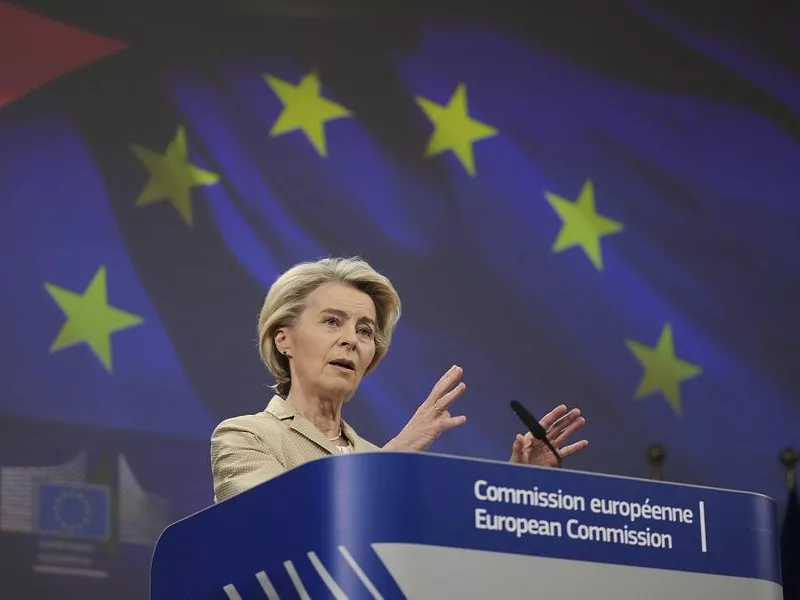
European Commission officials met this week with member state agricultural ministers as they tried to shore up support for a critical vote on Friday for a South American trade deal. As part of those negotiations, the commission revived pledges to increase checks on ag imports for banned pesticides.
The Council of the European Union is set to vote on the commission’s trade deal with Mercosur countries on Friday. Ag producers oppose the deal fearing that a flood of South American exports will threaten their livelihoods.
The European Parliament and Council agreed to insert safeguards in the agreement to protect domestic industries from surging imports, and the commission agreed to closely monitor the situation. But France and Poland were still opposing the deal heading into this week, with Italy’s position unclear.
Accordingly, Commissioner for Agriculture Christophe Hansen, Trade Commissioner Maroš Šefčovič and Commissioner for Health and Animal Welfare Olivér Várhelyi met with EU agriculture ministers and Minister Maria Panayiotou for the Cypriot Presidency of the Council to offer additional sweeteners.
The commission agrees to give farmers early access to €45 billion ($52 billion) from the next Common Agricultural Policy budget and reserve additional funding for rural investments. Officials also proposed suspending tariffs on fertilizers to reduce costs for farmers.
Several other goodies could affect U.S. exports to the bloc, however. The commission said it would bolster its imported products inspections to ensure compliance with the bloc’s maximum residue limits. Officials said audits for imports from non-EU countries would increase 50%, reiterating a pledge made several weeks ago.
“The Commission will update the level of checks of official controls at the borders more frequently and will help Member States carrying out most of these additional checks,” a summary document from the meeting says.
A new task force will also launch this month to streamline import controls, the document says.
The measures come after several EU efforts to increase scrutiny of food and ag imports. The bloc has already drafted a regulation that would lower maximum residue limits to zero for carbendazim, benomyl and thiophanate-methyl, and suggested it could restrict imports of products with any residues of certain pesticides.
The commission’s sweeteners also come as France, one of the remaining holdouts, took unilateral steps this week to ban imports containing traces of five pesticides that are prohibited in the EU but have been tolerated at low levels in imported products.
Will it work?
The commission needs to secure votes from member states representing at least 65% of the EU population to get the deal through the Council. Italy’s foreign minister suggested Wednesday evening that his government is now on board, which should give the deal the necessary support, according to former EU chief agricultural negotiator John Clarke.
“It will get through narrowly,” Clarke predicted in an interview with Agri-Pulse. Clarke said France and Poland may still oppose the deal, as could some other smaller countries.
But Alice O’Donovan, secretary general of the European Liaison Committee for the Agricultural and Agri-food Trade, noted that the optics of a major EU member and agricultural producer like France opposing the deal wouldn’t be good.
She pointed out that many farmers remain concerned by the deal – which has been in the works for around 25 years – even with the added safeguards.
“They just see it as Armageddon for their own industries,” she said. Beef producers, for example, are concerned that Brazil could fill a beef quota with prime cuts of meat that, they say, would “decimate” the high-value beef market.
Meanwhile, other farmers see the merits of a deal that could provide a buffer against an increasingly volatile international trade landscape, she said.
“Other people are saying, ‘Look, we'll adapt, we'll survive, and we really, really need to strengthen the EU's links with the South American countries – and the Western Hemisphere, given what's happening,” she said.
If the Council approves the deal, European Commission President Ursula von der Leyen will sign the deal before the deal goes to the European Parliament for approval.
With lingering opposition from EU farmers, Clarke anticipates further frictions in the parliament, however.
“I'm quite sure we'll see renewed farmers protests in Brussels and elsewhere,” once parliamentary debates and votes get underway, he said. But he said the commission might get a headwind from an unlikely source: President Donald Trump.
If the U.S. president continues to throw grenades into the global trading system, Clarke noted, more Europeans could come around to the commission’s arguments for bolstering EU trade ties.
“The more that Trump causes problems for the EU, the better that bodes for Mercosur,” he said.
For more news, go to Agri-Pulse.com

