

The Supreme Court will not rule on President Donald Trump’s emergency tariffs today. But speculation continues on how the Court will rule when it finally does.
“I think everyone kind of agrees that maybe we're slightly above 50% chance of the Supreme Court ruling these tariffs illegal,” Simon Lester, a nonresident fellow at the Baker Institute’s international economics program, told Agri-Pulse.
Trump has been doubling down on the duties in recent days and warning of dire outcomes if the court strikes them down.
Trump told the Detroit Economic Club on Tuesday that those who brought the case before the court are being “China-centric.”
“I wouldn't want [the tariffs] if I was China either,” Trump said. “China's one of our biggest taxpayers right now,” he added, claiming that other countries, not U.S. citizens, are paying the tariffs.
But recent analyses show that U.S. businesses absorbed many of the early tariff costs, and U.S. consumers are paying many of them now. Meanwhile, foreign companies are only eating between 14 and 25% of the costs.
More from SCOTUS: The high court redistributed for conference on Friday a petition from Bayer subsidiary Monsanto. The petition asks the court to take up the question of whether federal pesticide law pre-empts claims brought under state liability law.
It’s possible the court could have a decision by Monday, Jan. 19, on whether it will take up the case. It also could delay action and again distribute the petition for conference.
Corn glut and E15
The larger-than-expected U.S. corn supply is triggering fresh calls for Congress to pass ethanol legislation the industry says is critical to future growth.
Biofuel backers pushing for the ability to sell higher blends of ethanol, known as E15, both all year and nationwide, say USDA made their case for them on Monday.
That’s when USDA’s supply-and-demand report showed a record large 2025 corn crop of more than 17 billion bushels, with inventories rising the most in eight years and prices falling to the lowest level in six years.
Renewable Fuels Association CEO Geoff Cooper says the bearish market forces are a “sobering wake-up call about the state of the farm economy.” He says doing away with the E15 barrier, as well as outdated fuel retail infrastructure regulations, is the fastest way to get the market on the right track.
Cooper says that ethanol expansion through E15 sales could create new demand for more than 2 billion bushels of corn and sorghum and save consumers an estimated 10 to 30 cents per gallon at the gasoline pump.
Farm-state lawmakers are trying to pass E15 legislation early this year. They face opposition from some independent refiners, environmentalists and some Democrats.
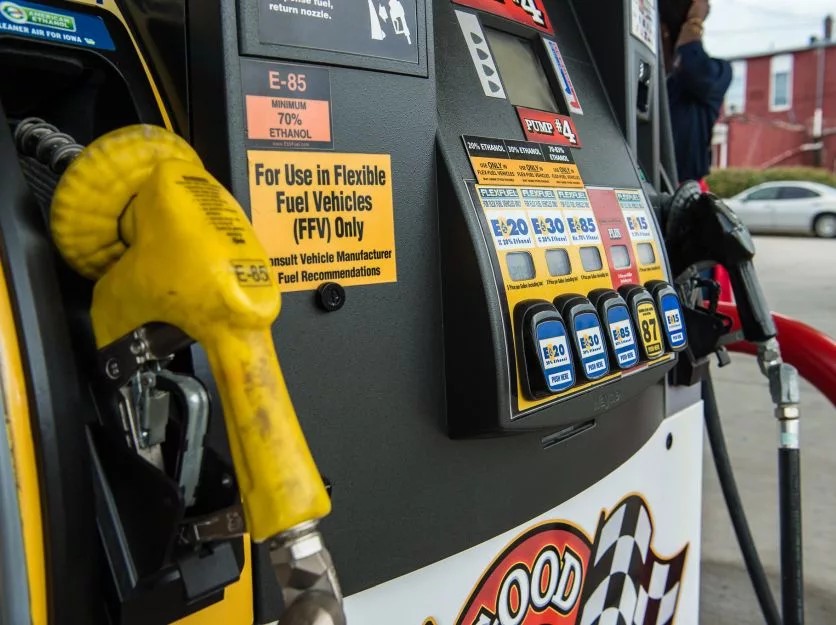 Pump in Nevada, Iowa (Photo by Dennis Schroeder/NREL)
EPA floats new water quality certification proposal
The Environmental Protection Agency is proposing a new rule that would affect how states certify that federal infrastructure projects do not harm water quality.
Under the Clean Water Act’s Section 401, states must show EPA how projects, such as hydroelectric dams, will not violate water quality standards. EPA news release says the proposal would increase permitting efficiency and eliminate “unwarranted delays that have stifled economic growth.”
A 2023 Biden administration rule allowed states to employ “delay tactics and protracted certification timelines inconsistent with the Clean Water Act,” EPA’s release says.
Carbon pipeline drama
In Iowa, which is the top U.S. corn and ethanol producer, a bill was introduced that would bar using eminent domain for carbon pipeline projects, spurring backlash from biofuel and ag groups.
The Iowa Renewable Fuels Association says the measure would cut off tools that ethanol firms need to compete in a fast-changing energy economy.
“This bill would essentially ban CO2 projects in Iowa while our neighboring states are moving forward,” IRFA Executive Director Monte Shaw says. Capturing and sequestering carbon from Iowa plants would reduce greenhouse gases, enhance oil production and generate $3 billion in federal incentives, he says.
Summit Carbon Solutions also spoke out. It has faced opposition to its effort to build a nearly $10 billion CO2 pipeline through Iowa and four other states.
“At a time when corn prices are already under pressure, rural communities need policies that expand opportunity and investment – not ones that shut the door on future markets,” the Iowa-based company says.
The pipeline project is meant to capture and store emissions from ethanol plants, which is part of the industry’s push to decarbonize and be more competitive in low-carbon fuel markets.
CO2 pipeline opponents have raised concerns about property rights and safety.
Summit says it remains focused on working with landowners and policymakers to find the right path forward.
Iowa Governor Kim Reynolds vetoed a similar bill last year.
Eminent domain, sometimes used for infrastructure projects, is a legal process for accessing privately owned land when an agreement can’t be reached with landowners.
Final Word
“There’s no real advantage to it, it’s irrelevant… Canada wants it. They need it…. The problem is we don't need their product. You know, we don't need cars made in Canada. We don't need cars made in Mexico.” – President Trump on the U.S.-Mexico-Canada Agreement. The deal comes up for review in July.
.webp?t=1762183428)


