
|
Agricultural leaders and San Joaquin Valley air regulators are warning that Gov. Gavin Newsom’s budget proposal fails to restore funding for some of the valley’s most effective air quality and agricultural incentive programs, even as California increasingly leans on working lands to deliver wildfire mitigation, water resilience and climate benefits.
Diverting more cap-and-trade (now Cap-and-Invest) revenues away from grants for climate-smart agriculture and for reducing car, truck and tractor emissions is raising concerns over how the industry can meet stringent state and federal clean air mandates.
The governor’s initial budget proposal for the fiscal year starting in July includes $200 million for a new light-duty zero-emission vehicle incentive program and continues funding for the Community Air Protection Program, but it provides no funding for the FARMER program, agricultural burning alternatives or Clean Cars 4 All — programs district officials and growers say deliver some of the fastest and most cost-effective air quality improvements in the valley.
In a statement responding to the budget, California Farm Bureau President Shannon Douglass said the proposal “invests heavily in wildfire response, but funding for proactive strategies on working lands remains limited,” a concern echoed repeatedly during the San Joaquin Valley Air Pollution Control District’s monthly board hearing last week.
Mark Montelongo, the district’s director of policy and government affairs, told board members that while stationary source emissions in the valley have dropped more than 90% since the 1990s, more than 80% of the remaining nitrogen oxide emissions now come from mobile sources.
“In order to meet the current air quality mandates, strong state support is needed,” said Montelongo, emphasizing that local air districts lack authority over vehicle and engine standards and must rely on incentive programs to achieve reductions.
 Samir Sheikh, San Joaquin Valley Air Pollution Control District (office photo)
FARMER oversubscribed as funding disappears
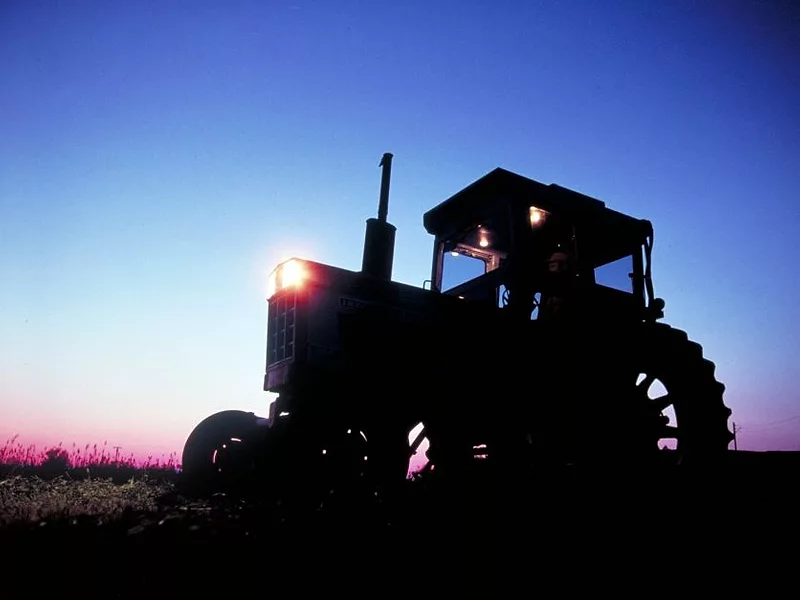
District staff said the FARMER program, which helps growers replace older tractors and equipment with cleaner or zero-emission models, is severely oversubscribed. The district is requesting $200 million per year statewide, with more than 6,600 applications already in its queue representing roughly $665 million in demand. Acceptance of new applications was suspended in mid-2025 after available funding was exhausted.
The funding shortfall drew sharp criticism from Roger Isom, president and CEO of the Western Tree Nut Association and the California Cotton Ginners and Growers Association.
“At a high level, Cap-and-Invest is a good program, especially for those people that have to comply with it,” said Isom. “Where the wheels start to get wobbly and almost come off is how the money is spent to get greenhouse gas reductions.”
Isom described FARMER as “probably the best program to get the reductions that the concept was originally intended for,” thanking district staff for continuing to advocate for its restoration in Sacramento.
“Our team has already been at work doing the same thing this year and not giving up on it,” he said.
Legislative support for FARMER and agricultural burning alternatives remains strong, but budget pressures and diversions from the Greenhouse Gas Reduction Fund had undercut the funding last year, according to Isom.
Interested in more news on California agriculture, labor, water and rural issues? Sign up for a four-week free trial to Agri-Pulse West. You’ll receive our content - absolutely free - during the trial period.
“One of the big things that hurt us this last go-around was a billion or so that went to the wildfire fund,” he said. “For all intents and purposes, the fund has become a slush fund.”
Douglass made a similar point in the farm bureau’s budget response, arguing agriculture is increasingly expected to shoulder wildfire mitigation through grazing, vegetation management and stewardship, even as funding is shifted toward emergency response rather than prevention. She said agriculture is “increasingly relied upon for wildfire mitigation, water resilience and climate solutions, yet it is not recognized as critical infrastructure.”
Growers warn rural communities will bear the cost
Manuel Cunha, president of the Nisei Farmers League, sharply questioned the state’s handling of cap-and-trade revenue and warned that rural valley communities are being left behind.
“Cap-and-trade today … is a slush fund for the governor,” Cunha said, while criticizing long-standing diversions to projects outside of the climate policy arena, such as high-speed rail.
Cunha questioned how California moved from a massive surplus starting in 2021 to repeated deficits starting in 2023, while agricultural air quality programs went unfunded.
“California had a $95 billion surplus,” he said. “What happened to that money?”
He warned that land fallowing driven by water scarcity and the Sustainable Groundwater Management Act could idle up to 900,000 acres of farmland, devastating small rural towns.
“Who gets screwed?” said Cunha. “The farm community, the working community, the store community of Avenal, Firebaugh, Tranquillity, Wasco.”
 Manuel Cunha (Nisei Farmers League photo)
Douglass raised a parallel concern in her statement, saying investments in water infrastructure must be paired with regulatory efficiency “so they can move forward and deliver real, on-the-ground benefits for farms and ranches,” particularly in regions already facing land retirement and economic strain.
The plan includes $69 million from the 2024 Proposition 4 climate bond to allocate toward fixing canals and other conveyance infrastructure, particularly to account for damage due to subsidence. Yet valley water interests have long advocated for far greater spending to shore up supplies to prepare for SGMA cutbacks and climate impacts.
Cunha also said growers are increasingly worried agriculture will be targeted to compensate for emission reductions the state can no longer achieve through federal vehicle rules.
“When I sat down with CARB in December, what I heard for what CARB needs to do to make up the deficit of the emissions issue on trucks was to go after agriculture,” he said.
District leaders acknowledged the challenges posed by a constrained state budget and uncertainty surrounding cap-and-invest auction revenues. While lawmakers approved a long-term extension of the program, revenue projections remain volatile.
Samir Sheikh, the district’s executive director, said the newly authorized continuous appropriation for the Community Air Protection Program — up to $250 million annually over 20 years — represents a major win, but near-term funding levels depend on cap-and-invest revenues. Newsom plans to allocate $177 million for the program.
“That number is essentially proportionalized based on projected revenues,” said Sheikh, adding that future auctions could change the figure as the budget process unfolds.
In her statement, Douglass said agriculture can continue delivering environmental benefits “with the right funding and regulatory support,” but warned that the current budget leaves gaps that could slow progress.
As budget negotiations move toward the May revision and June deadline, valley air officials and farm groups alike said they plan to intensify outreach to lawmakers, arguing that programs like FARMER and agricultural burning alternatives deliver immediate public health benefits while supporting rural economies.
“When the state is saying they don’t have the reductions because of what’s happened at the federal level, we have ways to get some of that back,” said Isom. “And we can get it.”

