
|
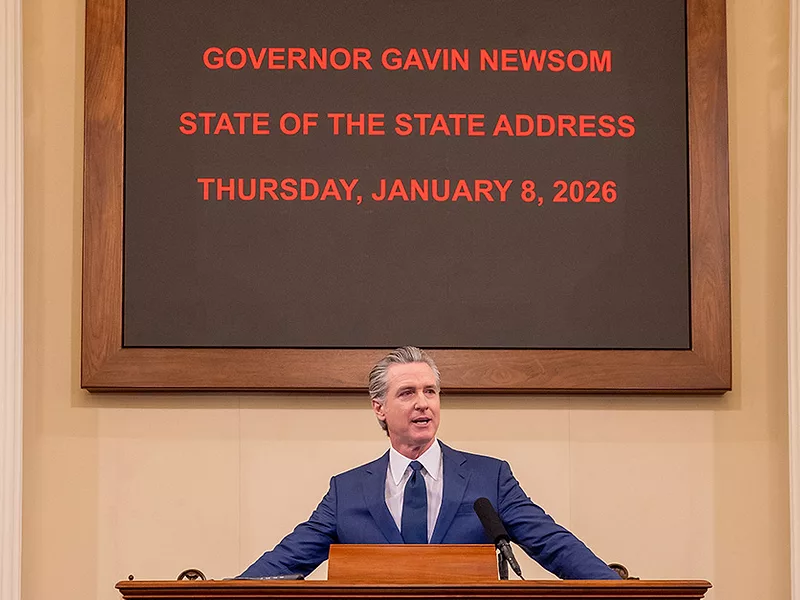
Gov. Gavin Newsom’s initial budget proposal for the fiscal year starting July 1 takes a cautious posture while quietly progressing a set of policy choices that carry implications for agriculture, water, food programs and health care for undocumented Californians.
The $348.9 billion spending plan relies on rebounding revenues to rebuild reserves rather than launch sweeping new initiatives. For agriculture and rural communities, the details reveal a budget that maintains some climate grants, without returning them to pre-deficit levels, and protects nutrition and health programs that many farmworker families rely on.
In his message to lawmakers, Newsom warned against assuming the state’s revenue rebound will last.
“History teaches us that prosperity, if taken for granted, can vanish as quickly as it arrives,” he wrote. “California’s responsibility is to act with steady hands and anticipate future instability.”
That caution frames a proposal that largely avoids new spending commitments while using bonds, special funds and limited proposals to move forward on some programs for water, climate, pesticide oversight and worker protections.
 CDFA Secretary Karen Ross (Fred Greaves/ Agri-Pulse photo)
Climate-smart ag and school food programs
Rather than headline-grabbing spending increases, agriculture policy in the budget has moved through incremental but consequential investments.
At a media briefing, California Department of Food and Agriculture Secretary Karen Ross emphasized the scale of existing agricultural climate programs and the administration’s intent to build on them.
“We’ve invested nearly $600 million in a suite of advanced climate-smart agricultural practices on nearly 3,000 projects, which equate to 300,000 acres under these practices,” said Ross. “The projects have resulted in a reduction of approximately 27.7 million metric tons of carbon dioxide equivalent across the lifetime of the projects.”
Those programs would receive $2.1 billion under the proposed spending plan for the climate bond voters approved in 2024, with $89 million spread across more than a dozen climate-smart agriculture programs. The Healthy Soils Program, at $25 million, would get the bulk of the funding, while others would receive enough to keep the programs running. Another $792 million would go toward various water resilience projects.
Outside of bond funding, the budget seeks to make the Farm to School Incubator Grant Program a permanent feature of state policy. CDFA is requesting $25 million from the general taxpayer account, with comparable funding in subsequent years, to support local food procurement, infrastructure and technical assistance for schools.
Interested in more news on California agriculture, labor, water and rural issues? Sign up for a four-week free trial to Agri-Pulse West. You’ll receive our content - absolutely free - during the trial period.
The Community Alliance with Family Farmers argues the programs help build stable institutional markets for farmers while improving student nutrition. The alliance warns that federal cuts to local food procurement could weaken those markets just as food insecurity remains elevated.
Water planning and permitting take center stage
Water policy emerges as one of the most consequential areas of the budget for agriculture.
A key investment is funding to implement Senate Bill 72, which requires the Department of Water Resources to modernize the California Water Plan and establish water supply targets through 2040. DWR is requesting $6 million annually for five years to carry out that work.
Finance officials tied SB 72 to projections showing climate change could reduce California’s water supplies by roughly 10% by 2040. For agriculture, the planning effort is likely to shape future decisions on groundwater recharge, surface storage, conveyance and land repurposing, particularly in basins under pressure from the Sustainable Groundwater Management Act.
At the same time, the budget includes $3 million for the State Water Resources Control Board to staff up in response to the U.S. Supreme Court’s Sackett v. EPA decision. That ruling sharply narrowed federal Clean Water Act jurisdiction, leaving many wetlands and streams without federal protection and shifting responsibility to states.
Agri-Pulse has reported that the decision effectively pushed more permitting and enforcement responsibility onto California, increasing the water board’s workload and raising concerns about project timelines for farmers, water districts and habitat restoration efforts. The proposed funding would add staff to manage permitting, monitoring and enforcement under state law, a move environmental groups support and farm groups are watching closely as it could affect how quickly projects move.
Pesticide oversight and labor enforcement
Several agency proposals expand regulatory capacity in areas that directly affect growers.
The Department of Pesticide Regulation is seeking ongoing funding to maintain Spray Days, the statewide pesticide notification system launched last year. Without new funding, DPR warned the system’s cloud infrastructure and outreach efforts would lapse.
DPR is also requesting additional scientific staff to expand modeling and mitigation work related to 1,3-dichloropropene and other fumigants. While the proposals stop short of new restrictions, they signal continued investment in data collection and oversight that could inform future regulatory decisions.
Labor enforcement is another focus. The Department of Industrial Relations is seeking $8 million and 34 positions to continue extreme heat workload enforcement and outreach, building on temporary funding that is set to expire. Agriculture remains one of the sectors most affected by heat illness, and state officials argue permanent staffing is necessary as extreme heat becomes more frequent.
DIR is also requesting funding to implement Assembly Bill 1362, which expands foreign labor contractor registration requirements to agricultural H-2A recruiters beginning in 2027. The proposal would add licensing and enforcement resources, a change that could alter compliance obligations for farm labor contractors and employers who rely on the H-2A program.
 Sen. Roger Niello, R-Fair Oaks (Niello office photo)
Nutrition, health care and the negotiations ahead
Nutrition and food access programs also figure prominently for agricultural communities, particularly as federal policy shifts threaten to reduce support.
The budget maintains funding for CalFresh and related nutrition programs even as the Newsom administration estimates federal actions will add significant financial pressure in the next fiscal cycle. The plan reflects an estimated $383 million increase for CalFresh tied to the federal cost shift, plus a $66 million reduction attributed to restricted eligibility under H.R. 1.
State officials have framed the decision as both a public health and economic necessity, particularly in rural areas where food insecurity rates remain high.
The Farm to School proposal is closely tied to that strategy, with the administration arguing that strengthening local food systems can improve nutrition outcomes while supporting in-state producers.
One of the most politically sensitive elements of the budget is the administration’s decision to maintain health care coverage for undocumented Californians through Medi-Cal, despite ongoing cost pressures.
Health and Human Services spending continues to grow, driven in part by enrollment and medical inflation. Finance officials have acknowledged that federal policy changes could further increase costs, but the budget plan does not roll back eligibility expansions adopted in recent years.
For agriculture, the decision carries direct implications for farmworker communities, where many rely on Medi-Cal coverage. Advocates argue that maintaining access to preventive and primary care reduces emergency room use and supports a healthier workforce, while critics point to long-term affordability concerns.
Business groups welcomed the absence of new taxes in the proposal. The California Chamber of Commerce praised the governor for advancing a balanced budget without additional tax burdens, arguing that California’s economy cannot absorb further costs as employers grapple with inflation and regulatory pressure.
Sen. Roger Niello, R-Fair Oaks, and his fellow Senate Republicans were more critical, arguing the state is “running-in-place” with a plan that fails to address affordability, water supply and public safety. GOP lawmakers have argued for redirecting spending toward water infrastructure and emergency preparedness, setting up familiar fault lines ahead of budget negotiations.
Budget committees will begin hearings on the proposal next week. April tax revenues will inform the next budget revisions, due out in May, and provide more clarity for what farmers and ranchers can expect for the year ahead.
Correction: This article previously misquoted Sec. Ross saying the state had invested in 30,000 climate-smart agricultural projects.

