
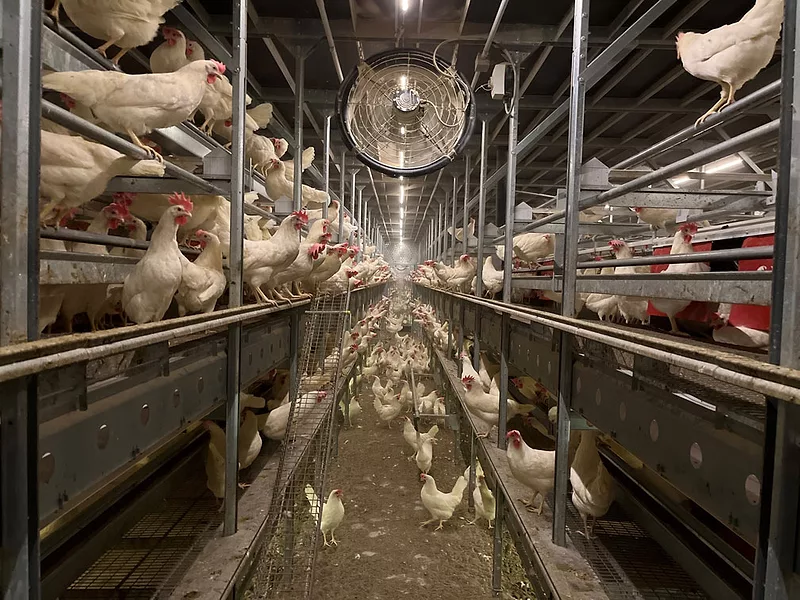
The Justice Department has filed suit to strike down Michigan's cage-free egg law, asserting that it's driving up prices for consumers around the nation, but the state's egg producers say avian flu has been the main reason for price spikes.
“By design and effect, Michigan’s ban on noncompliant eggs restricts supply and increases compliance costs, contributing to higher prices for American families,” says the lawsuit, filed Thursday in federal court in .the Western District of Michigan.
The lawsuit, which claims that only the federal government can regulate the "quality and inspection" of eggs sold in interstate commerce, cites no data or studies to support the claim that compliance costs have driven up the cost of eggs.
But the lawsuit also asserts, "The United States is facing a serious and sustained cost-of-living crisis. Overly burdensome and unnecessary regulations have diminished the purchasing power and prosperity of the American worker. These regulatory costs are borne most acutely by families purchasing essential goods, including food."
Nancy Barr, executive director of Michigan Allied Poultry Industries, told Agri-Pulse Friday that highly pathogenic avian influenza "is what had caused the prices to go up, much more so than cage-free production."
Barr noted the law has been in the works for 15 years, during which time producers "spent hundreds of millions of dollars converting all of their barns over to cage-free to be in compliance with the law."
"Our wish is that the administration would put more focus on a vaccine for HPAI to protect our flocks," she said. "I think that would do more than anything else to reduce the threat of egg prices going up."
Cut through the clutter! We deliver the news you need to stay informed about farm, food and rural issues. Sign up for a FREE month of Agri-Pulse here.
Barr also noted that a dozen cage-free eggs at her local Meijer in Lansing are going for $1.99.
Barr said it was too early to say whether the group may join the lawsuit to defend the law. However, she added that abandoning it would be problematic for producers, who have been investing in converting their barns for more than a decade.
"They did that to comply with the law. And if the law changes, it's difficult for producers to flex in that way. It just takes a long time," she says.
Like California’s Prop 12 animal welfare law, Michigan's cage-free law also prohibits the sale of eggs in the state that do not conform with Michigan’s housing standards. But Barr says Michigan doesn't need eggs from out of state.
"Michigan is an export state, so we produce enough eggs for all the Michigan consumers as well as for other states," she said. "We have plenty of supply."
In July, the Justice Department filed suit challenging Prop 12, which was upheld by the Supreme Court in 2023.
In that case, pork producers had sued California over the law’s ban on the sale of pork from the offspring of sows raised in gestation crates. The government’s complaints in both cases say the laws violate the Egg Products Inspection Act and the Constitution’s Supremacy Clause.
Under that clause, “federal law expressly preempts state law where, as here, Congress acting within its constitutional authority expresses an intent to preempt state law through explicit statutory language,” the complaints in both cases say.
The lawsuit cites no data or studies to support the claim that compliance costs have driven up the cost of eggs.
Egg prices, which have been a focus of the Trump administration, have fallen precipitously in the past few months. The St. Louis Federal Reserve Bank’s FRED data shows a current price of $2.71 for a dozen Grade A large eggs, down from about $6.23 in May 2025.
Humane World for Animals and the Humane World Action Fund criticized the lawsuit and noted that Michigan is one of 11 states that ban the use of cages for egg-laying hens and one of eight that ban the sale of eggs from cage facilities.
“We are confident this law, which protects animals from extreme cruelty and Michigan families from necessary food safety risks, will be upheld in court like similar laws consistently have been,” said Mitchell Nelson, Michigan state director for Humane World for Animals.
The lawsuit names as defendants the state of Michigan, Michigan Department of Agriculture and Rural Development Director Tim Boring, and Michigan Attorney General Dana Nessel.
For more news, go to Agri-Pulse.com.
This story was corrected to note the lawsuit was filed in Michigan

