
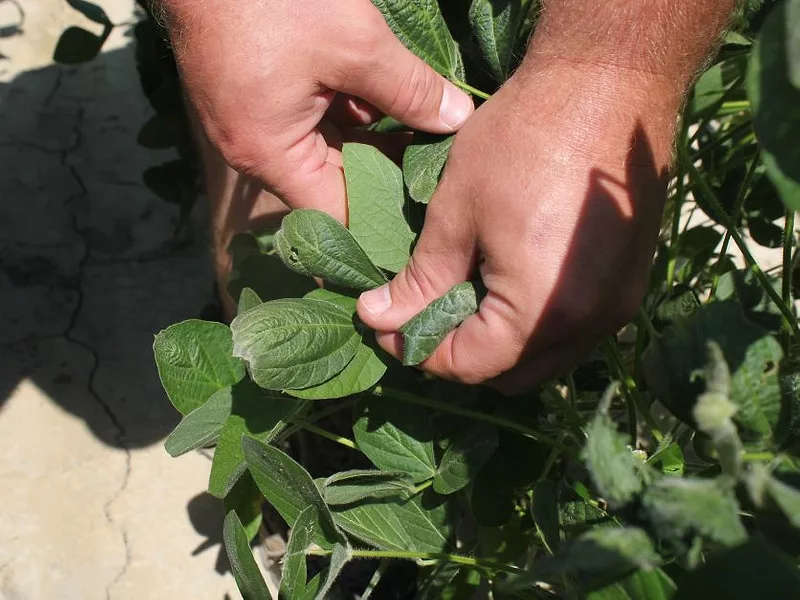
The Environmental Protection Agency has approved dicamba for over-the-top application in soybeans and cotton in a decision that it called a direct response to grower pleas.
The registrations for OTT applications of the controversial herbicide, whose volatility makes it prone to travel beyond application sites, had been vacated twice in recent years by federal courts. The chemical, sold as Xtendimax by Bayer, Tavium by Syngenta and Engenia by BASF, was not used over the top last year for the first time since 2017.
The registration comes with numerous conditions that could make the process of using it difficult for growers. EPA said it was establishing “the strictest restrictions [it] has ever required for any dicamba product.”
The approval is for the 2026 and 2027 growing seasons.
“This limited timeframe gives us a clear checkpoint to evaluate how these protections are working in the real world,” EPA said on its website. “During these two seasons, we'll be closely monitoring incident reports of off-target damage, environmental monitoring data, compliance with label requirements, and the real-world performance of all restrictions.”
After the 2026 and 2027 growing seasons, “EPA will comprehensively review all collected data. Based on that evidence, we will either allow continued use with current or stronger restrictions, adjust restrictions based on what we've learned, or revoke approval entirely if the protections aren't working as intended.”
The agency’s decision “responds directly to the strong advocacy of America's cotton and soybean farmers, particularly growers across the Cotton Belt, who have been clear and consistent about the critical challenges they face without access to this tool for controlling resistant weeds in their growing crops,” the agency’s news release said.
“Cotton farmers across the southern United States have been particularly vocal about why they need OTT dicamba as herbicide-resistant weeds like Palmer amaranth have become nearly impossible to control with other available tools, threatening crop yields and farm viability,” the release said.
The agency also noted that “the ecological risks associated with dicamba drift and volatility are real. If not carefully mitigated, off-target movement of dicamba can damage sensitive plants and impact neighboring farms and natural ecosystems.”
Among those restrictions, EPA has cut in half the amount that can be applied, to two applications of a half-pound per acre annually.
In addition, it has doubled the amount of volatility reduction agents to 40 ounces an acre and required growers to achieve 3 runoff/erosion mitigation points from EPA's certified conservation practices menu on each treated field to protect endangered and threatened species.
“In some geographically-specific pesticide use limitation areas (PULAs) where especially vulnerable species require additional safeguards, 6 points are required,” the agency said.
“These practices — such as vegetative buffers, contour farming, and cover crops —physically prevent dicamba from moving off-field in runoff or eroded soil, protecting waterways and habitats,” EPA said.
There are also temperature-based application limits. “For applications occurring on a day with a forecasted temperature between 85-95°F on the day of or the day after application, a user may only treat up to 50% of their untreated dicamba-tolerant cotton and soybean acres in a county,” EPA said.
“Remaining DT cotton and soybean acres may not be treated until at least two days after the initial application. This reduces risk during conditions when volatility and drift are elevated. No applications may occur if the temperature is forecasted to be at or above 95°F on the day of or the day after a planned application, eliminating applications during the highest-risk conditions.”
Agri-Pulse reported in September that while comments submitted to EPA on proposed labels for the three products varied in substance, “grower groups and farmers were generally in favor of approval but expressed concern about the complex nature of the proposed labels. Environmental groups and some growers are staunchly opposed to allowing the Bayer, Syngenta and BASF products back in the fields, citing extensive off-target damage caused by spray drift and volatilization, especially at high temperatures.”
For more news, go to www.Agri-Pulse.com.

