
|
USDA Undersecretary for Trade and Foreign Agricultural Affairs Luke Lindberg used multiple appearances at the World Ag Expo last week in Tulare to lay out what he described as an aggressive, execution-focused strategy to expand U.S. agricultural exports.
Lindberg asserted that the Trump administration is restoring agriculture’s global competitiveness by reversing the trade deficit and creating more reliable export demand.
“Our job is to be the top salespeople overseas for American agriculture,” Lindberg told the State Board of Food and Agriculture, which held its monthly meeting adjacent to the expo. “Our goal is to sell more U.S. crops overseas, and we take that very seriously.”
The message resonated in the Central Valley, where many commodities depend heavily on international markets. But the discussion also revealed deeper concerns among producers about trade disruptions, fluctuating export relationships and the pace at which policy wins translate into actual sales.
 Bryce Lunderg (Brad Hooker/Agri-Pulse photo)
 Trade deficit as the ‘scoreboard’
Lindberg framed his remarks around the agricultural trade balance, describing it as a simple way to measure whether the U.S. is gaining or losing ground globally.
He said the administration inherited forecasts of a $50 billion agricultural trade deficit, which has since improved to $41.5 billion, with projections of around $36 billion in the coming year.
“We haven’t won yet, and we certainly won’t until we get back to a surplus, but we’re moving in the right direction,” he said.
That emphasis mirrors his broader national message. In an interview with Agri-Pulse earlier this year, Lindberg noted the U.S. posted a record $43.7 billion agricultural trade deficit in fiscal 2025 but expected the gap to narrow.
He has been making that point since before taking office. During his Senate confirmation process, Lindberg told lawmakers his top priority would be eliminating the agricultural trade deficit and restoring global competitiveness for U.S. producers.
At World Ag Expo, he described the deficit as a scoreboard farmers can understand: If the U.S. is exporting more than it imports, agriculture is winning. If not, it’s losing ground.
Lindberg highlighted a series of recent trade agreements and negotiations aimed at expanding market access in Central America, Asia and elsewhere, pointing to commitments to reduce tariffs, streamline certification and open new purchasing channels.
He stressed that policy announcements alone won’t help farmers unless they lead to actual shipments.
“2026 is a year of execution,” he said, emphasizing that agreements must translate into contracts and exports.
He has been leading what the administration calls rapid-response trade missions — sending commodity groups and agribusiness leaders into newly opened markets soon after agreements are signed to accelerate demand.
On rice, Canada and market stability
A leading California rice grower described the volatility of export relationships, particularly with Canada.
“My family’s biggest trading partner is in Canada, and our sales last year in Canada were down about half, but they’re coming back,” said board member Bryce Lundberg, vice president at Lundberg Family Farms. “We were wondering if our Canadian customers would be upset with us. But I would say we’re back to pretty close to being on par.”
Lundberg’s comment reflected broader concerns about stability in long-standing markets.
Lindberg responded by pointing to what he described as a significant development in Japan: increased acceptance and visibility of U.S. rice.
“They’re now allowing U.S. rice to be marketed on their shelves as U.S. rice,” he said, noting that previously it was largely used behind the scenes in processed foods. “That changes the hearts and minds of consumers over there. They know it's good quality, and they can link the two together.”
He acknowledged tensions with Canada, particularly over agricultural trade issues affecting the wine sector.
“Canada is being a troublesome actor right now,” said Lindberg, adding that the administration is working on solutions.
California Department of Food and Agriculture Secretary Karen Ross also pressed Lindberg on regulatory challenges overseas, particularly with sanitary and phytosanitary standards and international science-based rules.
He responded that removing nontariff barriers, such as shifting certification requirements or import restrictions, is just as important as reducing tariffs.
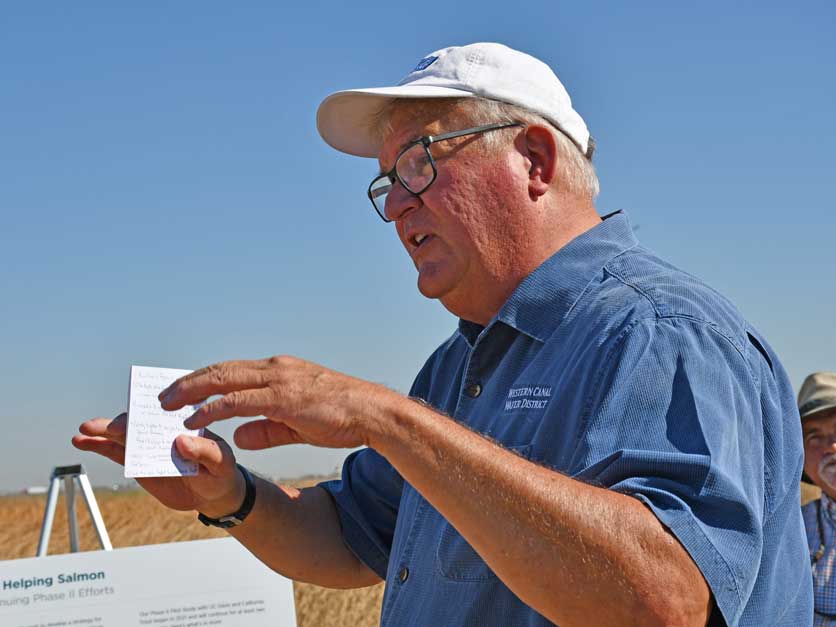
 Lindberg at the World Ag Expo (Brad Hooker/Agri-Pulse photo)
“The real challenging group for us, related to SPS issues [and international standards established by the Codex Alimentarius Commission] is the European Union,” said Lindberg, describing ongoing disputes over biotechnology, production standards and labeling.
That focus aligns with ongoing negotiations abroad. Lindberg told Agri-Pulse last fall that a U.S.-EU trade framework could begin benefiting farmers once implementation moves forward, and industry groups are closely watching how quickly new tariff structures take effect.
Another thread running through Lindberg’s remarks was the growing importance of Southeast Asia.
He cited recent developments in Malaysia, where officials agreed to recognize the U.S. food system as safe — a shift he said could reduce regulatory friction and open doors for a wide range of commodities.
That effort is part of a broader strategy. Lindberg has been traveling frequently to Southeast Asia to pursue new trade opportunities, particularly in Indonesia and Malaysia, where officials see strong potential demand for soy, dairy and feed ingredients.
Lindberg also fielded concerns over whether the U.S. has enough staff and presence in international regulatory bodies to defend science-based standards. He said USDA is working to fill critical positions in the Foreign Agricultural Service and maintain strong engagement in global forums that shape import rules.
He emphasized that regulatory battles abroad often determine whether U.S. products can enter a market at all and stressed the role of commodity groups and cooperatives in expanding exports through federal promotion programs.
“These folks are our partners,” he said during a fireside chat at the World Ag Expo with California Farm Service Agency Executive Director Connie Conway. “It's a very farmer-driven process in most of these other countries around the world.”
These partnerships, he said, help bring foreign buyers to U.S. farms, fund trade missions and support marketing campaigns designed to boost demand.
In addition to trade policy, Lindberg addressed the transfer of the Food for Peace program to USDA oversight, saying the shift will prioritize the use of U.S.-grown commodities in international food assistance.
He framed the move as both humanitarian and economic — feeding populations in need while supporting U.S. producers.
Throughout the day, Lindberg highlighted California’s importance in the national export picture, describing the Central Valley as a key production hub and innovation center.
He said the most consistent message he hears from producers nationwide is the need for fair competition abroad.
“The number one request I heard from producer groups … is that they need the opportunity to compete on a level fair playing field,” he told the board.

