
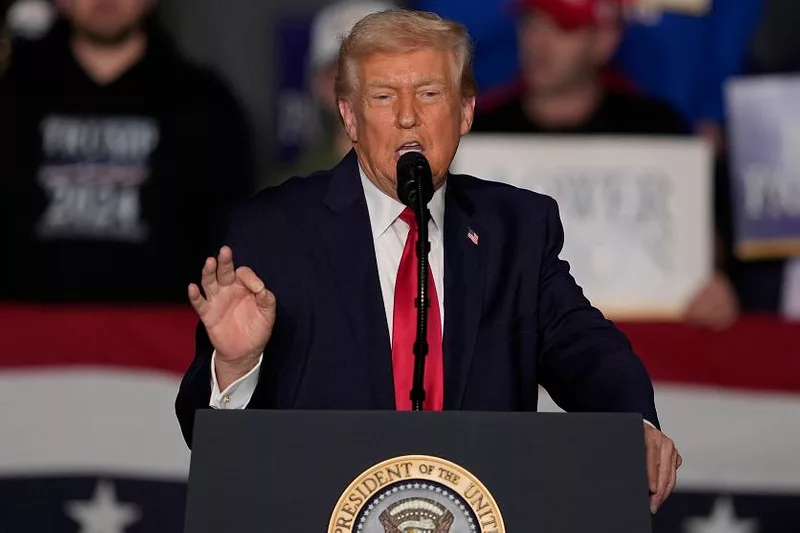
Less than a day after President Trump signed a proclamation to implement a 10% baseline tariff to reinstate some of the duties struck down by the Supreme Court, the president said he is raising it.
In a Truth Social post Saturday, Trump said that after completing “a thorough, detailed, and complete review” of the court’s ruling, he would raise the new tariff to 15%.
“During the next short number of months, the Trump Administration will determine and issue the new and legally permissible Tariffs, which will continue our extraordinarily successful process of Making America Great Again,” he wrote.
The Supreme Court on Friday struck down all of the tariffs Trump had implemented under a 1977 law known as the International Emergency Economic Powers Act. These included the “reciprocal” tariffs with rates set on individual countries, as well as the tariffs imposed on Canada, Mexico and China over fentanyl and migration concerns, among others.
On Friday evening, the president signed a proclamation to adopt a 10% worldwide tariff -- like the one unveiled last April that the Supreme Court overturned -- using a legal mechanism known as Section 122. The duty is set to kick in Tuesday.
Section 122 of the 1974 Trade Act allows a president to impose tariffs of up to 15% to address a balance-of-payments issue for up to 150 days.
Accordingly, Trump said the new rate of 15% is “fully allowed, and legally tested.” It also replicated several of the carveouts included in the emergency tariffs, including on fertilizers, certain agriculture products and products covered by a North American free trade agreement.
In addition to the 15% duty, the administration said on Friday that it would pursue several new investigations of countries’ unfair trade practices in the coming weeks and months. These investigations, known as Section 301 probes, can also be used to impose tariffs following their conclusion and can be carried out on an expedited basis.
The Office of the U.S. Trade Representative said Friday that it anticipated the probes would eventually cover “most major trading partners” and focus on issues like excess industrial capacity and unfair trade practices in rice and seafood markets, among other issues.
Questions remain around what will happen to the new global tariff after the 150 day deadline. The section 301 probes could take several months, and may not be ready to justify tariffs once the 150 days elapse.
“Is the 150-day limit an actual limit?” Kathleen Claussen, a law professor at Georgetown University asked in a webinar hosted by the Washington International Trade Association on Friday.
Technically, after 150 days, Congress would have to extend the measure. But Claussen doubted that there would be anything in statute that would prevent the president from rescinding the existing Section 122 order and issuing a separate one on day 151 to maintain the global 15% tariff for another 150 days.
“We'll see if they want to go longer, and if so, how they do it,” she added.
Peter Harrell, a former Biden era official and a visiting scholar at Georgetown Law School, also pointed out that Section 122 hasn’t been used before and there is no back history of case law setting clear legal guidelines on how it may be used.
“122 has never been used before today, and so has never been litigated,” he said. “So, we don't really know what it means.”
For more news, go to Agri-Pulse.com.

