

The House Agriculture Committee this week launches what is likely to be a highly partisan battle over a GOP farm bill, even as much of Washington’s attention will be focused on the ripple effects of the U.S. attack on Iran.
A prolonged military conflict in the Middle East could potentially upend key commodity markets due to Iran’s control of the Strait of Hormuz, one of the world’s most important trade routes. America’s crop growers could see fresh price spikes for inputs like fertilizer while battling a multi-year downturn in profitability, experts warned ahead of the attack.
Financial challenges within the ag and food sectors will be at the center of discussions during the House Ag’s markup of a farm bill from Chairman Glenn “GT” Thompson, R-Pa. Deliberations are set to start late Tuesday afternoon after being postponed for a week due to a winter storm.
The committee’s top-ranking Democrat, Minnesota Rep. Angie Craig, says the bill as written is full of non-starters, including provisions on pesticide labeling, livestock welfare and hemp.
Democrats will be seeking to restore federal funds to the Supplemental Nutrition Assistance Program after $187 billion was eliminated last year in new GOP-led tax law, marking the steepest ever cut to SNAP.
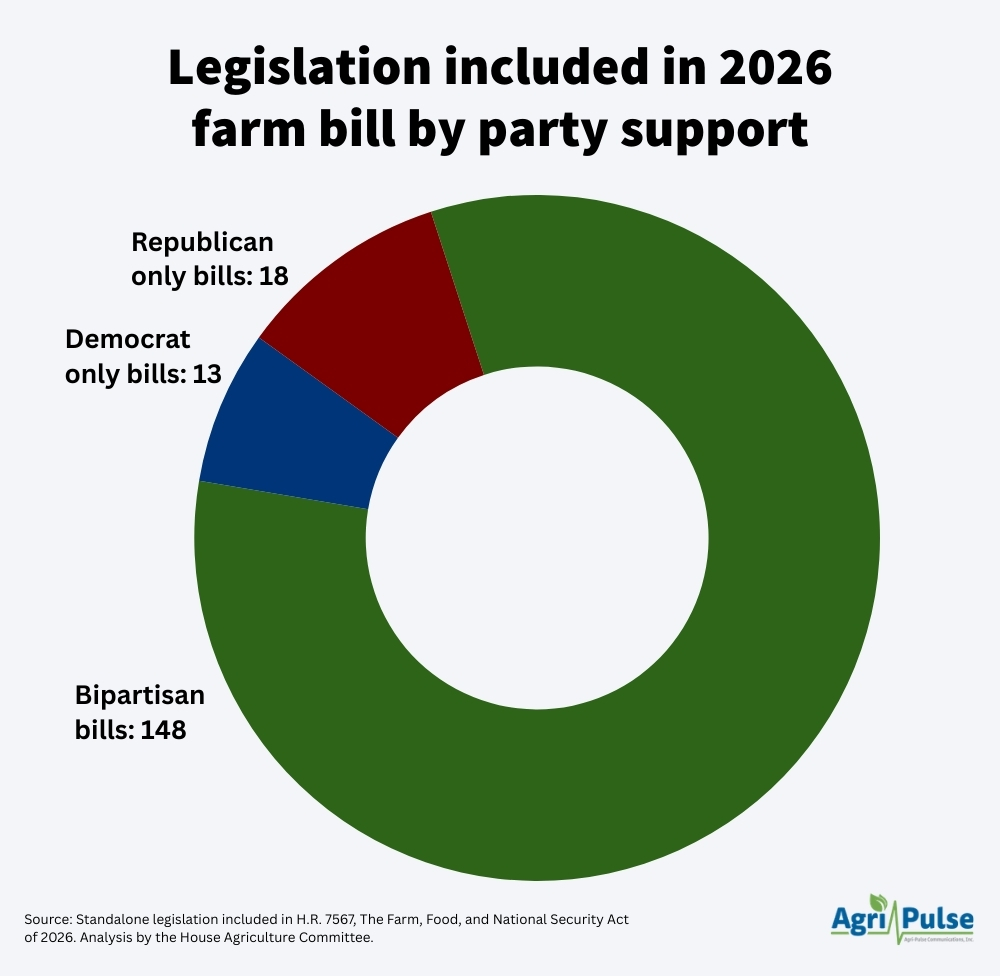
There are 179 pieces of legislation included in Thompson’s farm bill, including 148 bills with bipartisan support. Just 13 of the marker bills have exclusive support from Democrats, and 18 have exclusive support from Republicans.
Numerous amendments are expected to be offered. One filed by Rep. Nikki Budzinski, D-Ill., would require a mandatory update from the Department of Agriculture of commodity program base acres, a move that would likely cut spending and result in some growers losing lucrative base.
Rep. Jim Baird, R-Ind., plans an amendment seeking to delay by two years a redefinition of hemp that opponents say is too stringent and will hurt companies that have acted properly in building businesses around hemp products. Baird also has introduced a bill to delay the provision with support from Craig.
A new hemp law, passed in a funding bill last November without full congressional debate, is intended to rein in purveyors of hemp-derived products containing THC, the cannabinoid that produces the high sought by consumers.
Thompson’s draft farm bill includes updates of various ag programs that weren’t dealt with in last year’s One Big Beautiful Act, which included $66 billion in new spending on ag programs. The piecemeal approach is Congress’s answer to getting around a stalemate in passing a full, five-year farm bill.
While Craig has warned that lack of agreement on key issues could derail progress on passing the new bill, American Farm Bureau Federation President Zippy Duvall told Agri-Pulse he believes concern about the farmers’ financial plight could overcome the partisan divisions.
“If you look at the farm economy now, that’s why we need a farm bill, and that’s why I’m optimistic. No one can look across rural America and see what’s going on and not say that we need a new farm bill and modernized farm bill,” Duvall said.
“I know that there’s a lot of Democrats that come from rural parts of this country that realize how important it is to get this done. And I think at the end of the day, they’re going to be there helping the Republicans move it across the finish line.”
Mideast conflict to dominate attention
A major risk to American agriculture from military conflict in Iran stems from the Mideast’s crucial role in setting global prices for the key farm inputs of fuel, fertilizer and freight. “Even indirect impacts can pressure already-thin margins,” AFBF economist Daniel Munch said in an analysis last year.
Prior to the attack over the weekend, certain fertilizer prices were near historic highs for this time of year, said Josh Linville, vice president of fertilizer at StoneX.
A military conflict “could be devastating” for the global nitrogen and phosphate markets, Linville said in a note late last week prior to strikes on Iran by the U.S. and Israel.
Interested in more news on farm programs, trade and rural issues? Sign up for a four-week free trial to Agri-Pulse. You’ll receive our content - absolutely free - during the trial period.
“If that strait shuts down, the world will focus on oil/gas/energy impacts, however, it would have a massive impact on nitrogen and phosphate values,” he said.
As far as farming specific sectors, high-value crops like tree nuts, including almonds, pistachios and walnuts, are among top exports to the broader Middle East, totaling more than $1.5 billion in 2024, according to Munch.
“U.S. producers also maintain a strong presence in the region for feed ingredients such as distillers grains and soybean meal, alongside marketable volumes of cotton, rice and dairy products,” he said.
Allies push diversification efforts as US signals impending tariff hike
Canada’s Prime Minister Mark Carney is on a multi-leg trip this week to India, Australia and Japan – part of an effort to deepen trade ties between middle powers and reduce his country’s reliance on the U.S.
“The middle powers must act together, because if we're not at the table, we're on the menu,” Carney said during a speech at the World Economic Forum in Davos last month.
The nine-day trip is an offshoot of that sentiment, and the prime minister hopes to return with a slate of deals to boost exports of Canada’s natural resources and grow investment into its industries.
Carney’s jet-setting comes as the European Union has taken steps to fast-track an effort to diversify its own trade relationships. European Commission President Ursula von der Leyen announced Friday that the bloc will provisionally implement a free trade deal with South America’s Mercosur countries, despite the European Parliament’s insistence that the European Court of Justice examine the legality of the deal first.
Rupert Schlegelmilch, the deal’s former chief negotiator, said in a post to LinkedIn Friday that the decision to press ahead with implementation is the right one “in light of the uncertainty around trading with the U.S. and China.”
“Europe needs a proactive policy now to be present in these promising markets,” he said.
Meanwhile, uncertainty still reigns in U.S. tariff policy following the Supreme Court’s decision to strike down certain emergency tariffs. President Donald Trump has signaled that a new 10% global tariff will rise to 15%, but the timing and scope of the hike remains uncertain.
Here is a list of agriculture or rural-related events scheduled for this week in Washington and elsewhere (all times EST):
Monday, March 2
Annual Meat Conference, through Wednesday, National Harbor, Maryland.
3 p.m. – USDA releases data on cotton; oilseed crushings
Tuesday, March 3
Consumer Federation of America National Food Policy Conference, Washington Marriott at Metro Center, through Wednesday.
5 p.m. – House Agriculture Committee meeting to consider a farm bill, 1300 Longworth.
Wednesday, March 4
9:30 a.m. – The Brookings Institution will host an event to launch its “USMCA Forward 2026” report, which will preview the forthcoming review and outline priorities.
10:30 a.m. – House Agriculture Appropriations Subcommittee hearing with Luke Lindberg, USDA’s undersecretary for trade and foreign agricultural affairs, 2362-A Rayburn.
3 p.m. – USDA releases Broiler Hatchery report.
Thursday, March 5
8:30 a.m. – USDA releases Weekly Export Sales report
9:30 a.m. – The International Food Policy Research Institute webinar, “AI Innovation and Regulation for Producers and Users.”
For more news, go to Agri-Pulse.com.
.webp?t=1762183428)

