
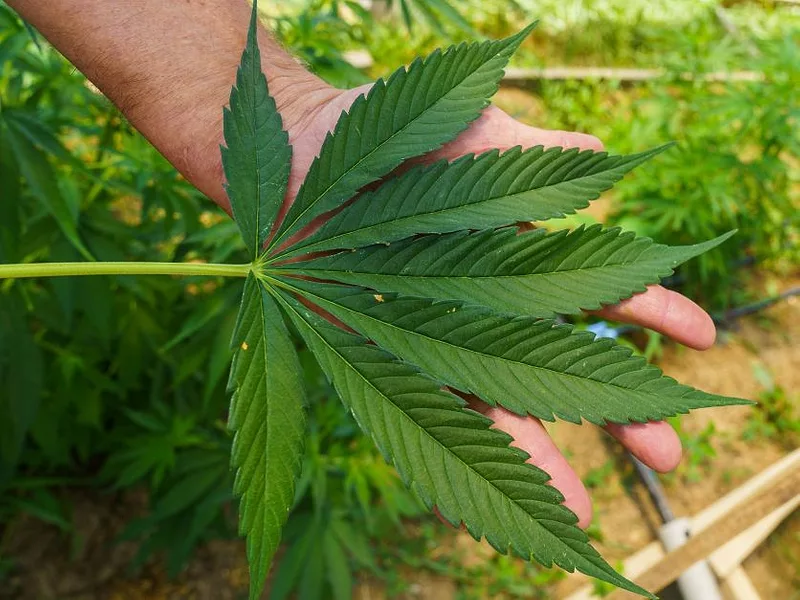
Groups representing different sectors of the cannabis industry are at odds over a new law that seeks to rein in purveyors of hemp-derived products containing THC, the cannabinoid that produces the high sought by consumers.
The American Trade Association for Cannabis and Hemp (ATACH) and The U.S. Hemp Roundtable are trading barbs over what the roundtable says is essentially a ban on hemp-derived products containing even non-intoxicating amounts of THC.
As reported in Agri-Pulse, the roundtable says the 0.4 mg limit of THC limit per container would capture “more than 90% of non-intoxicating hemp-derived products.” It plans to support legislation to roll back the new rules or get a second one-year extension.
But ATACH says the legislation is simply a way to provide industry regulation and is a rational response to a loophole in the 2018 farm bill that legalized industrial hemp, which naturally contains low levels of THC, so long as it only has 0.3% of THC by dry weight.
Supporters of hemp legalization in the 2018 farm bill never imagined that it would lead to a plethora of hemp-derived THC products, which in many cases are developed using chemical extraction methods, ATACH says.
The group also says that in states where the products are regulated, sellers of the hemp-derived products will still be able to market their products, they just won’t be allowed to ship them to other states.
“In the case of THC-infused beverages, for example, you know, if you are regulating these products at the state level, and you're ensuring that they're not doing interstate commerce, and … you're providing for public safety and consumer confidence, then the federal government's going to leave you alone,” said Chris Lindsey, vice president of policy and advocacy at ATACH.
 Chris Lindsey (LinkedIn photo)
But Jonathan Miller, general counsel at the Hemp Roundtable, says he’s not sure what the federal government’s role would be.
“It’s not clear how the federal government would treat this,” Miller said in response to questions from Agri-Pulse. “Regardless of what a state does, it still would be a federal crime to manufacture/purchase products, which means there are no protections for banking or other financial transactions.”
Even if the U.S. takes a hands-off approach, “the only intra-state commerce that could occur is where the hemp is grown in-state, manufactured in-state, packaged in-state and sold in-state,” he said. “The economies of scale would make this very difficult if not impossible in all but the largest states. Perhaps a new class of multi-state operators would emerge, like the folks that fund ATACH on the marijuana side. And perhaps this is their end game, all along?”
Jim Higdon, who founded Cornbread Hemp in Kentucky and chairs the roundtable, also criticized ATACH, pointing to members such as Cresco Labs, a cannabis and medical marijuana company in Illinois, and “major multi-state operators,” or MSOs, of marijuana dispensaries.
Don’t miss a beat! It’s easy to sign up for a FREE month of Agri-Pulse news! For the latest on what’s happening in Washington, D.C. and around the country in agriculture, just click here.
“The fact they have hemp in an acronym is kind of misleading,” he told Agri-Pulse. “They're for [the legislation] because they're against hemp, because hemp has access to interstate commerce and they don't.”
“They're frustrated and jealous and shut us down,” he said.
ATACH representatives, however, say they just want parity in the marketplace and that the ability to operate in interstate commerce gives the producers of hemp-derived products such as gummies and beverages an unfair advantage.
Being able to obtain those products online and have them shipped to you wherever you are amounts to “totally working around that regulated framework that exists in states,” said Cory Harris, a principal at Furrow Strategies and a lobbyist for ATACH.
Asked about its membership, Lindsey said, “We do have a lot of MSOs that are members. We've got quite a few mom-and-pop shops from different states. And we have companies that do beverages that are infused with THC derived from hemp.” He adds that ATACH also has been talking with industrial hemp producers.
“We're no strangers to hemp, but we definitely have certain things that we take very seriously, and that puts us often in a different camp,” he said.
Harris was more willing to tie the Hemp Roundtable to marijuana producers, pointing to the presence of members such as Cheech and Chong.
“I would say Hemp Roundtable is hardly a hemp organization,” he said.
 Jim Higdon (U.S. Hemp Roundtable)
Asked about the Hemp Roundtable’s membership, Higdon said the group "is a big-tent organization focused on every legitimate aspect of the hemp industry, from fiber and grain to pet products to dietary supplements and beverages.”
Part of the reason for the legislation, says longtime hemp advocate Eric Steenstra, is the Food and Drug Administration’s inability or unwillingness to issue regulations governing the cannabis industry.
“We knew that eventually there was going to need to be regulations, and what those were going to look like was always a question mark,” Steenstra said. “I feel like the bill was not the way to go about it.”
However, he said Sen. Mitch McConnell, R-Ky., who as Senate Majority Leader pushed for legalization in the 2018 farm bill, became frustrated by the proliferation of hemp-derived products and reports of their adverse effects.
Thirty-nine state attorneys general agreed, penning a letter in October that "legal, nonintoxicating hemp" has been used to "make make Frankenstein THC products that get adults high and harm and even kill children."
Steenstra would like to see uniform regulations. “The reality is that we need one lane [for] cannabinoid sales,” not separate sets of rules for a “hemp get-you-high product [and one for] a state-licensed cannabis get-high product. Let’s come up with a single lane, a single set of standards that makes sense.”
Another bone of contention concerns how much U.S.-grown hemp is used to make the products targeted by the legislation. ATACH says the small amount of acreage planted to “floral hemp” is probably not enough to sustain the market, and China has been filling the void.
Harris provided a screenshot, for example, showing a Chinese company has sold between $50 million and $100 million of CBD and full-spectrum hemp oil that can be used to extract THC. About 80% of the sales were to the U.S.
Miller said all Hemp Roundtable members “only source hemp from US crops, grown as part of USDA or state programs. We have heard rumors about Chinese imports, and if they are true we would support banning them.”
Miller also said the Hemp Roundtable opposes use of so-called “synthetic cannabinoids.”
“It's a complicated issue,” Higdon said. “States have come to define synthetic and semi-synthetic differently, and so we are against synthetics.” However, “a semi-synthetic, which is taking CBD isolate from hemp and converting it into Delta-9 THC, is important for the hemp supply chain.”
Delta-9 is the principal psychoactive compound in cannabis.

