
|
Indonesia’s crusade to provide every student with a daily free school meal should drive fresh demand for U.S. dairy products and could serve as a model to boost exports to other emerging markets, according to leaders of the American dairy industry.
In January 2025, the newly elected Indonesian President Prabowo Subianto launched a flagship initiative to combat childhood malnutrition: a government program to provide 60 million school-age children with a free school meal, known as the “Free Nutritious Meals (FNM)” program.
The program is using more than 11,000 regional kitchens to prepare and distribute food and, as of October, was serving more than 34 million students each week, according to USDA. The government is aiming to expand the program to include pregnant and breastfeeding mothers in 2026, setting a goal of reaching more than 80 million people by the end of the year.
The FNM program is more than just a health and poverty-busting gambit for the U.S. dairy sector; it also has the potential to become a major export driver. The program includes an optional milk component, and the country relies on imports for more than 80% of its dairy supply.
“They don't have the ability to meet all the demand,” Krysta Harden, president and CEO of the U.S. Dairy Export Council and a former deputy secretary of agriculture, told Agri-Pulse in an interview. “We could be a good player.”
To provide milk options through the program, Indonesia imports milk powder and mixes it or combines it with domestically produced milk supplies, said Shawna Morris, executive vice president of trade policy and global affairs at the National Milk Producers Federation.
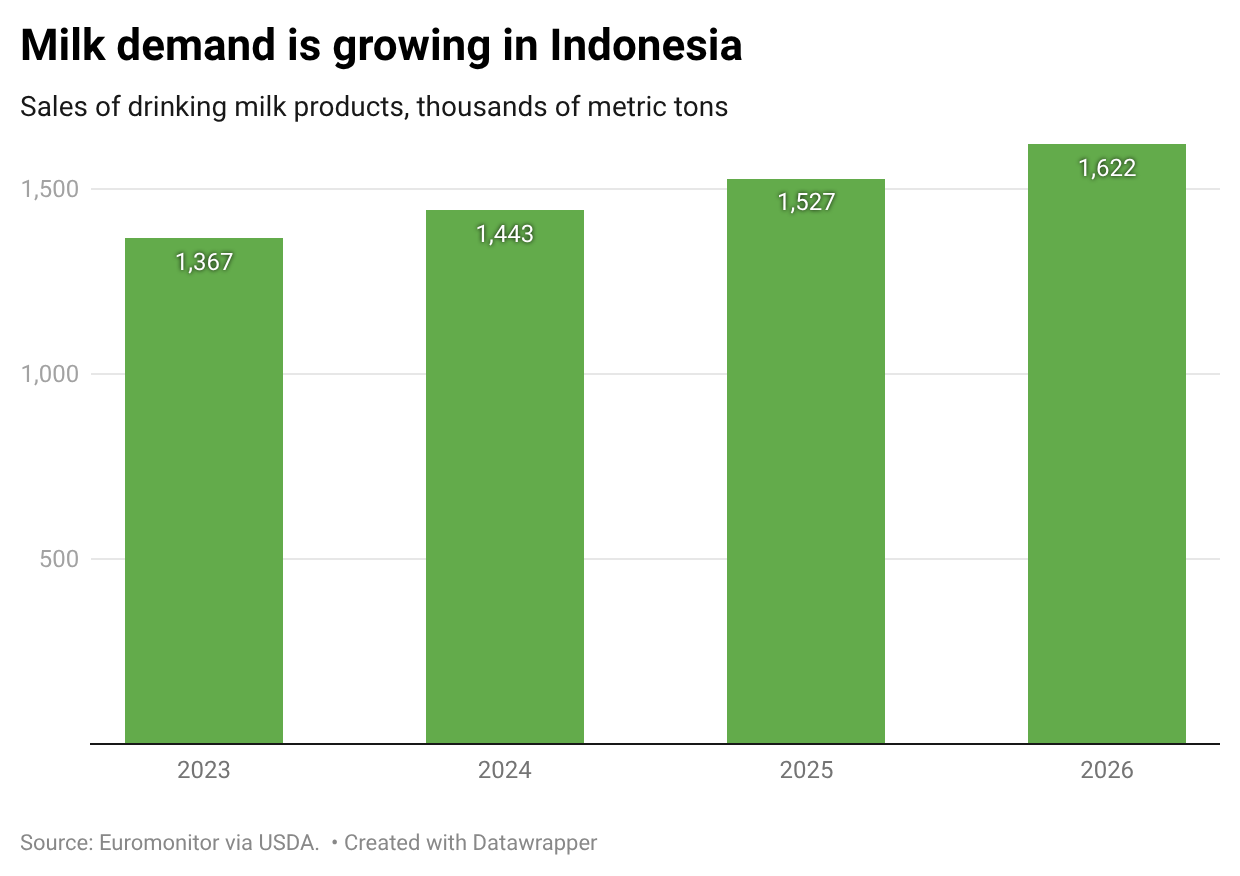 From January to August 2025, Indonesia’s imports of whole milk powder were up by 17% from the previous year, according to USDA data, and fat-filled milk imports were up 14.5%, although the department doesn’t yet view the program as a major consumption driver.
The FNM program is still in its infancy, and access to milk through the program is currently limited by a lack of availability, according to Deddy Kurniawan, who founded Dairy Pro Indonesia, a dairy consultancy.
The program has also had some setbacks; 112 kitchens were suspended last year over food poisoning cases, USDA notes. Getting dairy products to students across an archipelago of around 6,000 inhabited islands is also a challenge. But industry representatives expect the long-term trajectory to be positive.
“Just like any new program of this magnitude, it's going to be a rolling process of growth, starting in the most convenient, easiest places to get supply,” Harden said.
Raise demand, plus improve market share
The opportunities for the U.S. industry are particularly promising when combined with a recent trade pact that lowered barriers for U.S. dairy exporters. If the FNM program is raising demand for dairy, the new deal can help U.S. producers get a larger share of the growing pie, she said.
The deal, inked during Subianto’s trip to Washington last month, eliminates tariffs on U.S. dairy products and streamlines export procedures by recognizing U.S. oversight – including U.S. regulatory authorities’ dairy certificates.
Interested in more news on farm programs, trade and rural issues? Sign up for a four-week free trial to Agri-Pulse. You’ll receive our content - absolutely free - during the trial period.
From January to August 2025, the U.S. dairy sector provided 14% of Indonesia’s dairy market needs, according to USDA, a lower share than the previous year, when the U.S. secured 19% of the dairy market. It is the third-largest supplier behind the European Union and New Zealand.
Tariff reductions in the new U.S.-Indonesia deal should put American exporters in a more competitive position, however. U.S. exports to the country have been subject to a 5% tariff, while New Zealand enjoys tariff-free trade with Indonesia under a free trade agreement.
With this two-pronged approach of driving dairy demand higher while boosting the position of U.S. products relative to competitors, the industry believes it has hit on a model that could serve as a basis for spurring U.S. dairy exports in other emerging markets.
Harden says there are up to four countries that could be strong candidates for replicating the school meal model, although she declined to say which countries they are.
Promising markets, she said, need to have a government working to bolster child nutrition, and the U.S. industry needs to be in a position to feasibly scale up exports.
“In Indonesia, all that came together,” she said. “I'm sure there are others that we will look at in the future.”
 Krysta Harden (X photo)
Courting domestic buy-in
One other component of the Indonesia model should also make any trade gains more permanent, participants told Agri-Pulse. The U.S. industry has been taking steps to ensure that Indonesian dairy producers also see ample benefits.
If the Indonesian government sees domestic dairy market share falling as a result of the program’s growth, Kurniawan argued, it could leave it vulnerable to political challenges.
“The government won't like it,” he said.
The U.S. Dairy Export Council, the New Mexico Department of Agriculture and New Mexico State University, in collaboration with experts from Indonesian universities, built out a training program for boosting yields among medium and small-scale dairy farmers, Morris said.
Among the topics that the training sessions covered, Kurniawan said, were feed and water quality, animal health and genetics.
The program has worked with around 100 dairy farmers, he added, with participants almost doubling their productivity.
The training program, Kurniawan argued, can help raise public awareness around milk, its benefits, and the work undertaken by dairy farmers. But it also ensures that local farmers retain their foothold in the local market and improve their economic performance, which he argues will foster industry buy-in and lead to a more resilient program, less vulnerable to political attack.
“Their goal, of course, would be to have as much local production as possible and that makes sense,” Harden said. “We just want to be the source of choice when it comes to [imports].”

