
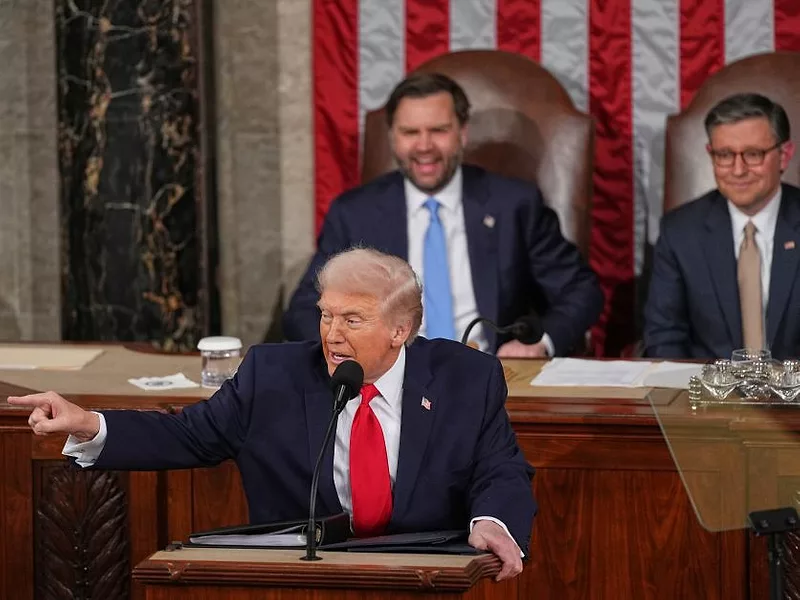
President Donald Trump told reporters Tuesday that the U.S. and China are rescheduling a planned meeting between the two leaders.
“We're resetting the meeting, and it looks like it'll take place in about five weeks,” he said.
Trump and Chinese President Xi Jinping were scheduled to meet at the end of this month, but earlier this week Trump said he had asked to delay the meeting so that he could focus on the Iran conflict. Soybean prices fell more than 70 cents Monday on news that the meeting could be delayed.
“We're working with China,” Trump added Tuesday. “They were fine with it.”
Flocking to China: Trump isn’t the only one planning a China trip. Brazil’s Valor International reported on Tuesday that Brazilian officials will travel to the country next week to negotiate processes for soybean inspections.
China has been complaining of weeds in Brazilian soybean cargoes, Ag Minister Carlos Fávaro told reporters last week, prompting the Brazilian government to tighten cargo inspections. As a result, Brazilian soybean exports have slowed as 22 ships were held up, according to Valor.
Read more about U.S.-China trade frictions in the latest Agri-Pulse newsletter today. Chinese authorities have increasingly been rejecting more food and agricultural imports at the border. Other stories look at the rising cost of fertilizer, challenges with staffing at USDA county offices, and the impact of the Iran war on fuel prices.
Biofuel boom ahead?
Deputy Agriculture Secretary Stephen Vaden has good news for farmers waiting for strong biofuel-blending rules from EPA and pro-ethanol legislation from Congress.
Both are on their way, Vaden predicted in a talk at the University of Arkansas.
EPA’s final biofuel regulations for this year and next will be the “most pro-biofuel rule put in place by any administration of either party,” Vaden says.
That will help drive momentum for Congress to finally pass legislation to allow year-round sales of higher ethanol fuel blends, known as E15, according to the second highest-ranking USDA official.
Vaden also is optimistic about the demand outlook for airplane fuel made from U.S. ag products. Japan’s recent agreement to buy American sustainable aviation fuel has already led to at least one proposal to build a SAF plant in the United States that can supply the Asian nation, he said at the event on Tuesday without providing details.
Marine fuel is also a huge opportunity.
In Europe, all new vessels of shipping giant Maersk can be powered by biofuels, and the Danish-based company replaces 5% of its fleet each year, according to Vaden.
“That really represents a new horizon,” he said. “They see that as the future and since they are European-based it may be mandated over there.”
Farmers tout ethanol in D.C.
The American Coalition for Ethanol began a two-day Washington fly-in on Tuesday as members of the South Dakota-based group press for pro-ethanol policies. Farmers and biofuel producers are meeting with members of Congress, their staff and officials from USDA and EPA.
Top priorities include E15 and strong biofuel-blending targets.
They also are pressing for “swift and clear guidance on the 45Z Clean Fuel Production Tax Credit.” That includes clarity on how ethanol producers can benefit from low-carbon farming practices, according to ACE.
“The stakes are high,” ACE CEO Brian Jennings said.
Interior to provide $889 million for water projects
Water infrastructure projects across the U.S. will receive $889 in new funding from the Interior Department for storage expansion and modernization, the agency announced Tuesday.
Funding will go towards bolstering water supplies and repairing canal systems in North Dakota, replacement of a 110-year-old canal in Utah, and a water conveyance and pump storage project in Idaho, among other projects.
California is set to see funding for five projects. For a more detailed breakdown of projects, read our story on the announcement.
Americans blame social media for science misinformation, but they keep using it
Four in five Americans blame social media for “false or misleading health and science information,” but three in four say they have shared health and science articles with someone else based solely on the headline, a new poll finds.
“Despite these challenges, the data confirms the need for innovation to improve lives, with the majority of Americans across the political spectrum respecting scientists and agreeing rigorous science is necessary for continued human progress – a rare bipartisan consensus in a divided world,” according to a news release from The Harris Poll.
Health and science misinformation “could be affecting trust in credible sources like doctors and scientists, particularly among young adults,” the release says. Most adults aged 18-34 (51%) “rely on social media as their primary source of science and health information and nearly one in five distrust doctors (16%) and scientists (20%) as sources of information on health and science.”
The poll was sponsored by Bayer.
Cesar Chavez allegations prompt United Farm Workers union to cancel events
The United Farm Workers union will not be taking part in any Cesar Chavez day activities this year as it investigates allegations of sexual misconduct against the famous labor leader.
Recent allegations have suggested that Chavez, a well-known farmworker activist who died in 1993, “engaged in inappropriate sexual behavior with women and minors during his time as President of the United Farm Workers of America,” according to the Cesar Chavez Foundation.
On Tuesday, the UFW union, which Chavez co-founded, issued a statement announcing it would not be participating in any activities for Cesar Chavez on March 31, a federal commemorative holiday.
UFW's statement said that the organization “has not received any direct reports,” and does not “have any firsthand knowledge of these allegations.” However, it said the allegations are “serious enough to that we feel compelled to take urgent steps to learn more and provide space for people who may have been victimized to find support and share their stories if that is what they choose."
“These allegations have been profoundly shocking,” the UFW statement said. "We need some time to get this right, including to ensure robust, trauma-informed services are available to those who may need it."
Final word
“These policies are raising the cost of numerous consumer goods – including coffee. Coffee, which is essentially not produced at all in the United States, was subject to tariffs in April 2025.” – Sen. Elizabeth Warren, D-Mass., in letters to Tim Cofer, CEO of Keurig Dr Pepper, and Mark Smucker, CEO of J.M. Smucker Co., which makes Folgers, Dunkin’, and Cafe Bustelo, seeking information on how the Trump administration’s tariffs “have driven up coffee prices and hit families’ pocketbooks,” according to a release from her office.
For more news, go to Agri-Pulse.com.

