
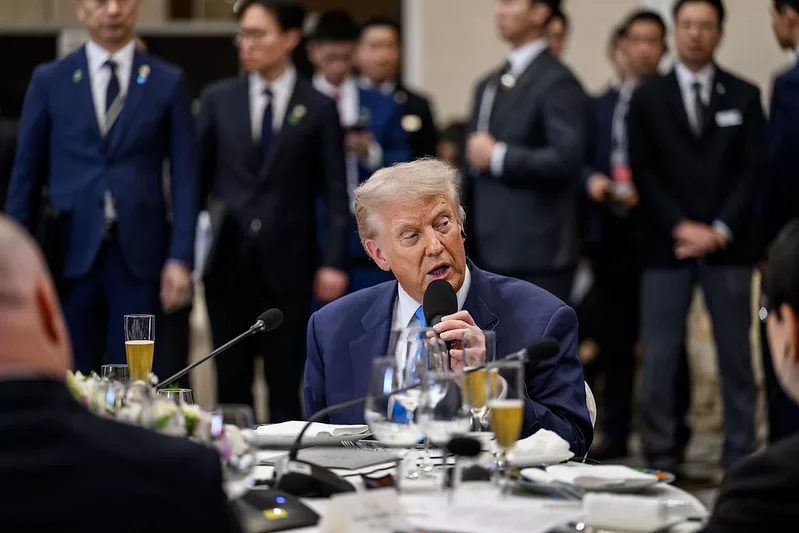
President Donald Trump says Beijing has committed to buying “tremendous” amounts of U.S. ag products after he secured a one-year deal with Chinese President Xi Jinping in exchange for lower U.S. tariffs.
“Tremendous amounts of the soybeans and other farm products are going to be purchased immediately,” Trump told reporters following his meeting with Xi in South Korea Thursday. The president did not provide any details on how much or what commodities might benefit, however.
Trump and Xi met for the first face-to-face meeting of Trump's second term at a military base in Busan, South Korea. The closed-door meeting lasted a little over 90 minutes. The pair left without making a joint announcement or addressing the media in attendance, but Trump spoke with reporters shortly after on Air Force One.
The president told reporters that in addition to agreeing to purchase U.S. soybeans and ag products, China had committed to work to curb exports of fentanyl and precursor materials. In return, Trump said the U.S. would slash a 20% tariff imposed over China’s role in the fentanyl crisis to 10%.
“We're going to issue a statement on some of the details,” Trump said, but he stressed that “we have a deal.”
The agreement, Trump said, would last for one year, at which point officials could “renegotiate” and extend the pact.
“I think the deal will go on for a long time, long beyond the year,” Trump said.
Also included in the agreement, Trump said, are measures relating to China’s export controls on rare earth that will allow mineral exports to the U.S to continue uninterrupted.
Cut through the clutter! We deliver the news you need to stay informed about farm, food and rural issues. Sign up for a FREE month of Agri-Pulse here.
The pair also discussed Trump’s visit to China next year, which the president said will occur in April. Xi will visit the U.S. at some point after that visit, Trump added.
There are still some outstanding issues to be hammered out, Trump said. U.S. Trade Representative Jamieson Greer, who also attended the meeting, told reporters that the U.S. would postpone recent port fees applied to Chinese-made and operated ships while the two sides negotiate a lasting solution.
“But that's no longer an issue,” Trump stressed.
Treasury Secretary Scott Bessent, Commerce Secretary Howard Lutnick, Secretary of State Marco Rubio, Chief of Staff Susie Wiles, and U.S. Ambassador to China David Perdue were also at the meeting.
A Chinese readout of the meeting says that the two sides "reached consensus on solving various issues," and argued that the two parties "should work out and finalize the follow-up steps as soon as possible."
China's Ministry of Commerce said that the two sides had agreed to expand agricultural trade, but provided no further details. A spokesperson also told Chinese state media that the U.S. had agreed to extend its tariff truce for a year and that China would also delay its retaliatory port fees as part of the deal.
In a post to Truth Social after the meeting, Trump touted the deal's potential for U.S. agriculture.
"Our Farmers will be very happy!" Trump wrote. "In fact, as I said once before during my first Administration, Farmers should immediately go out and buy more land and larger tractors."
Going into Thursday, the U.S. maintained an average tariff rate of around 55% on most Chinese exports. If the 20% fentanyl tariff is lowered to 10%, China would face a rate much closer to that faced by other large U.S. trading partners. India, for example, has been hit with 50% duties so far under the second Trump administration, as has Brazil.
The stakes heading into the meeting for U.S. agriculture were high. China bought some U.S. soybeans on Wednesday – what Trump called “a very nice gesture” – but before those orders, Chinese buyers hadn’t placed any since May. Similarly, sales of sorghum, cotton, pork and other ag products to China were also lagging recent years.
Both sides had also been ratcheting up trade tensions in recent weeks, with China expanding its export controls on rare earths, and the U.S. adding Chinese entities to a sanction list and threatening a return to triple-digit tariff rates.
Less than an hour before the meeting was scheduled to start, Trump also fired off an ominously timed Truth Social post announcing that the U.S. would restart nuclear testing after a more than 30-year hiatus.
“The United States has more Nuclear Weapons than any other country,” Trump wrote to Truth Social. “Russia is second, and China is a distant third, but will be even within 5 years,” he added.
Asked why he chose to send that instruction right before the meeting, Trump said “it had to do with others,” not China. “With others doing testing, I think it's appropriate that we do also.”
The end of the meeting draws the curtain on Trump's six-day Asia trip. Trump heads back to the U.S. on Thursday, while Xi departed Busan for Gyeongju to attend an Asia-Pacific Economic Cooperation summit.
For more news, go to Agri-Pulse.com.

