

Pressure is mounting on both the White House and Congress to provide a new round of payments to farmers.
On Tuesday, farm groups appealed directly to President Donald Trump to include farm aid in a supplemental spending package the White House is preparing to fund the war in Iran. A letter from the groups to Trump doesn’t specify an amount of money that’s needed for the ag sector but does say the turmoil in energy and fertilizer markets created by the war is further stressing the farm economy.
House Agriculture Committee Chairman Glenn “GT” Thompson, R-Pa., says in this week’s Agri-Pulse Newsmakers that he’s looking at $15 billion in additional aid, with $10 billion set aside for specialty crops. Thompson also wants to help the forestry sector by earmarking $200 million for sawmills.
Take note: Thompson suggests the cost of the additional aid needs to be offset with other spending cuts. “Normally, these supplemental bills are not paid for. I think we need to be accountable in terms of finding pay-fors,” he says. “I'm looking around within the jurisdiction of the Agriculture Committee to see where we might be able to find some additional pay-fors.”
By the way: Thompson doesn’t think the dairy industry needs additional aid, in part because of new legislation returning whole milk to school meals, and the revenue dairy producers are getting from breeding beef calves.
This week’s Newsmakers show will be available today at Agri-Pulse.com.
ACE CEO: It’s time for a clean E15 bill
After weeks of failed attempts to get oil refiners on board with legislation to allow more corn fuel in cars, it’s time to go it alone, Brian Jennings tells Agri-Pulse.
“We can’t continue to be held hostage,” the American Coalition for Ethanol chief executive says.
Lawmakers are trying to salvage efforts to pass a bill to enable year-round U.S. sales of higher ethanol mixes, known as E15. A compromise deal among the biofuel, agriculture and fossil fuel industries fell apart in January. The sticking point wasn’t E15, but a proposal to revamp the Renewable Fuel Standard so not as many refineries could get exemptions from yearly biofuel-blending requirements. Jennings says it may be best to scrap the provision altogether.
“Refiners are insisting on trying to attach something regarding the RFS to E15,” Jennings says. “We don’t think that’s necessarily the right way to go, and I think there’s a growing sense in Congress that they agree with us. They’ve tried to be patient.”
Also, unless legislation is passed quickly, the EPA is likely to “very soon” issue an emergency waiver for summertime E15 sales.
RVOs expected next week
Jennings also says he expects that next week, EPA will release its final biofuel-blending rules for this year and next.
“We do have concerns about potential easing back of RVOs with respect to advanced biofuels,” Jennings says. He stressed the need for full reallocation of small refinery exemption volumes from 2023-25, though he acknowledged widespread speculation that it will be less than 100%.
Jennings also is concerned about the Energy Department potentially trying to block low-carbon farming practices from being valued in the final 45Z biofuel production tax credit rules currently under consideration by the Treasury Department.
“We don’t want to force farmers to adopt these practices. We don’t want to force ethanol producers to buy corn from farmers who are adopting these practices, but it ought to be an option and we think that’s what Congress intended,” Jennings says.
Brazil-China frictions could extend U.S. soybean export season
Brazil and China are at odds over the presence of weed seeds in soybean cargoes, which could extend the export season for U.S. producers, an analyst says.
China has raised concerns over Brazilian soybean cargoes, delaying shipments and prompting the Brazilian government to increase scrutiny of outbound shipments. Cargill has halted its shipments to China until a settlement is reached and exports have slowed significantly.
“It may move some China business out of Brazil and back to the U.S.,” Consus Ag’s Angie Setzer told Agri-Pulse. “The U.S. basically is going to maintain a relatively steady export outlook as we work through the end of the crop year.”
U.S. soybean exports to China have slowed in recent weeks after Brazil’s harvest got underway. The country’s product still enjoys a price advantage over U.S. beans in the Chinese market.
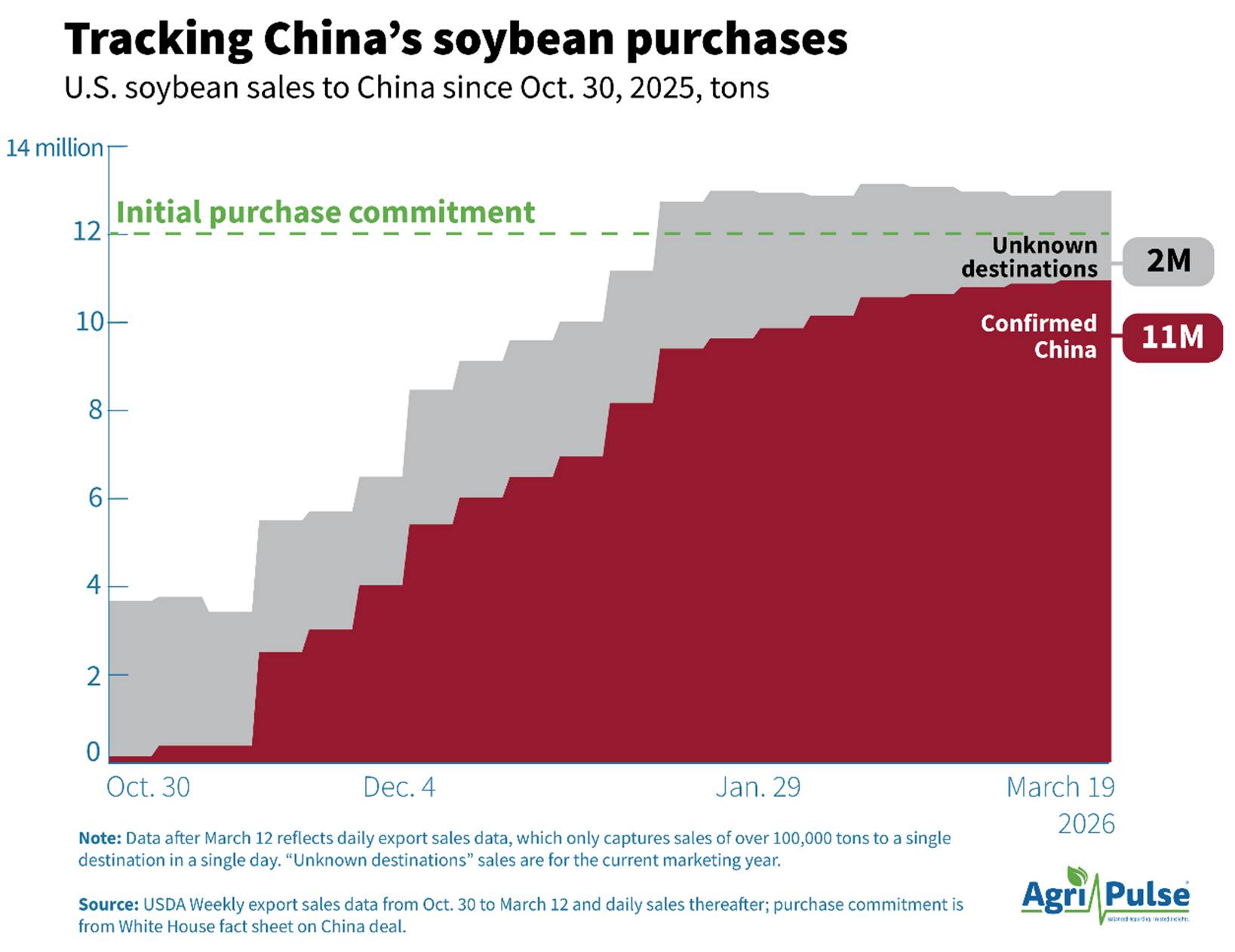
(Click on the chart to go to the soybean tracker page)
Take note: In recent years China has increasingly used sanitary and phytosanitary checks as a statecraft tool, including against the U.S. Brazil moved to impose anti-dumping duties on Chinese steel products at the end of last month, sparking Beijing’s ire.
“It's very political,” Setzer said.
Read more on China’s use of border inspections as a trade weapon at agri-pulse.com
EU-US deal clears parliamentary hurdle
The European Parliament’s international trade committee has approved a deal with the U.S. agreed to last year, but with some key adjustments.
The deal slashes tariffs on a slate of U.S. agriculture exports, but members of parliament argued it needed a “multi-tiered safety net.” The commission attached language to kill the deal if:
- The U.S. fails to make good on its 15% tariff ceiling for most EU products.
- The U.S. imposes tariffs on EU states for foreign policy decisions – à la Trump’s Greenland threats.
- The U.S. fails to lower tariffs on some European steel and aluminum products.
- The deal is not reauthorized after 2028.
“I do hope that with this vote we are launching a positive dynamic of trade cooperation where mutual interests converge, where tariff threats disappear, and where business and consumer can plan ahead to increase our shared prosperity and affordability,” committee chair Bernd Lange said in a statement.
The deal will now go to a vote before the full parliament on March 26. After that, member states will weigh in.
Take note: Lange was supposed to be in Washington Friday, but ended up not joining a parliamentary delegation. A spokesperson for the parliament told Agri-Pulse he changed his plans to complete “necessary follow-up work” following the vote.
Abbott proposes $40 million in upgrades at Michigan plant in settlement offer
Abbott Laboratories is proposing to invest $40 million in a Michigan plant at the center of a major 2022 infant formula shortage to resolve a shareholder lawsuit.
Investors allege company leaders failed in their oversight of powdered infant formula production at the facility. Under the terms of a proposed settlement, Abbott would invest the money in “targeted capital expenditures” at a plant in Sturgis, Michigan, to “enhance core operations, food safety, and quality control over the next five years.”
It also calls for infant formula product testing for the presence of Cronobacter and annual third-party environmental swabbing of certain locations, according to a brief filed by the plaintiffs urging approval of the settlement.
The settlement still requires approval of U.S. District Judge Sunil Harjani in the eastern division of Illinois’ Northern District.
Take note: In 2022, Abbott recalled powder formulas and temporarily shut down its plant following an FDA investigation into reports of lax cleaning practices and falsification of certain records, according to a study of the incident commissioned by Congress. The closure exacerbated existing supply chain challenges, and the combination fueled a nationwide shortage of formula.
Final word
"We therefore urge the Administration, within all applicable rules and regulations, to use the Joint Review process to implement seasonal, product-specific tariff rate quotas, as requested by our Florida industry. Targeted TRQs will allow for continued trade while preventing import surges that jeopardize the viability of domestic production during Florida’s peak harvest months." – Fourteen Florida lawmakers in a letter Thursday urging President Trump to seek quotas on Mexican fruit and vegetables during an upcoming review of the U.S.-Mexico-Canada Agreement.

.webp?t=1762183428)


