
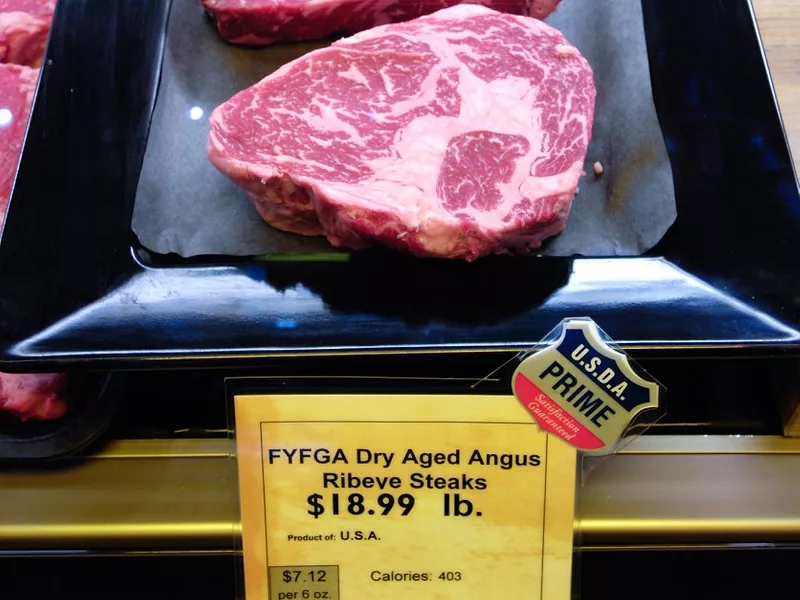
Trump administration officials are pushing for an American flag and the words “Product of USA” to appear on more meat product packaging as they roll out a campaign to raise awareness of a voluntary labeling program that went into effect in January. So far, it's unclear how many meat companies will pursue the opportunity, though Agriculture Secretary Brooke Rollins says she’s already had calls with some about it.
The USDA last week unveiled a new "Product of USA" label to be used on meat, poultry and egg products from animals born, raised, harvested and processed in the United States. At a press conference Tuesday, Rollins said she had three calls with big food companies that day “to put the pressure on them to buy that beef from American ranchers and to put that label on.”
“We think it’s a great step, but it’s just a step,” Rollins said. “The goal is to be able, at the end of the day, to wholly subsist and rely on American ranchers.”
Until 2015, the U.S. required mandatory country-of-origin for beef and pork, though that was repealed to avoid retaliation from Canada and Mexico after a World Trade Organization ruling on the requirements.
Kansas State University Agricultural Economist Glynn Tonsor, who helps lead the Meat Demand Monitor, a monthly survey tracking consumers' meat preferences, said respondents are asked to rank what they feel is most important when they consider buying meat. Origin and traceability generally fall to the bottom four of 12 rankings, while factors such as taste, freshness and price rise to the top, he said.
Kansas State University Agricultural Economist Glynn Tonsor, who helps lead the Meat Demand Monitor, a monthly survey tracking consumers' meat preferences, said respondents are asked to rank what they feel is most important when they consider buyin
Agriculture Secretary Brooke Rollins speaks at the National Ag Day event. (USDA photo)
It’s easy to be “in the know” about what’s happening in Washington, D.C. Sign up for a FREE month of Agri-Pulse news! Simply click here
Still, he noted that around 15% put it as a top consideration when they’re buying a package of meat, which could create some “niche” market opportunities for companies that want to pursue it.
Tonsor said he’s not expecting to see much use out of the voluntary label in the ground beef market, since hamburger is often blended together from animals of varying origins. While he doesn’t expect to see it used much for muscle cuts either, he said it is likely to be used more for these products than for ground beef because they typically come from only one animal, which would be easier for companies to track.
Still, he said the fact that the label is voluntary rather than mandatory suggests that “in aggregate, it won’t add costs to the system that don’t pay for themselves.”
“No rational person is going to go out of their way to put that label on, be compliant in a voluntary world, unless they think they get enough benefit to justify it,” Tonsor said, adding that in that context, he generally expects to see "a no-harm-done kind of mindset” surrounding the idea.
Chicken is already subject to mandatory country-of-origin labeling requirements. Tom Super, senior vice president of public affairs for the National Chicken Council, said in an email that “nearly all chicken consumed in the USA (more than 99%) is hatched, raised and processed here, and this must be noted on the package in retail."
"We are very proud of that distinction, and now our members have another tool to showcase that their chicken is American made,” he wrote, in reference to the new label.
National Pork Producers Council spokesperson Wendy Brannen told Agri-Pulse in a statement that the "voluntary label program reinforces the industry’s option to use a Product of USA label to indicate clearly where products, including pork, are from should they choose.”
"We are thankful to President Trump and Agriculture Secretary Rollins for supporting American agriculture and the men and women it comprises — and who work hard every day to produce safe, nutrient dense, quality food here at home in the U.S.” she said.
Justin Tupper, the president of the U.S. Cattlemen’s Association, told Agri-Pulse the label limits companies from using "Product of USA" claims on products that don’t meet the right requirements.
“This, now, says that if it wears the Product of the USA label, you have to have the documentation to back that up,” Tupper said. “I think that’s a big step in the right direction. I don’t think it’s the final answer, but it’s a good step in the right direction.”
Tupper said he’d like to see mandatory country-of-origin labeling reinstated. That’s a sentiment other labeling supporters expressed to Agri-Pulse. Mike Stranz, the vice president of advocacy for the National Farmers Union, said “it’s only a small step towards mandatory country of origin labeling,” but added that “it’s progress and we’re glad that the label has more integrity to it than it used to.”
Bill Bullard, the CEO of R-Calf USA, said the new voluntary label could “help pave the way” for future congressional action on a mandatory program.
Rollins, at the press conference, also called herself a “big supporter” of the idea of mandatory country-of-origin labeling. However, she noted it could come with “some trade implications” and ultimately said it “has to be a congressionally passed effort.”
“We’ll continue to work on it, work with Congress, and work with those who’d like to move it forward,” Rollins said. “For me, it’s black and white. Everyone in America should know where their food is coming from.”

